MA-VR voor


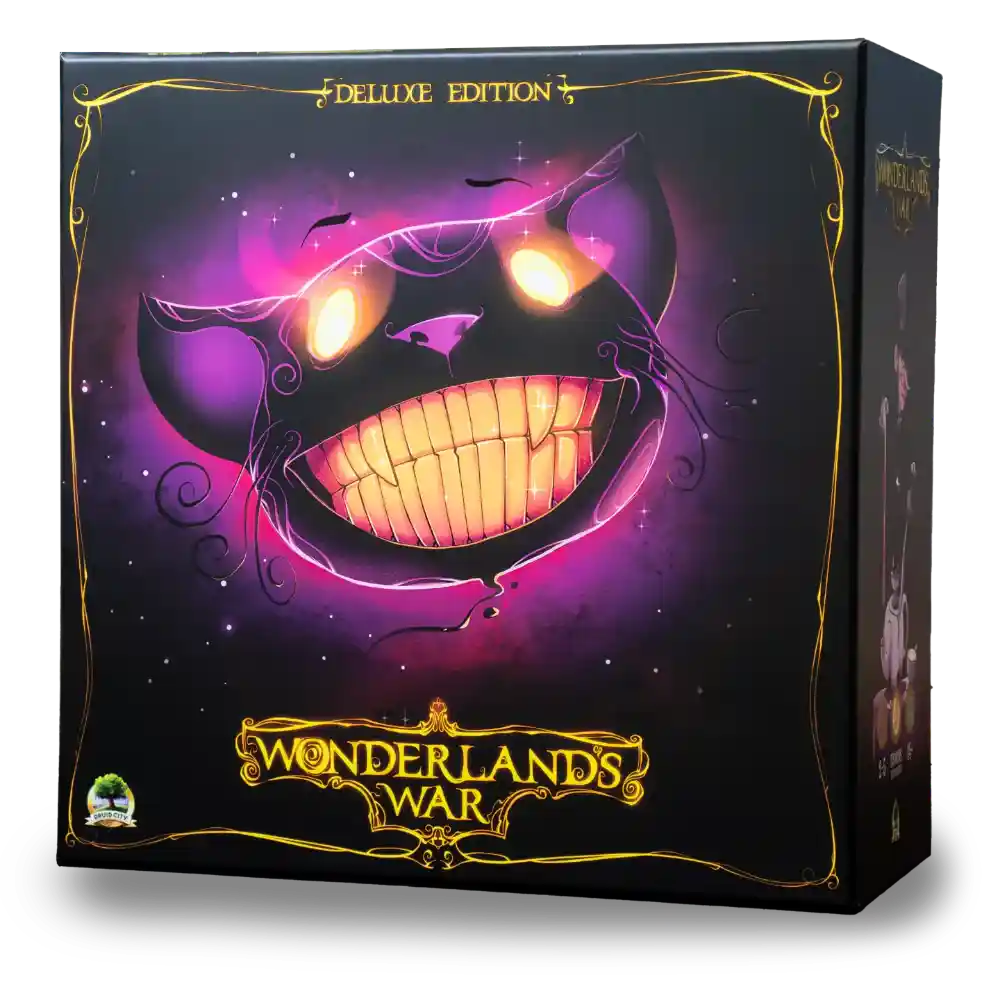
Wonderland’s War review
Druid City Games | 2–5 spelers | 13+ | 45–125 minuten
There is a moment in every game of Wonderland's War — usually somewhere in the second round, usually when you have committed too many supporters to a region you cannot win and too few to a region you must — when you reach into your bag, feel the chips shift under your fingers, and understand with absolute clarity that the next thing you pull out will define the next fifteen minutes of your evening. You have no idea what it will be. Neither does the bag. This does not stop you from believing, with the desperate conviction of a person buying a lottery ticket, that you can *feel* the right chip. voelen.
You cannot.
The Premise
Wonderland has gone to war. Not the pastel, Disney-adjacent Wonderland of nursery posters, but a factional, splintered Wonderland where Alice, the Mad Hatter, the Queen of Hearts, the Cheshire Cat, and the Jabberwock have each decided that the realm would be better off under their particular brand of management. Before the fighting begins, naturally, there is tea.
The game spans three rounds, each split into two halves: a drafting phase called the Tea Party, and a battle phase called, with admirable directness, the War. Designer trio Tim Eisner, Ben Eisner, and Ian Moss have built something that looks like an area control game, smells like a bag-builder, and plays like a poker tournament held in a bouncy castle.
How It Actually Works
The Tea Party is a rondel draft. Cards sit in a circle; you move your leader clockwise, stopping at one to claim it. Four picks per round. Cards give you supporter chips for your bag, powerful Wonderlandian allies, quests, tower pieces, leader upgrades, and — sometimes — shards, which are Wonderland's way of reminding you that nothing here is free. What you take matters. What you leave for the player behind you matters more.
Then the War begins. Players commit supporters to regions on the board, and battles resolve one at a time. In each battle, you draw chips from your bag one by one. Numbered supporters add to your total. Wonderlandians trigger special abilities. Shard chips — madness, essentially — accumulate toward a threshold that, if crossed, sends your entire force fleeing in what can only be described as a catastrophic existential crisis.
You can stop drawing at any time. You can lock in your total, sit back, and watch your opponents tempt fate. Or you can reach into the bag again, because the chip you need is *definitely* in there, you can practically feel it, and — zeker in, je voelt het bijna, en dan…
It was a madness chip.
Een madness chip, ontvangen aan het begin van het spel en daarna aan het begin van elk A madness chip, received at the start of the game and then at the start of every fight, determines how quickly you descend into madness. Sometimes luck is generous. Sometimes it isn't. This is the game that tells you, with the serene cruelty of a Cheshire grin, that your carefully curated bag is a suggestion. Not a guarantee.
What It Gets Right
The bag-building is genuinely inspired. Not because bag-building is new — it isn't — but because the Eisners and Moss understood something about the psychology of reaching into an opaque container. Drawing from a bag feels different from drawing from a deck. A deck is mathematics. A bag is faith. Your brain insists it has agency over the outcome.¹ It does not. But the insistence is the entire point, and the game is built around that beautiful, irrational conviction.
The asymmetric factions are distinct in ways that matter. The Mad Hatter can refresh the tea party display and snatch a card without moving — a power so universally useful that experienced groups sometimes eye-roll when someone picks him, which is itself a sign of good faction design. The Queen of Hearts forces every opponent to lose a supporter when she activates, which is the kind of ability that makes people remember your name. The Jabberwock poisons tea party cards, seeding shard chips into opponents' bags like a guest who brings wine and grudges to the dinner party.
The theme integration is uncommonly strong. Madness isn't just a penalty — it's Wonderland's operating principle. The chaos of combat, the unreliable allies, the way a perfectly sound strategy can dissolve into nonsense at the pull of a chip: this is what Wonderland *is*. The game doesn't use its theme as wallpaper. It uses it as architecture. is Wonderland. Het spel gebruikt zijn thema niet als behang. Het gebruikt het als draagconstructie.
And Manny Trembley's art — bold, saturated, expressively cartoonish — holds the whole thing together visually. Every one of the 185 cards looks like it was torn from a graphic novel you'd actually want to read.
¹ Dan Thurot of Space-Biff put this rather well. The bag, he noted, evokes a different sensation from a deck. Our insensate brain imagines it has control. It does not. It never did.
Where It Stumbles
Setup. Two hundred and thirty-five chips. Multiple card decks. Asymmetric player boards. A large central board with regions and tracks and castles and — look, you will need the Game Trayz insert or a very organized friend, and even then, budget fifteen minutes before anyone touches a card. Teardown is the same process in reverse, with the added indignity of sorting chips back into their correct bags while someone asks if you want to play again.
At five players, the game runs to three hours. This is not inherently a problem — some of the best games in the hobby ask for three hours — but Wonderland's War at three hours feels like a game that knows it should be two hours and just... isn't. The battles multiply, the downtime creeps in, and the push-your-luck tension that sings at three or four players starts to lose its pitch.
The luck question is real. You can build your bag with surgical precision, weight the odds in your favour, play the draft perfectly, and then draw three shards in a row in the battle that matters most. This will happen. It will happen to you specifically, in a game you were winning, and you will feel like the universe has made a clerical error. Some players find this thematically perfect — Wonderland *should* betray you. Others find it unforgivable. You know which kind of player you are. hoort je te verraden. Anderen vinden het onvergeeflijk. Je weet zelf welk type speler je bent.
And there is a balance wrinkle. The Mad Hatter is strong. The Jabberwock is situational. Updated faction boards have been released to address this, which suggests the designers know and care, but the gap is visible.
Who Is This For?
Players who want area control with a heartbeat. People who enjoy the specific agony of deciding whether to draw one more chip, knowing that the smart move is to stop and the exciting move is to continue and these are not the same move and they are going to continue anyway. Groups of three or four who have two hours and a taste for faction-driven conflict that somehow manages to feel combative without feeling cruel.
Not for players who need their strategic investments to pay reliable dividends. Not for anyone who considers a fifteen-minute setup an affront to human dignity. Not at five, unless everyone at the table has played before and knows what they're signing up for.
The Verdict
Wonderland's War is a game about the gap between what you plan and what happens. It is a game about watching your careful calculations vanish down a rabbit hole, about the specific joy of pulling the exact chip you needed and the specific despair of pulling the one you didn't, about a tea party that is also a negotiation that is also a war that is also, somehow, genuinely funny when it goes wrong.
It is not a game for everyone. It is a game for the people it is for, and those people will love it with the fierce, irrational loyalty of someone who keeps reaching into the bag.
**A magnificent mess, and it knows it.**