MA-VR voor


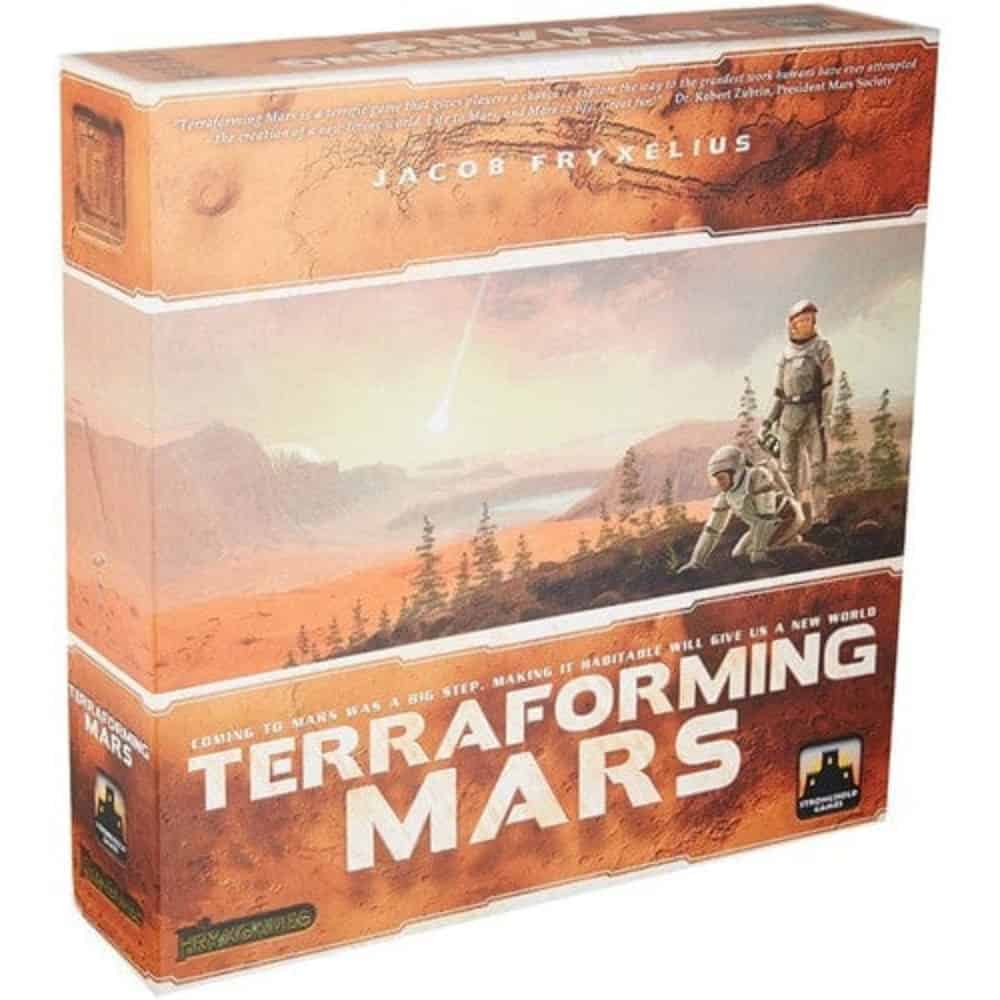
Terraforming Mars review
FryxGames | 1–5 spelers | 12+ | 120 minuten
Somewhere in the second century of board gaming's modern era, a Swedish chemist with a PhD and a family full of enthusiastic playtesters sat down and asked himself: what if making an entire planet habitable was, fundamentally, an accounting problem?
Jacob Fryxelius spent six years answering that question. The result was Terraforming Mars, a game in which you play a corporation — not a hero, not a faction, not a plucky band of rebels, but a *corporation* — competing with other corporations to raise the temperature, oxygenate the atmosphere, and flood the surface of Mars with water. You do this by playing cards. Hundreds of them. Cards that represent everything from importing nitrogen to breeding livestock to crashing asteroids into the planet's surface, which is the kind of urban planning you can only get away with when there are no urban residents yet.
The goal is shared. The glory is not.
How It Actually Works
Each round — called a generation, because the game has ambitions — you buy project cards, play project cards, and watch your production engine slowly accumulate the resources needed to play more project cards. There are six types of resources. Steel makes buildings cheaper. Titanium makes space things cheaper. Plants eventually become greenery tiles. Energy becomes heat. Heat raises the temperature. MegaCredits buy everything else, and you will never, at any point, have enough of them.
The board is a hex grid of Mars. You place oceans, cities, and greenery on it, collecting bonuses and blocking your opponents from the spots they wanted. Three global parameters — temperature, oxygen, and ocean coverage — creep upward over the course of the game. When all three max out, Mars is terraformed, the game ends, and everyone counts their points with the quiet intensity of tax auditors in April.
Your corporation gives you a unique starting position. Ecoline is good with plants. Tharsis Republic profits from cities. Inventrix plays fast and loose with the laws of physics, or at least with card requirements. The corporate draft — technically optional, universally adopted — lets you choose between two corporations at the start, which is the game's way of making you responsible for your own fate before you've even taken a turn.¹
¹ There is something beautifully corporate about being handed two business plans and told to pick the one you'll regret less.
What It Gets Right
The engine. The engine is the thing.
Terraforming Mars begrijpt dat het diepste plezier in bordspellen schuilt in het moment waarop een wankel, geimproviseerd apparaat begint te werkenTerraforming Mars understands that the deepest pleasure in gaming is watching a rickety, improvised machine begin to *work*. Your first few generations are lean and desperate. You're buying cards you can't afford to play yet, investing in production that won't pay off for three rounds, and watching your opponents do the same while pretending not to be worried. Then, somewhere around generation five or six, the engine catches. Your titanium production feeds your space cards, which generate science tags, which unlock your research bonuses, which draw you more cards, which — well. You get the idea. The snowball is rolling.
The card pool is enormous and almost entirely unique. Over two hundred project cards in the base game, each doing something slightly different, and they interact in ways that the designer clearly spent years balancing and that players will spend years discovering. You might play fifty games before you see a particular two-card combination that makes you sit up straighter.
En dan is er het thema. Terraforming Mars is dat zeldzame spel waar de mechanismen het thema zijnAnd then there is the theme. Terraforming Mars is that rare game where the mechanics *are* the theme. When you convert plants into greenery tiles that increase the oxygen level, you are not performing an abstracted action that happens to correlate with a thematic label. You are doing the thing. You are greening Mars. The temperature track starts at minus thirty and climbs in two-degree increments, and each increment feels like progress because it *is* progress. Fryxelius's chemistry background shows in the way every conversion chain makes scientific sense, or at least scientific-adjacent sense, which is more than most games bother with. is. De scheikundeachtergrond van Fryxelius is zichtbaar in de manier waarop elke conversieketen wetenschappelijk klopt, of in elk geval wetenschappelijk aannemelijk is, wat meer is dan de meeste spellen zich verwaardigen.
The solo mode deserves a mention. Playing against a timer that raises the global parameters each generation, racing to terraform Mars before the neutral corporations beat you to it, is one of the better solo experiences in the hobby. It captures the frantic energy of a startup with a deadline and no safety net.
Where It Stumbles
Let us talk about the art.
Isaac Fryxelius, Jacob's brother, handled the visuals, and the result is what happens when a family project meets a two-hundred-card deadline. Some cards feature lovely original illustrations. Others feature stock photography that looks like it was licensed at three in the morning. One card might show a beautifully rendered Martian landscape; the next, a photograph of a cow that appears to have been sourced from a veterinary supply catalogue. The visual experience is less "cohesive artistic vision" and more "group presentation where everyone did their slides separately."
The player boards are thin cardboard. This would be merely disappointing, except that the game requires you to place small plastic cubes on them to track six different resources and six different production values. Bump the table. Breathe too aggressively. A cat walks through the room three streets away. Your cubes move. Your production tracks become archaeological mysteries, and no one can remember whether they were producing three steel or four. The aftermarket player board overlay industry exists because of Terraforming Mars, and it is thriving.
Then there is the time. The box says 120 minutes. The box is an optimist. With five players and the draft variant, you are looking at three hours, possibly more if anyone at the table has a tendency to read every card twice before selecting one. Analysis paralysis is not a bug in Terraforming Mars; it is a feature the game accidentally cultivated by making every decision genuinely interesting. Which is, if you think about it, both the problem and the compliment.
The iconography takes commitment. New players will spend their first game with the reference card in one hand and a growing sense of inadequacy in the other. The symbols are logical once you learn them, the way a foreign alphabet is logical once you learn it, which is to say: cold comfort during the learning.
Who Is This For?
If you are the kind of person who has ever felt genuine satisfaction from watching a spreadsheet auto-calculate, this game was made for you. That is not an insult. That is a love language, and Terraforming Mars speaks it fluently.
It is a game for people who enjoy building things more than destroying them. For players who want their decisions on turn three to matter on turn fifteen. For anyone who has looked up at Mars on a clear night and thought, not "how beautiful," but "how *fixable*." repareerbaar.”
It is less ideal for groups who want constant interaction, quick play, or consistent art direction. Players who find engine building meditative will love it. Players who find it repetitive will check out by generation four and spend the remaining ninety minutes wondering why they didn't suggest Ticket to Ride.
The Verdict
Terraforming Mars has held a spot near the top of the global rankings for nearly a decade, and it earned that position the same way its corporations earn their terraform rating: slowly, methodically, one good decision at a time. The art is inconsistent. The player boards are a scandal. The game occasionally overstays its welcome by a full generation.
None of that matters when the engine catches.
You will play a card that triggers a chain of effects you planned three generations ago. You will place a greenery tile in the exact hex that turns your opponent's city into your victory points. You will watch the temperature track cross zero and feel, absurdly, *warm*. warm.
The Red Planet's finest spreadsheet, and the only game where crashing an asteroid into a planet counts as community service.