MO-FR ordered before


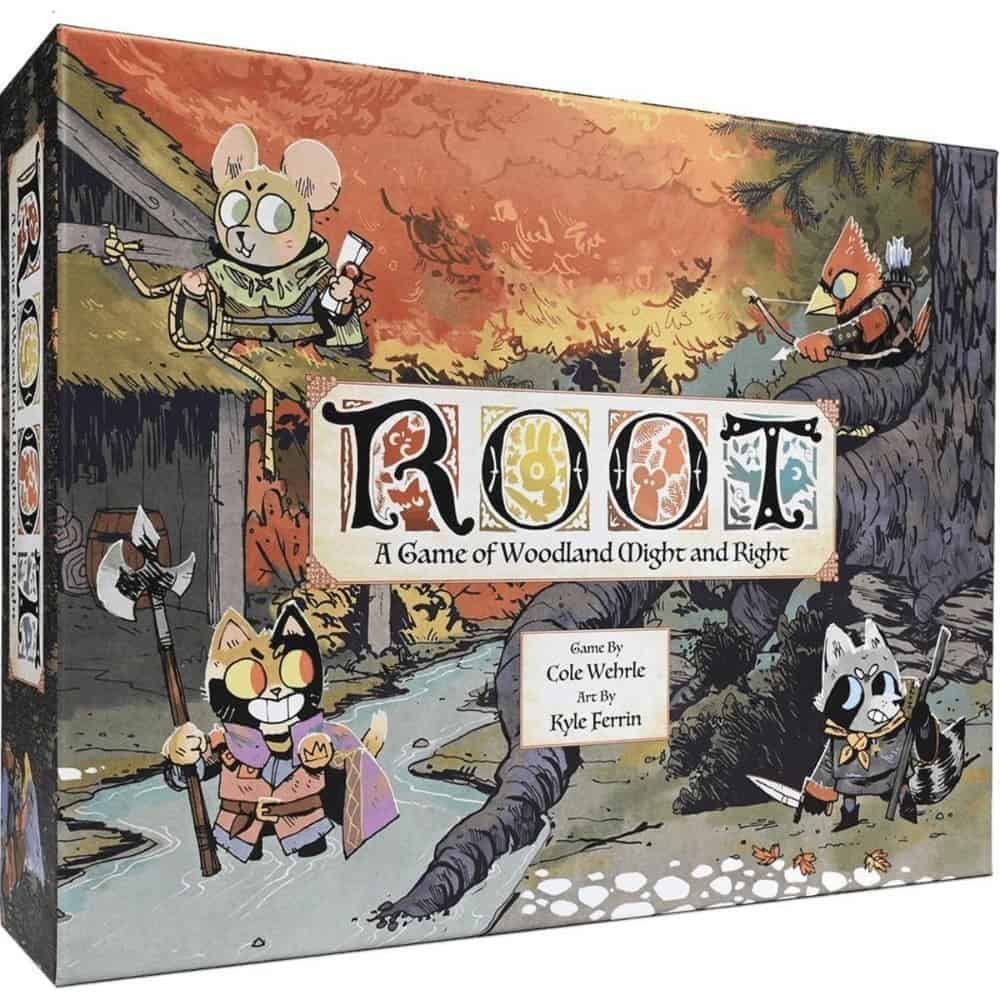
Root: A Game of Woodland Right & Might review
Leder Games | 2–4 spelers | 14+ | 60 – 90 minuten
There is a forest. In this forest live cats, birds, mice, foxes, and one suspicious-looking raccoon with a sword. They are at war. Not a polite, chess-like war of manoeuvre and counter-manoeuvre, but the ugly kind — the kind where supply lines matter more than heroics, where a popular uprising can undo months of careful empire-building, and where the raccoon just nicked your crossbow while you were busy arguing with the birds.
Root asks you to accept two things. First, that woodland creatures make excellent stand-ins for the messy realities of colonial occupation, insurgency, and political collapse. Second, that you and your friends will each be playing a fundamentally different game at the same table, following different rules, chasing different goals, and occasionally making eye contact across a clearing full of smouldering cat workshops while one of you mutters, "I didn't think the birds could do that."
They can. They absolutely can. Until they can't, at which point everything falls apart spectacularly, and that's rather the point.
How It Actually Works
Cole Wehrle, who designed Root while completing a PhD on British imperialism (which explains a lot, actually), built the game around four factions so different they might as well have arrived from separate boxes.
The Marquise de Cat occupies nearly the entire board from turn one. She builds sawmills that produce wood that builds more buildings. She is an industrial engine, and like all industrial engines, she works brilliantly until someone sets fire to one of the factories. The Eyrie Dynasties are fallen bird aristocrats clawing back territory through an ever-growing Decree — a programmed sequence of mandatory actions that makes them terrifyingly efficient right up to the moment it makes them terrifyingly incompetent. The Woodland Alliance starts with nothing: no warriors, no buildings, just righteous anger and a stack of sympathy tokens that function as both propaganda and tripwire. And the Vagabond wanders the map alone, completing quests, rummaging through ruins, and making friends with everyone until the precise moment friendship stops being profitable.
Each turn follows three phases. You play cards, move pieces, fight. Combat uses two dice — attacker takes the high roll, defender the low — which keeps battles quick and slightly cruel.¹ The first player to 30 points wins. Or you can abandon the point race entirely, slap down a Dominance Card, and try to hold territory instead, which is the board game equivalent of flipping the table but within the rules.
De facties beinvloeden elkaar voortdurend, parasitair, prachtig. De Alliance belast beweging door gesympatiseerde open plekken. De Vagabond ruilt items voor goodwill. De Katten staan te dun uitgespreid terwijl ze alles proberen vast te houden. De Vogels crashen, branden op, en herrijzen. Elke beslissing rimpelt naar buiten. Je kunt Root niet in isolatie spelen. Het spel staat je dat simpelweg niet toe.
¹ There is a special kind of despair reserved for rolling a zero as the attacker against a single defending mouse. The mouse knows it. You can see it in those tiny, ink-drawn eyes.
What It Gets Right
Root's asymmetry is genuine. Not the cosmetic variety where each faction gets a slightly different bonus — this is structural, architectural, load-bearing asymmetry. The Cats play a logistics game. The Birds play a programming puzzle. The Alliance plays an insurgency simulator. The Vagabond plays an RPG. They share a board, a deck of cards, and a combat system, and that's about it. Everything else is different.
Dat betekent dat Root verhalen creert. Geen gescripte narratieven, maar het spontane soort, het soort dat begint met “weet je nog toen de otters huurlingen verkochten aan beide kanten en daarna de oorlog verklaarden aan iedereen?” Kyle Ferrins prachtige, handgetekende illustraties verkopen de truc volledig. Zijn wezens zijn charmant genoeg voor een kinderkamermuur en woest genoeg om je te laten geloven dat ze daadwerkelijk oorlog zouden voeren om een open plek vol paddenstoelen. De kunst won niet voor niets een Golden Geek.
Het spel doet ook iets stilletjes briljants met machtsverhoudingen. De Marquise ziet er aan het begin dominant uit; ze bezet de hele kaart. Ervaren spelers weten dat ze eigenlijk kwetsbaar is, te dun uitgespreid, afhankelijk van een bevoorradingsketen, een goed getimede opstand verwijderd van een ramp. De Alliance ziet er zwak uit. Ervaren spelers weten dat ze een tikkende tijdbom is. Root beloont het lezen van de tafel, onderhandeling, en de bereidheid om naar de leider te wijzen en te vragen: “Gaan we dit allemaal gewoon laten gebeuren?” Het antwoord is, historisch gezien, ja. Tot het te laat is. Dan paniek. Dan verwijten. Dan stelt iemand voor om nog een potje te spelen en iedereen zegt onmiddellijk ja, wat het hoogste compliment is dat een bordspel kan ontvangen.
Where It Stumbles
Teaching Root is an ordeal. There's no kind way to say this. Four factions means four sets of rules, four player boards of iconography, four entirely separate strategic frameworks. The rulebook recommends a "learning game" and it is not being coy. Your first play will be messy, lopsided, and roughly twice as long as the box suggests. Someone will accidentally let the birds score fifteen points unopposed because they didn't understand how the Decree worked. That someone might be you.
De Vagabond blijft een discussiepunt, ook na jaren praten binnen de community. Hij speelt vaak langs de andere facties heen, doet minder mee aan de strijd om gebieden en kan soms winnen terwijl de rest het gevoel heeft dat zij eigenlijk het echte spel aan het spelen waren. Met twee spelers werkt het basisspel niet altijd even goed. Leder Games heeft dat later verbeterd met uitbreidingen, bots en het Hirelings-mechanisme, maar daarvoor waren wel meerdere jaren en meerdere dozen nodig.
Root vraagt bovendien om meerdere sessies. Niet op de manier waarop een goede puzzel uitnodigt tot herbezoek, maar op de manier waarop een taal onderdompeling vereist voor je vloeiend wordt. Je vijfde potje Root is een categorisch andere ervaring dan je eerste, en het spel toont pas echt zijn hand rond partij drie of vier. Dat is een flinke eis, zeker als je groep regelmatig van spel wisselt.
Who Is This For?
Root wil een vaste groep. Vier spelers, bij voorkeur, die zich samen inzetten om te leren over meerdere sessies en de tafelinstincten ontwikkelen die voorkomen dat een factie er ongecontroleerd vandoor gaat. Het beloont spelers die net zoveel plezier halen uit het lezen van tegenstanders en de staat van het bord als uit het lezen van kaarten. Als je favoriete spelmomenten draaien om onderhandeling, verraad, of het langzaam gloeiende besef dat je bent uitgespeeld door iemand die eruitzag alsof ze aan het verliezen waren: Root heeft op je gewacht.
If you prefer your strategy games symmetrical, if you dislike teaching-heavy first sessions, or if your game nights run on a strict ninety-minute clock, this is not your forest. Root will not apologise for that. It has a war to run.
Solo players and couples can lean on the Clockwork Expansions, which provide competent automated opponents, though the experience is a narrower corridor than the wide-open chaos of a full table. The digital adaptation by Dire Wolf is excellent for learning — its tutorials do in forty minutes what the rulebook does in an evening — and playing online with friends who already know the rules.
The Verdict
Root is a game about power: who has it, who wants it, and who is quietly stockpiling sympathy tokens while the powerful aren't paying attention. It is a war game that looks like a picture book and plays like a political thriller. Its learning curve is steep and honest: it does not pretend to be simpler than it is, which is itself a form of respect.
Wehrle designed it with the conviction that games should be compelling rather than merely fun, and Root is compelling in the way a good argument is compelling: you come away from it seeing the other side a little more clearly, even if you lost badly and the raccoon stole your last hammer.
A civil war you'll be glad you started.