MO-FR ordered before


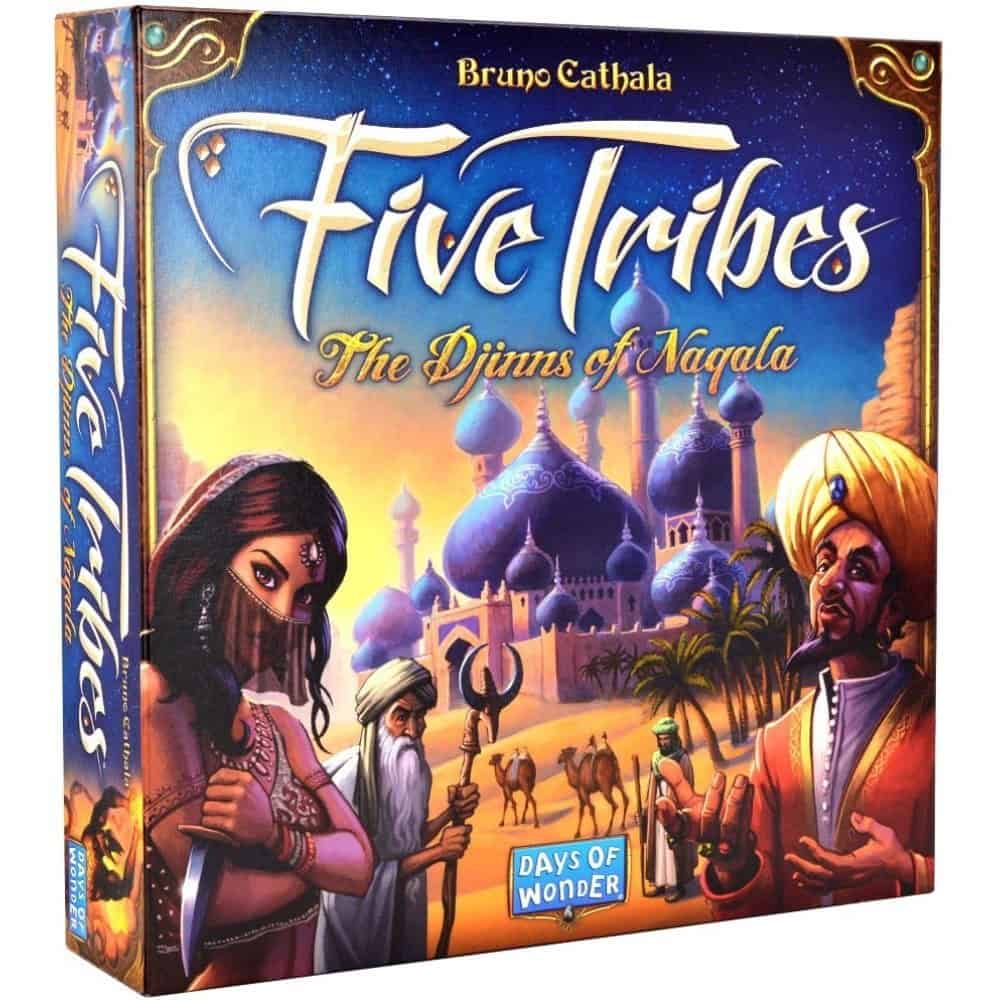
Five Tribes review
Days of Wonder | 2–4 spelers | 13+ | 40 – 80 minuten
The Sultanate of Naqala needs a new ruler, and the method of selection is, as these things tend to be, profoundly undemocratic. You will not be voted in. You will not inherit. You will instead shuffle coloured wooden people around a grid of desert tiles until you have accumulated more points than everyone else at the table, at which point you are declared Great Sultan, a title that sounds magnificent right up until you realise you earned it by being very good at picking up and putting down meeples.
Bruno Cathala — the Frenchman who spent eighteen years designing tungsten alloys before deciding game design paid better in joy if not in euros — took the mancala mechanism, a thing older than most civilisations, and wrapped it in the perfumed silks of One Thousand and One Nights. The result is a game about desert politics that somehow captures the feeling of desert politics: everything is visible, nothing is simple, and the person who looked relaxed three minutes ago is now staring at the board like it insulted their mother.
How It Actually Works
Thirty tiles are laid out in a grid. Ninety meeples in five colours are scattered across them at random. On your turn, you pick up all the meeples from one tile and drop them, one per tile, along an orthogonal path — the ancient sow-and-reap of mancala, except here you are sowing little wooden people across a fictional sultanate, which is either a beautiful metaphor or a deeply uncomfortable one depending on your mood.
Your last meeple must land on a tile containing at least one meeple of the same colour. You then scoop up all matching meeples and do whatever that tribe does. Yellow Viziers accumulate political influence.¹ White Elders summon Djinns. Blue Builders generate gold. Green Merchants collect goods. Red Assassins murder things, because every colour-coded system needs one colour that makes the table go quiet.
Before any of this happens, though, you bid for turn order. With your own money. Which is also your victory points. So going first costs you the game a little, every single round, unless going first wins you the game a lot. This is the kind of elegant cruelty that makes Euro game designers weep with admiration.
¹ They sit there, basically. But they sit there *politically*.
What It Gets Right
The mancala core is extraordinary. Every other mechanism in the game — the area control, the set collection, the Djinn powers, the bidding — orbits it like planets around a sun, and the sun is the simple act of picking up wooden pieces and putting them down again. Cathala understood something profound: the best mechanisms are the ones where you can explain the rules in thirty seconds and spend thirty years exploring the consequences.
The board is a puzzle that regenerates itself. Each move changes everything. The path you planned two minutes ago is gone, eaten by the player to your right who grabbed the green meeples you needed and is now looking at their merchant cards with the quiet satisfaction of someone who has just stolen your lunch and knows exactly how good it tastes.
And the scoring. The scoring is a thing of scattered beauty. Points come from everywhere — tiles you control, Viziers you hoard, goods you collect, Djinns you summon, gold you didn't spend on bidding. There is no single path to victory, which means there is no single path to understanding how badly you're losing. You might be behind by forty points or ahead by ten, and you genuinely cannot tell until the final count. This uncertainty is not a flaw. It is the engine that keeps the game breathing.
The Djinns deserve particular mention. Twenty-two of them, each bending the rules in a different direction, each making you feel briefly like you've found a secret passage through the game's architecture. They add the variability that prevents the hundredth play from feeling like the tenth.
Where It Stumbles
There is a monster living inside Five Tribes, and its name is Analysis Paralysis.
The entire board is visible. Every meeple, every tile, every possible path. For a certain kind of player — the kind who believes that somewhere in the decision space lies a mathematically optimal move and that finding it is not optional — this openness is catastrophic. Turns stretch. Eyes glaze. Someone gets up to make tea, comes back, and the active player is still tracing paths with a fingertip, muttering.
The game knows this about itself. You can see it in the turn order bidding, which was partly designed to keep things moving — pay more to go first, when the board is rich with options, or save your coins and pick from the leftovers. But the bidding doesn't solve the problem so much as relocate it. Now you have AP about the bidding *and* AP about the move.
At four players, the board transforms so completely between your turns that planning ahead becomes an act of optimistic fiction. You can think of a beautiful three-step strategy, watch three opponents demolish its foundations, and then stare at a board that bears no resemblance to the one you studied. Some people find this liberating. Others find it like trying to read a book while someone keeps shuffling the pages.
At two players, the game tightens into something closer to a duel, and most of these problems shrink. Two-player Five Tribes is a different animal — leaner, meaner, and much less likely to end friendships.
Who Is This For?
Five Tribes sits in a peculiar spot. It looks accessible — bright colours, wooden meeples, a theme borrowed from fairy tales. The rules fit on a few pages. You could teach it to a keen thirteen-year-old in fifteen minutes.
Then the first turn happens, and you watch that thirteen-year-old realise that "simple rules" and "simple decisions" are not the same thing at all. Not even a little.
This is a game for people who enjoy the *sensation* of thinking. Not the kind of thinking where you solve the puzzle — the kind where you stand inside the puzzle and admire its geometry, knowing you'll never see all of it at once. Tables that get energised by difficult decisions, by the electric moment where someone spots a devastating mancala path that crosses five tiles and assassinates a critical Vizier — those tables will play this for years. gevoel van nadenken. Niet het soort nadenken waarbij je de puzzel oplost, maar het soort waarbij je in de puzzel staat en de geometrie bewondert, wetende dat je nooit alles tegelijk zult zien. Tafels die energie krijgen van moeilijke beslissingen, van dat elektrische moment waarop iemand een verwoestend mancala-pad ontdekt dat vijf tegels doorkruist en een cruciale Vizier vermoordt; die tafels spelen dit jarenlang.
Chatty groups, on the other hand, should probably keep walking. Five Tribes does not apologise for the silence it creates. It considers the silence a feature.
The Verdict
Bruno Cathala took a mechanism older than written language, planted it in a desert full of Djinns and colourful wooden people, and produced something that plays like no other game on the shelf. It is slow when it shouldn't be, occasionally baffling at higher player counts, and absolutely magnetic when it works.
The slave card controversy is worth noting as a historical footnote: early printings included slave cards, later replaced by fakirs after community objection. Days of Wonder listened, acted, and the game is better for it — not mechanically, since the cards function identically, but in the way that matters more.
Five Tribes is a game that trusts you to find your own way through a desert of possibilities. It doesn't hold your hand. It doesn't point. It just lays out the sand and the meeples and the Djinns and waits to see what you'll build.
**A desert that rewards those patient enough to read the sand.**