


Too Many Bones review
13 oktober 2026
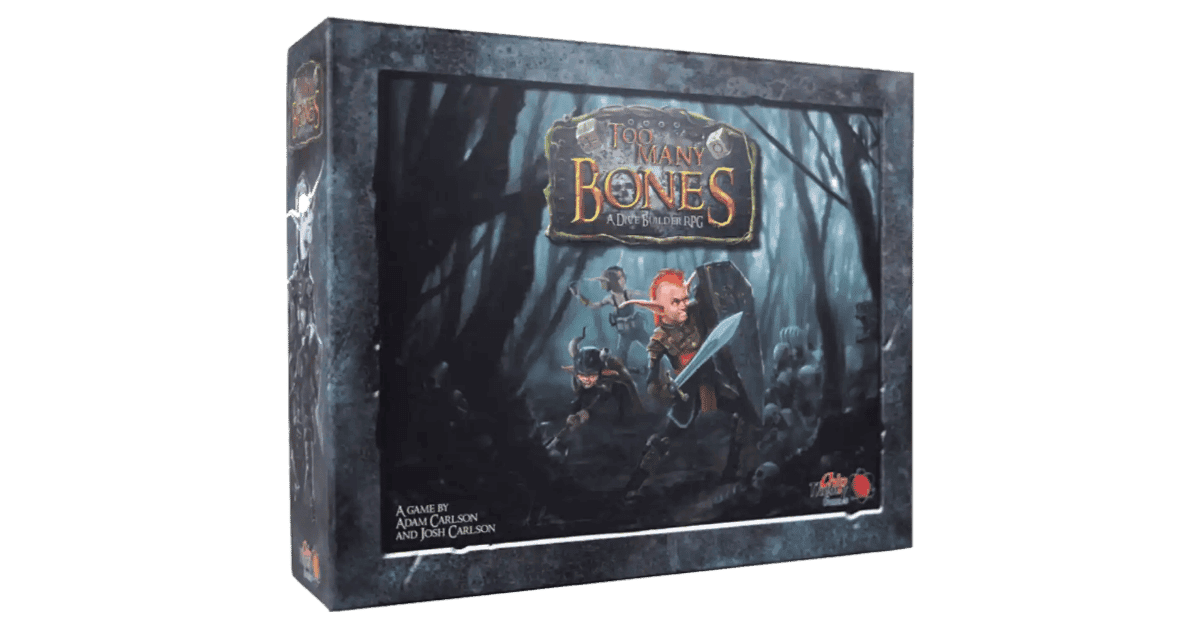
Review: Too Many Bones
Too Many Bones is not a game you “just give a try”. In fact, it is more like a special bottle of wine. You leave the box in the cupboard for a while. Every now and then you glance at it, and the game seems to cast a tempting look back. It is a game you deliberately set aside time for and reserve a nice spot on the table for. One where you think “shall we, tonight…” a few times, purely and simply to prepare yourself mentally.
This is not a dungeon crawler light, nor a narrative adventure game with a handful of dice on the side. Too Many Bones is an outspoken, technical and seemingly merciless dice-builder RPG. Get ready to get to the bottom of a system, manage risks and lose yourself in the rich world of Daelore.
Are we not heroes?! No, we are Gearlocs!
Thematically, Too Many Bones sits somewhere between classic fantasy and tongue-in-cheek absurdism. You do not play a noble knight or a wizard, but a Gearloc: small, tough creatures with big mouths and even bigger ears. Oh yes, and all four of them have a completely different skill tree.
Too Many Bones is not a game where every character “does roughly the same thing, just in a different colour”. Each Gearloc forces you into a different mindset and play style.
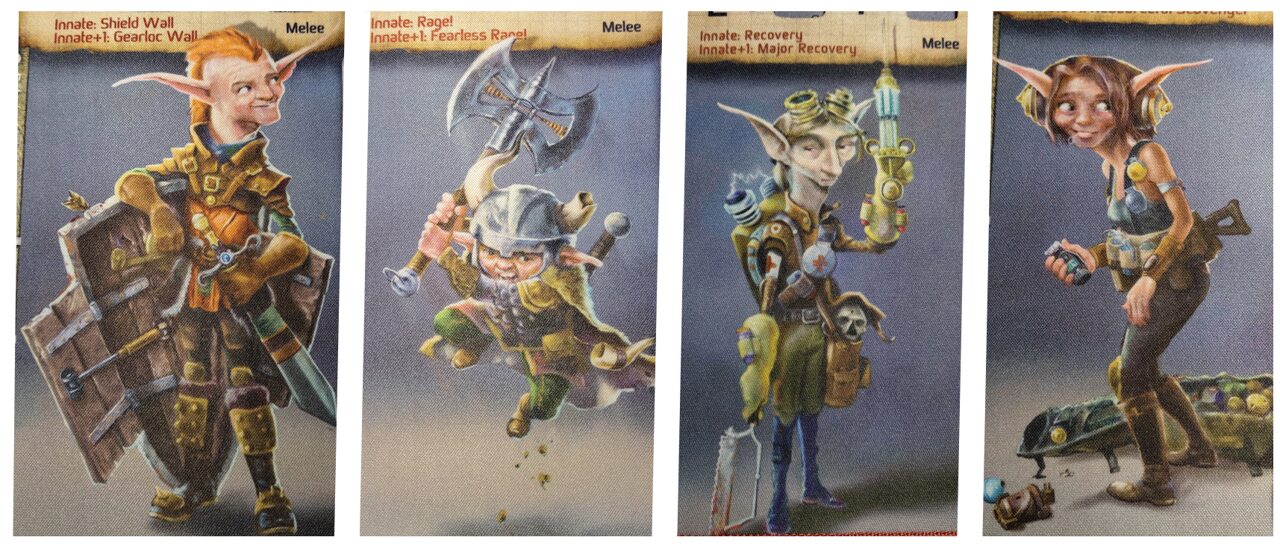
Looking for an explosive fight? Then play Boomer. This Gearloc builds bombs, and with them you literally bend the battlefield to your will. More into tanking? Then Picket is for you: shields, healing and then suddenly… SHIELD BASH!
Patches is indispensable in a party, because he is the healer of the bunch. But make no mistake: with the concoctions in his skill tree you can achieve harmful results (for yourself and the baddies). The last Gearloc is Tantrum. The name says it all: this character gets angrier the more hitting, pounding and taking punishment there is. Exactly what you want on the front line.
Hans… Are we the Baddies?
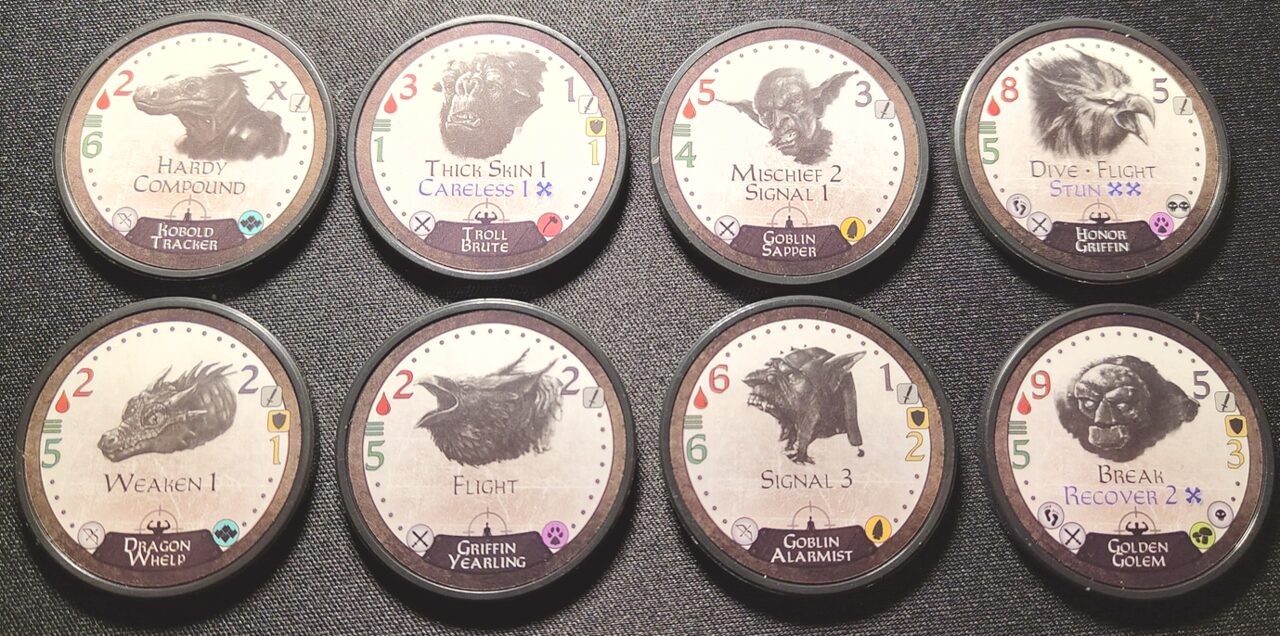
In Too Many Bones you take on Baddies. That is your usual repertoire of riff-raff: griffins, kobolds, dire wolves, the usual suspects. This band of misery is led by one Tyrant, the target you have to eliminate on your adventure in Too Many Bones.
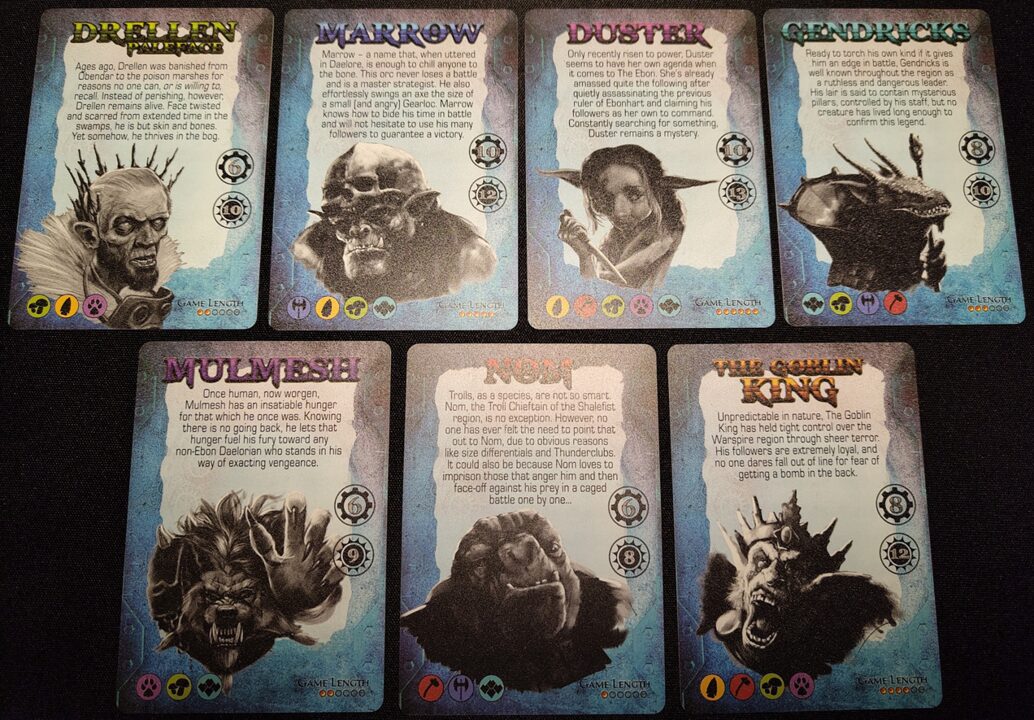
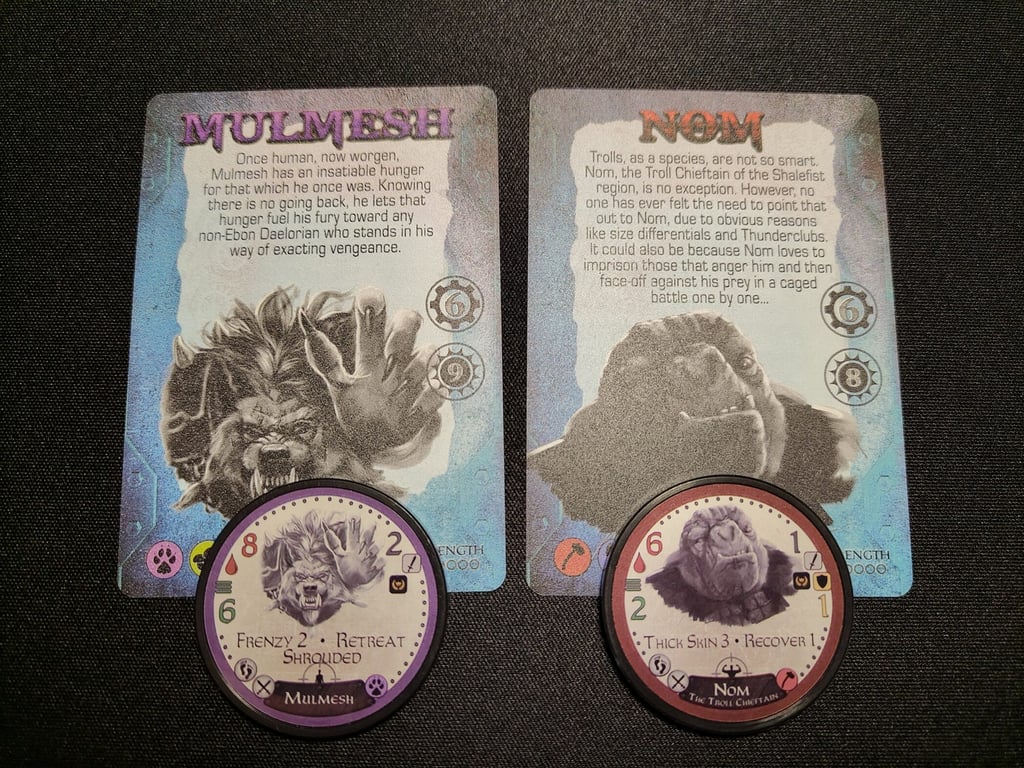
That Tyrant might be, for example, a largely brainless troll-like creature that calls itself Chieftain of the Shalefist region. Or Mulmesh, formerly a human and now a Worgen… whatever that may be. Either way, he is not a pleasant character: Mulmesh has an insatiable hunger for what he once was, and nothing and nobody will stand in the way of his revenge. On whom? Well… that is a question for you, the reader, and something only the reviewer knows.
The adventure begins by selecting a Tyrant. It is important to inspect the Tyrant carefully, because it is not a given that every Gearloc is a match for every Tyrant. The fight between Picket (the tank) and Nom (the Chieftain of the Shalefist region), for instance, is a fairly hopeless undertaking. Tantrum’s furious temper is much more effective here.
The Tyrants are not simple “more HP, more damage” bosses. Each Tyrant changes the rules of the game. Some force time pressure, others limit healing, still others change how baddies spawn or move.
That means that you:
- have to adapt your Gearloc's development to the Tyrant,
- make different choices in encounters,
- and sometimes explore completely different skill trees.
A build that worked perfectly against Tyrant A can fail completely against Tyrant B. That makes preparation just as important as execution.
The engine: encounters, a good scrap and training points
A game of Too Many Bones takes place over a set number of days, depending on the Tyrant you choose. That is how many days you have to challenge (and defeat) the Tyrant. So the Tyrant's difficulty level determines how long you play.
Each day roughly consists of:
- Encounter, a card with what your Gearloc experiences on the front and 2 options on the back
- Rewards, receive Training Points, Loot and sometimes even Trove Loot
- Preparing for the next day: healing, lockpicking, trading loot or taking a gamble, and spying on the next Baddies.
Once those 3 phases are behind you, the new day begins, and you are one step closer to the Tyrant or to your doom. It all depends on how the Encounter went for you. If you have earned Training Points, you take your next step with more health, dexterity, attack or defence. Did you not manage to get any Training Points? Then you will feel the time pressure rising…
This mechanism creates constant tension. You know the Tyrant is coming. You also know you will have to make choices: every day you do not earn Training Points, you fall behind. Every wrong choice increases the chance that you go into the final battle unprepared.
Encounters are not little stories to read aloud and then forget. They are the proverbial ‘bread and butter’ of our Gearlocs, the path to the Tyrant and above all a measure of how strong you become during your journey. Playing it safe is something you should only do very sparingly in this game.
The beating heart: dice building without mercy
While many games call themselves deck-builders, Too Many Bones is a pure dice builder. Your success is essentially the sum of your stats, Gearloc skills and choices. And you improve those stats and skills with dice.
With every Training Point you earn from Encounters, you can improve your stats or unlock new skills. More attack gives you more attack dice to use, more defence gives you more defence dice, and so on.
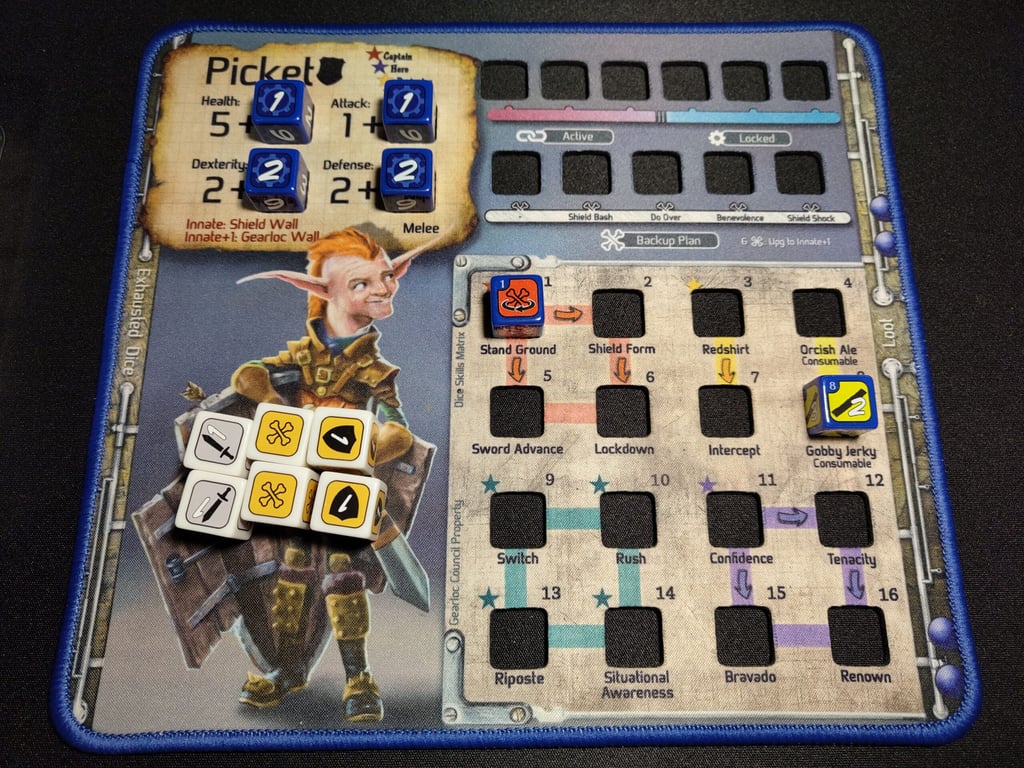
Skill Dice represent the unique abilities your Gearloc learns. Think of it as a profession you teach your character. Picket (the tank), for example, can be developed as a Captain, Hero, Protector or Warden. That way, as well as protecting himself with a Shield Wall, Picket can also donate defence to his teammates.
You ‘plug’ those skill dice, literally, into your character sheet. That is a mat with lots of square holes that the dice fit into neatly and snugly. Chip Theory did a cracking job there, because you are constantly moving the dice back and forth. Terraforming Mars could learn a thing or two from it…
The fighting itself: knife fight in a phone booth
Battles take place on a compact battle mat with fixed positions where you can place your Gearloc and where the Baddies will spawn. The Gearlocs have four melee and four ranged spots. The same layout is reserved for the Baddies. Positioning is crucial, because if you are standing opposite a kobold, it will not hesitate for a moment to give you a smack in the face. Or at least try to, because baddies have to roll dice too. The phone booth in this case is 16 spaces in size, so you are (almost) always in conflict.
The Initiative Track determines the order each round, both for you and for the baddies. Those baddies also bring unique skills of their own. Some absorb the first damage you deal them, others attack with poison. There are no fewer than 2 A4 sheets of unique keywords the baddies can draw from!
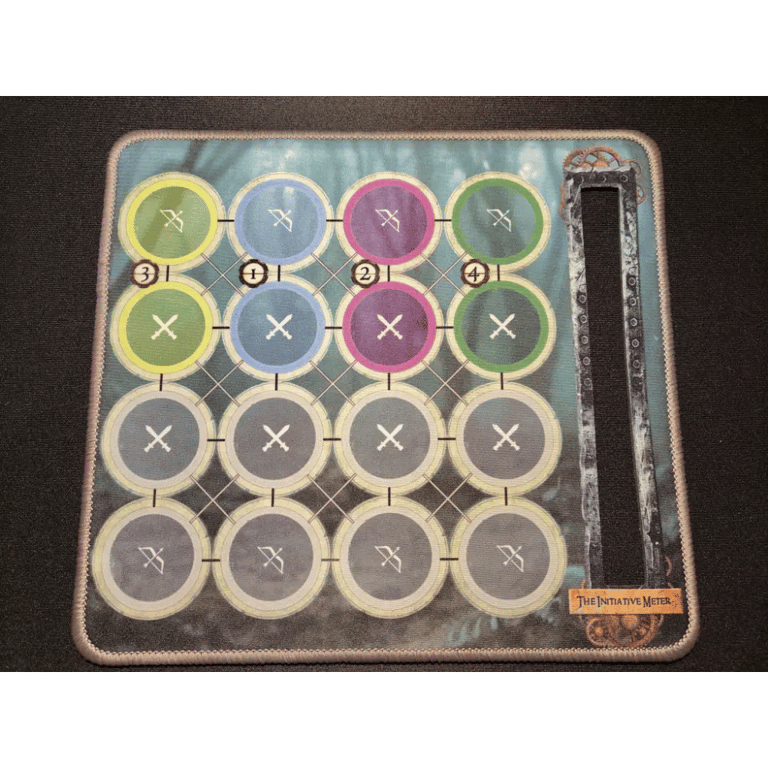
A few elements that make the battles so intense: melee baddies focus on whoever is closest or on a preferred target. That can be the strongest or, just as easily, the weakest Gearloc. Melee baddies move 2 spaces and then attack if they end up next to someone. Ranged baddies, on the other hand, are much less bound by movement: they shoot at their preferred target.
This brings an element of tactical movement into the battles. You often want to take out the ranged baddies quickly, because you cannot dodge their attacks. By moving around cleverly, you can leave the melee baddies trailing behind and so avoid having to endure any attacks from them!
And avoiding attacks and watching your HP dwindle (whether by running away or putting up defences) is essential, because Too Many Bones is downright unforgiving. A badly placed Gearloc, taking too big a risk or prioritising the wrong baddies can make your encounter very short-lived.
A (little) example
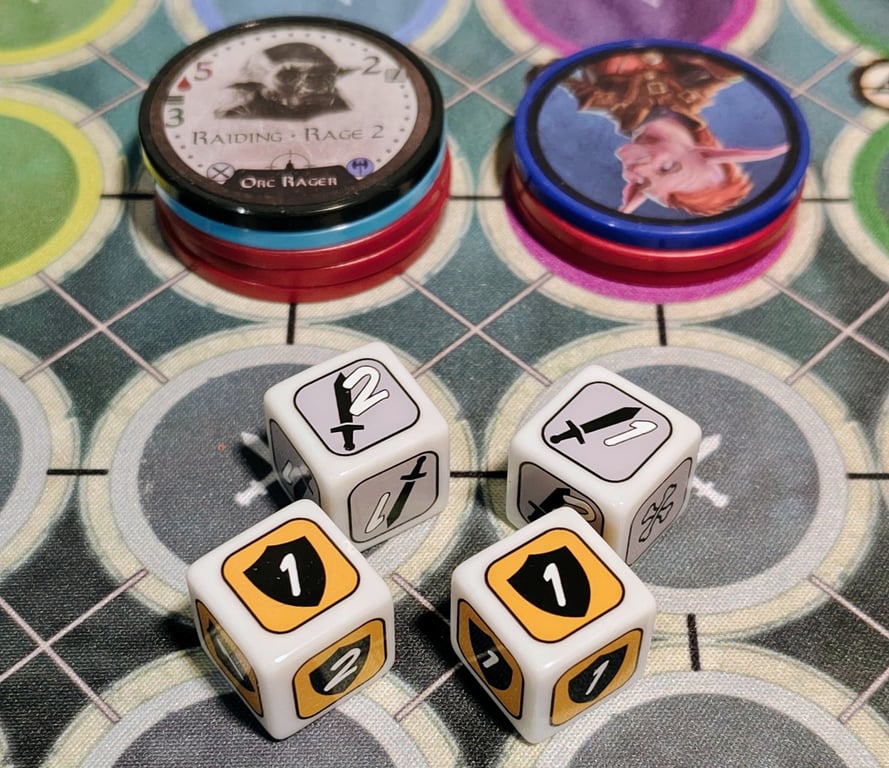
As a Gearloc, on your turn you roll the dice available to you. Those can be attack, defence or skill dice. How many you have depends on your stats. 4 attack? Then you have 4 attack dice at your disposal. How many you may roll in a turn depends on your dexterity. You also need dexterity to move, so if you decide to go for a walk, there will not be much attack or defence left.
Say your Gearloc has 5 dexterity. Your attack stat is 4, defence 3. On your turn you decide to take 1 step and attack the baddie you then end up next to. You may then still choose 4 dice (5 minus 1 for walking). You choose 2 attack (out of 4) and 2 defence (out of 3). You are lucky with your defence: a 2 and a 1. You lock those into your active slots so they act as a shield. Your 2 attack rolls were less fortunate: a 1 and a …bones? You deal 1 damage to the baddie, and that bones result goes into your backup plan.
“Wait… backup plan?” I hear you think. Yes, we have that too. Every character has a unique set of skills in their backup plan, which you fill with the misses (bones) you roll. Hidden in there are all sorts of powerful skills that get better the more bones you store in them. Because a die that has been rolled and placed in an active, locked or backup plan slot is not in your dice pool the next round. And so you cannot use it.
That makes Too Many Bones much more than ‘roll some dice and trigger some effects’: you really have to ask yourself what your actions will be, because your next turn will be largely shaped by them.
Solo or multiplayer?
Too Many Bones is exceptionally strong solo. Because the game has completely open information and still demands a lot of thinking ahead, solo does not feel like “multiplayer minus the company”, but much more like a pure tactical puzzle. One that, by the way, is very satisfying when you manage to crack it.
In cooperative play, communication comes on top of that: which option do you choose in an encounter, what are your priorities in battle and which Gearloc can use which skills? Importantly, the game avoids the quarterback problem through the asymmetry of the characters and the unique dice that come with them.
Chip Theory delivers quality
The component quality is legendary, and rightly so. Neoprene mats, heavy poker-style chips, clear iconography. It is all absolutely immaculate. The art may not be to your taste, but it is applied consistently and woven into a coherent theme.
Final verdict
Too Many Bones is not a game everyone will enjoy. And that is exactly why it is so good. It picks a clear target audience, builds an uncompromising system for it and does not budge a millimetre from it. It is hard, sometimes frustrating, often brilliant and always fair. Except when there are poison enemies; those are not fair. And when you choose the wrong Gearloc for a Tyrant. And when you run into the Tyrant encounter early. And… and… and… 😉
For the player looking for a game that does not just sit on the table, but keeps haunting your brain afterwards and sometimes makes for a pensive night: Too Many Bones does it all.
Why we recommend it
Too Many Bones is an uncompromising dice-builder RPG for players who love complexity, tactical depth and a real challenge. It rewards learning, planning and working together. Even after many games, it stays sharp, exciting and demanding.