


Lords of Waterdeep review
28 juli 2026 · Bijgewerkt 28 juli 2026

Wizards of the Coast | 2 tot 5 players | 12+ | 60-120 minutes
Like many board games, Lords of Waterdeep makes a strong first impression with its presentation. Yet beneath the artwork lies a surprisingly straightforward experience. At its heart, it is a simple worker placement game where the main objective is to complete quests.
On your turn, you send one of your workers to an available location on the board and perform the corresponding action. Most locations allow you to collect resources, but you can also construct new buildings. To do so, you simply choose an available building, pay its cost, and place it on an empty space. From that moment on, every player can use the new location. Whenever another player visits a building you own, you receive a small reward.
That means your investment is guaranteed to pay off throughout the game. Since each location can only be occupied by a single worker, another player using your building often feels better than watching it sit unused.

In addition to your regular action, you can also complete quests. You begin the game with a few available, and more can be acquired through various actions. Completing a quest usually requires spending a specific combination of adventurers and gold, rewarding you with victory points and often additional resources in return. Since victory points determine the winner, completing quests efficiently is the core of the game.
Planning the order in which you complete your quests is an important part of the strategy. One quest might require a certain type of adventurer but reward you with another type that can immediately be used for your next quest. Chaining quests together in this way is both satisfying and rewarding.
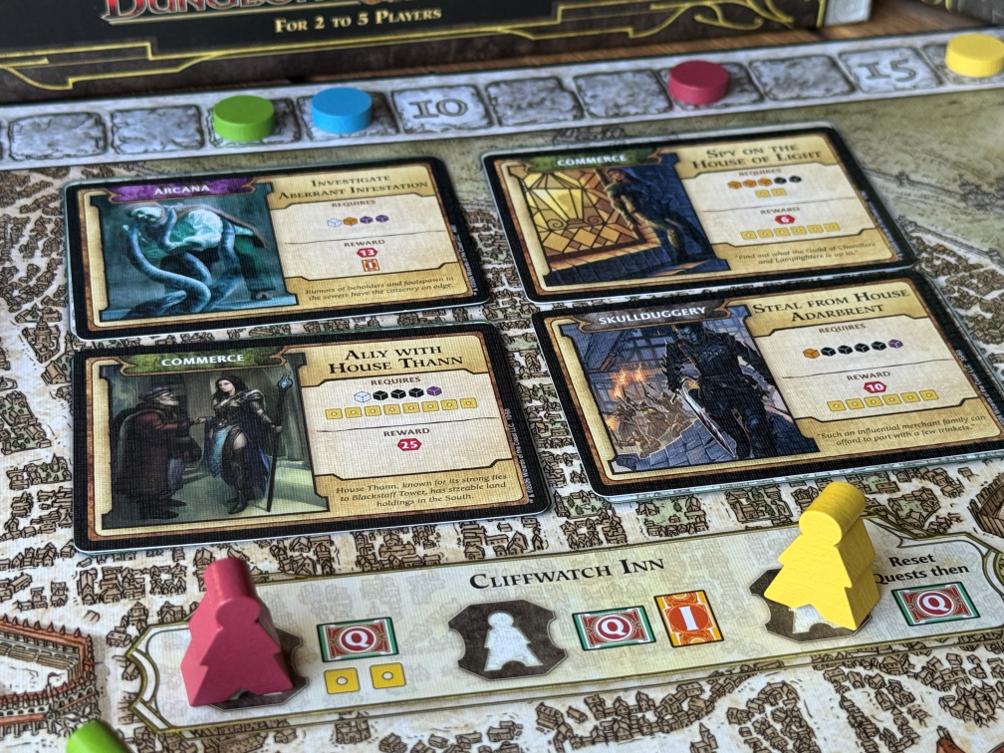
Then there are the Intrigue Cards, which add a layer of player interaction. While they sound disruptive, they are generally less punishing than you might expect. Many grant you extra resources or gold while forcing you to share some with your opponents. Others require your opponents to pay resources instead. These effects can be annoying, but rarely devastating, and players usually recover quickly. If you plan ahead, chances are you'll have an Intrigue Card of your own ready for a future turn.
The most distinctive type of Intrigue Card introduces a mandatory quest. You can assign one of these to another player, forcing them to complete it before they are allowed to tackle any of their own quests. Fortunately, these mandatory quests are relatively easy to finish and still provide a modest reward, so they function more as a speed bump than a serious setback.
As a result, player interaction is more about slowing each other down than outright sabotaging one another. This creates a friendlier atmosphere at the table, especially for groups that prefer indirect competition over harsh conflict.

At the end of each round, new buildings become available, and any buildings that remain unclaimed receive additional victory points. This creates a nice incentive to purchase buildings that may have seemed less attractive in previous rounds. After the fifth round, every player gains an extra worker, opening up additional possibilities. The game concludes after eight rounds.
Once the final round ends, everyone totals their victory points. The player with the highest score wins. However, Lords of Waterdeep includes one final twist: each player secretly represents a different Lord. Every Lord rewards a specific playstyle with bonus points. One Lord, for example, earns extra points for completing Commerce quests. Because of this, observant players can try to identify which quests their opponents are prioritizing and subtly interfere with their plans.
With only two players, there is plenty of room to pursue your own strategy and direct competition is fairly limited. As more players join, available actions become tighter, competition increases, and interaction becomes much more prominent. Higher player counts naturally lead to more blocking, more tactical decisions, and a greater sense of unpredictability.

If you're looking for a worker placement game that gets straight to the point, plays quickly, and offers meaningful interaction without becoming overly complicated, Lords of Waterdeep is well worth a look.