


Keer op Keer Kids rules
13 oktober 2026
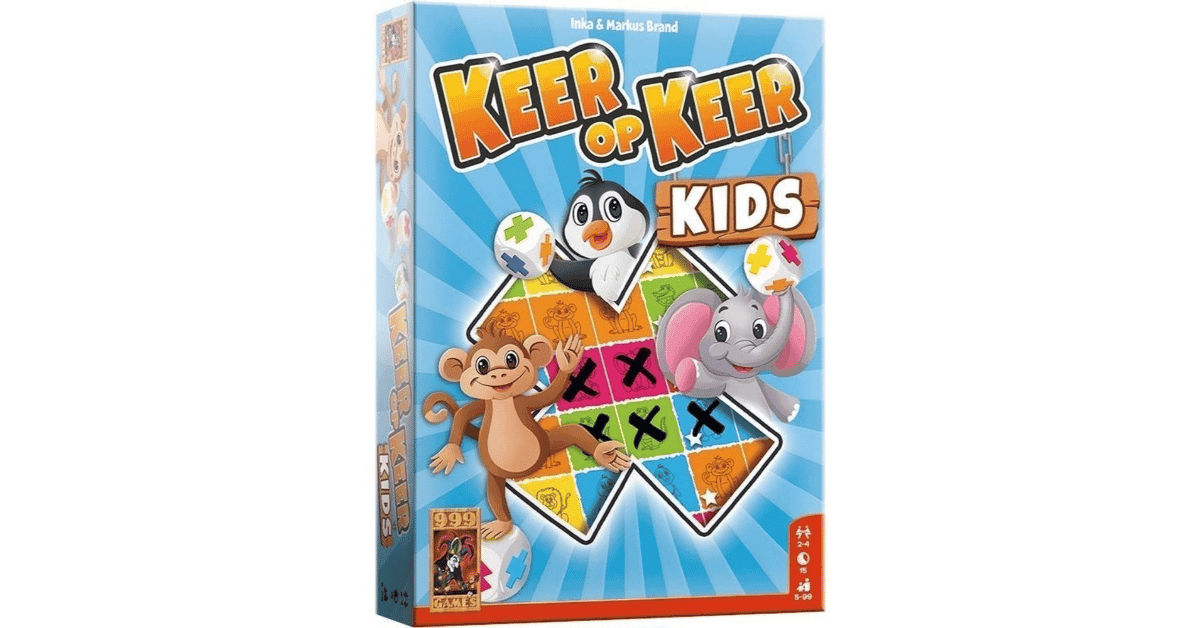
2 to 4 players · ages 5+ · 15 minutes · dice game
Three colour dice, a sheet full of animal enclosures and a pencil. That is all there is. On every roll everyone crosses something off, so a five-year-old never has to wait for their turn, and after fifteen minutes you know who has fed the animals best.
Set up in one minute
- Everyone gets a sheet from the score pad and a pencil. All sheets in the pad are the same.
- Put the three colour dice in the middle. Each die has five animal colours and one purple cross.
- Look at your sheet: thirteen columns with five animals, and in the middle column every square has a star. That is where everyone starts.
- Whoever was at a zoo most recently rolls first.
How to play a turn
In short: the roller rolls the three dice and keeps one. The other players choose from the two that are left. Everyone crosses off one whole enclosure of the chosen colour: at the star, or next to what you already have.
- Is it your turn? Roll all three dice at once.
- Choose one die and put it aside. That colour is yours.
- The other players choose from the two dice that are left. Both may pick the same one; the dice stay in the middle.
- Find an enclosure of your colour on your sheet. An enclosure is a group of one to four squares with the same animal. You always cross off the whole enclosure, never half of it.
- The enclosure must contain a star, or share a side with an enclosure you have already crossed off. Just touching at a corner does not count.
- Did you choose purple? Then you cross off one exclamation mark next to the chameleons on the right of your sheet. For every second exclamation mark you get a chameleon: immediately cross off an enclosure of your choice, whatever the colour. The star-or-border rule applies here too.
- Then pass the dice to the player on your left.
When does the game end?
The game stops as soon as one player has completely filled two animal types, for example all the penguins and all the lions. That player will then have circled four food squares. Then everyone counts up.
Scoring
You earn points during the game by drawing circles. At the end you count all the circles on your sheet. Each circle is 1 point.
| What you achieved | What you circle | Who may do it |
| A full column | The buckets under that column (0, 1 or 2) | Everyone who fills the column |
| First to fill a column | The visitor above the column as well | Only the first player; everyone else crosses that visitor out |
| All squares of one animal | The two food squares next to that animal at the bottom | Everyone who manages it |
Call it out straight away when your column is full and name the visitor above it ("the man with the wheelbarrow!"), so the others know that one is gone. If two players fill the same column first on the same roll, they both circle the visitor. The most circles wins; in a tie there are simply two winners.
Frequently asked questions
What is the difference from the regular Keer op Keer?
In the regular Keer op Keer you roll six dice: three with colours and three with numbers. Colour plus number decides how many squares you cross off. In Kids there are only three colour dice, you always cross off one whole enclosure and there are no penalty points. That means a five-year-old can join in without counting.
Can I cross off an exclamation mark if I choose a normal colour?
No. You only cross off an exclamation mark when you choose the purple side, and only one per turn. So a chameleon always costs two turns with purple.
Do I always have to cross something off?
If you can, yes. If your colour does not fit anywhere, choose a different die. If none of the dice you may choose fits, you skip this turn. There are no minus points.
If only one square of an enclosure borders my crosses, can I take the whole enclosure?
Definitely. One square sharing a side with your crosses is enough. You then cross off the whole enclosure, including the squares that are further away.
Someone else already filled that column, do I still get anything?
Yes, the buckets. Everyone who fills the column may circle those. Only the visitor above the column is for the first player.
Tips for experienced players
- Work from the middle outwards. The two outer columns on each side are worth two buckets, the star column in the middle none at all.
- Want to complete a colour? The crocodile has the fewest squares with fourteen, the penguin and elephant have seventeen. So green is the shortest route to the end.
- Purple is never wasted. Two purples give you an enclosure of your choice, and that is often exactly the one group that completes a column or a colour.
- Listen in. If someone else calls out a full column, that visitor is gone and you are better off completing a different column.
Do you play a house rule that is not listed here, or have you spotted a mistake? Let us know and we will update it.
Game help for tonight
Blok leeg? De dierentuin gaat gewoon open
Print een scoreblad en speel verder. Zelfde indeling als in de doos: dertien kolommen, vijf dieren, de sterren in het midden en de kameleons ernaast.
Email me the game help and the short rules
You also get the weekly letter: one email a week with new rules, a game help and one game that fits what you already own. Unsubscribe any time.
Next game night
What do we play next?
Five questions, thirty seconds, and you have three games that fit whoever is at the table tonight.
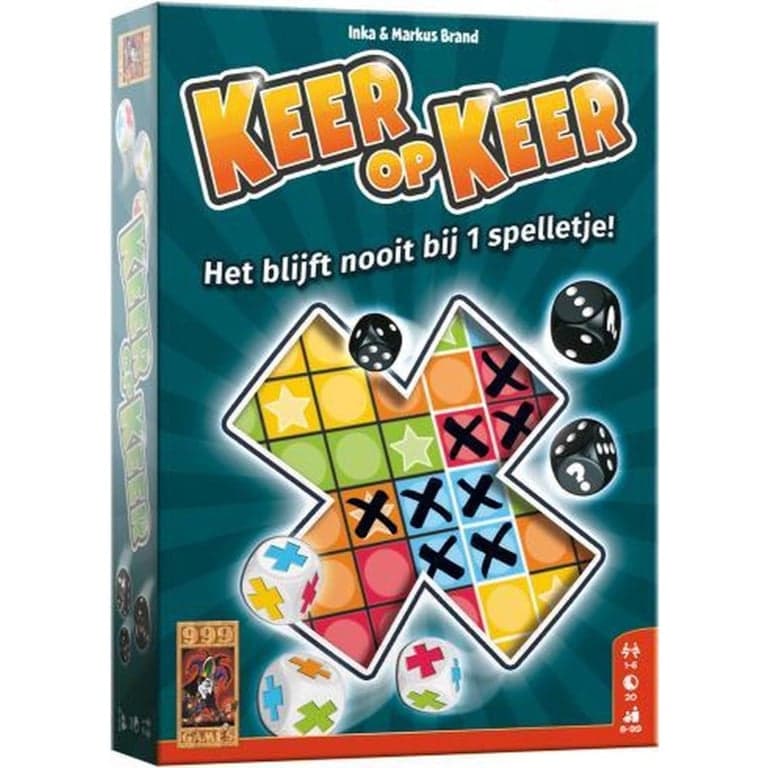
To the game finderDe grote Keer op Keer, voor als de kids de kleuren door hebben
Didn't grab the game help yet?
Email it to yourself, together with the short rules.