


Forest Shuffle review
13 oktober 2026
Forest Shuffle review
Lookout Games | 2 to 5 players | 10+ | 60 minutes
A forest, if you leave it completely alone, does not shuffle itself. It organises itself slowly, over centuries, according to principles that are older than our human customs and will outlive them too. The oak does not consult a market. The lynx does not wait for roe deer to get cheaper. The chaffinch does not move into its beech after an open house or a mortgage consultation, but simply because the beech is there and the chaffinch has certain requirements.
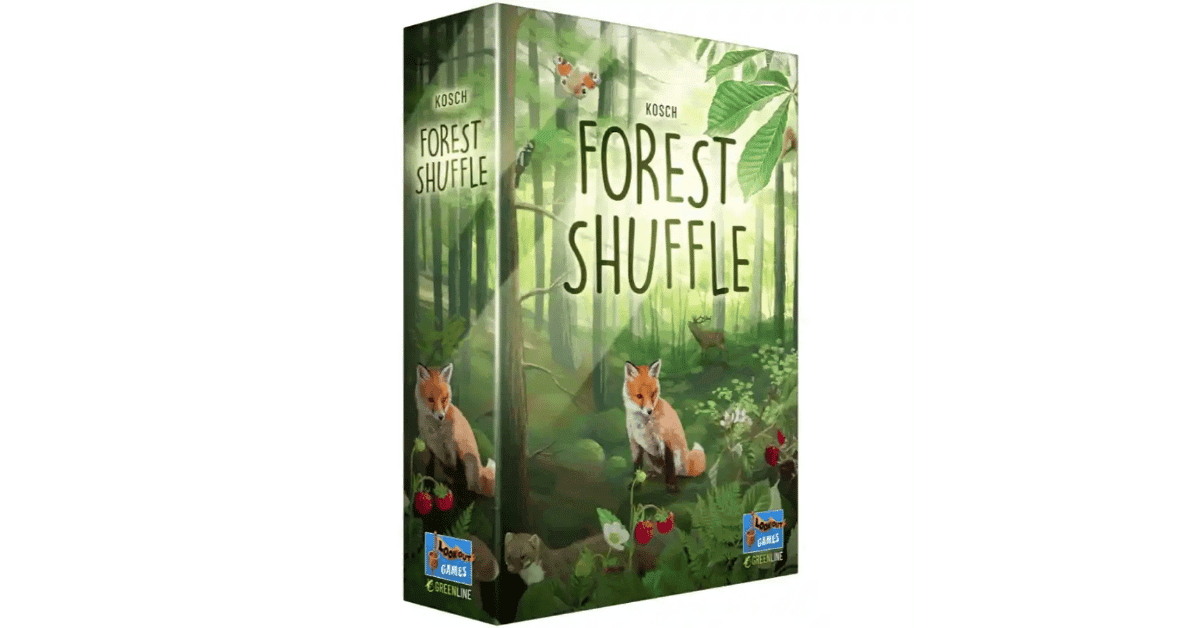
Forest Shuffle, designed by the simply named ‘Kosch’ for Lookout Games, takes this seemingly disorganised ecological system and turns it into a card game of genuine elegance. Judging by its wooden residents, the forest in question is Central European: oak, beech, birch, silver fir, sycamore, horse chestnut, linden, Douglas fir. Your task as its flesh-and-blood counterpart is to build the most ecologically coherent version of it, which turns out to be a deeply competitive pursuit in which the appearance of calm hides a rather fierce battle over who manages to secure the best specimens.
The components and their philosophy
The box is small for a game of this scope. It contains 180 cards, a cardboard clearing board, a score pad and reference cards. And nothing else, because Lookout Games released Forest Shuffle as the first title in its GreenLine label: no plastic anywhere, not even shrink-wrap, the box sealed with a paper sticker and the cards printed on FSC-certified material. This is no small footnote. It is the game's stated design ambition in physical form: the game about ecological responsibility is itself ecologically responsible. Owners of early editions reported that the stickers were sometimes hard to remove without leaving glue behind. The publisher acknowledged this and has fixed it. Nobody is perfect, not even the ecological card game.
The illustrations by Toni Llobet and Judit Piella are gorgeous. They are the particular kind of illustration that suggests the artists had a personal relationship with every forest dweller they depicted. The hedgehog looks like a hedgehog drawn by someone who respects hedgehogs. The fly agaric looks as if it knows exactly what it is doing, which is slightly unsettling and at the same time entirely right. The graphic design by Klemens Franz gives every card a clarity that makes its function readable at a glance once the iconography has sunk in, which takes about one game and then stays with you.
The split cards
The central mechanism of Forest Shuffle is so quietly ingenious that it is easy to underestimate on first acquaintance.
Most cards in the game are split: either top and bottom, each with a different forest dweller, or left and right, on exactly the same idea. When you play a split card like that, you choose one half, pay only that half's cost, and place the card so that the chosen part stays visible. The other half is an offering to the forest: you slide it under the tree you attach the animal to, and with that it is gone for good. The hidden half is lost for this game: it contributes nothing to the score and stays invisible to everyone.
That means every card you take contains a decision. The tawny owl sits at the top; the stag beetle hides beneath it. When you draw that card, you are in effect holding both at once, but you may only keep one. Which serves your forest? Which do you even have room for? Which quietly helps you to more points?
Tree cards are the exception: they are single, complete and fundamental. Each tree offers four spots: one on each side, top, bottom, left and right. Trees are the architecture within which everything else organises itself. You cannot play a forest dweller without a tree for it to attach to, and a tree with all four sides occupied counts as fully occupied. That just happens to be a state some species care about enormously, the pine marten in particular. With this furry creature you score five points for every fully occupied tree in your forest. That rewards completeness rather than sprawl.
How a turn works
There are two actions, and you must choose exactly one per turn.
Draw two cards: take them from the face-down deck, from the clearing, or a combination of both. You may hold a maximum of ten cards in your hand. The clearing is the game's shared discard market. Cards discarded as payment end up there, visible and reusable for any player who needs to take a card.
Play a card and check the clearing: pay the card's cost by discarding the same number of other cards from your hand to the clearing, then place the card in your forest and carry out its effect and any bonus. When you play a tree, you also draw the top card of the deck and put it in the clearing. So you top up the shared market, at the risk of a winter card turning up sooner than you would like.
After you have played a card, the rule is: if the clearing contains ten or more cards, you sweep it clean, removing all the cards from the game straight away. This is the game's pressure mechanism. The clearing gradually fills with discarded payments and extra cards from tree effects. Every player who lets cards land there pushes the count up. The player who tips it over ten wipes everything away, possibly destroying cards that other forest dwellers at the table had just been eyeing. This is not meant as a malicious goal in itself. You cannot use a trick to throw away extra cards, but it does have consequences, and players who become aware of the count will adjust their plans now and then.
The three winter cards
Somewhere in the bottom third of the deck, three winter cards are spread out using a specific shuffling procedure that stops them lying too close together. When you draw a winter card, you reveal it immediately next to the clearing and draw a replacement card from the deck. As soon as the third winter card is drawn, the game ends immediately. Not at the end of the round, not after everyone has had one more turn, but straight away. The player who drew it does not even finish their turn.
This mechanism is efficient and slightly ruthless. It means that a player with a half-built forest, waiting for just one more turn to complete the combination that would make their score add up, may never get that turn. Winter comes when winter comes. The forest does not negotiate.
The end-game tension this creates is real. For an experienced player it is a pleasant extra layer of depth, while it is not essential and so the game stays accessible for beginners.
Scoring and its variety
Every card in your forest scores according to its own logic, and that multitude of logics is exactly what gives Forest Shuffle its strategic texture.
Trees score differently from one another. Oaks are worth ten points each, but only if your forest contains all eight different tree species: an ambitious threshold that puts breadth above depth. Horse chestnuts score quadratically: one, four, nine, sixteen, twenty-five, thirty-six, forty-nine total points for one up to seven or more respectively, which makes a large chestnut grove enormously valuable.
Forest dwellers have their own conditions. Bats only score if you have at least three different bat species, which makes species diversity within a group just as important as quantity. Fireflies score on a fixed scale: one specimen zero, two ten, three fifteen, four twenty. Butterflies score as a set of different species and so reward variety over repetition. The large tortoiseshell, the small tortoiseshell and the silver-washed fritillary each contribute to that set, but you need all five species to reach the maximum. The hedgehog scores two points per butterfly in your forest, so its value depends entirely on what the butterflies get up to, and the bullfinch scores two points per insect, including the stag beetle and other invertebrates, and so on.
These subtle interdependencies, such as the lynx that needs roe deer, the dormouse that wants a bat on the same tree, the hawk that grows stronger from birds, are the engine of the game. A forest that accidentally builds up the right combination of bat species while actually pursuing something completely different suddenly scores handsomely. A forest that deliberately constructs that same combination bit by bit demands planning and restraint, and can regularly fall apart when the clearing wipes exactly the card you still needed. Both routes exist. Neither is guaranteed.
The bonus system
When you pay a card's cost, you may trigger its bonus by making sure all the cards you discard as payment have the same tree colour as the card you are playing. That adds an extra layer of hand management: not just paying the right price, but paying that price in the right colour. Bonuses usually let you place an extra animal for free, take another full turn, or draw extra cards. They are not always achievable, but when you do pull it off, they drive the game forward with a satisfying chain reaction of consequences.
The colour-matching requirement is strict enough to demand thinking ahead without becoming so strict that it feels arbitrary. A hand that contains enough birch-coloured cards to trigger the roe deer's bonus is a hand that has made deliberate choices about what to keep and what to give away.
The verdict
Forest Shuffle plays in about an hour and can be explained in less than ten minutes. The two-part turn structure – draw or play – is simple enough to put into one sentence (ta-da!), and the card effects are self-contained enough that the reference cards answer almost every question without the rulebook being needed after the first game.
What builds up within that simplicity, however, is a game with real depth. The decision about which half of a split card to keep, which cards to sacrifice as payment, when to go for breadth and when for depth, how closely you want to keep count of the clearing, and which of the dozens of competing scoring conditions you want to chase: none of those choices is trivial, and their interplay with the random draw of the deck makes sure no two forests grow the same.
With two players the game is tight and direct; the fight for cards from the clearing and the tension of the ten-card limit are felt very clearly. With four or five players the ecosystem fills up faster and the clearing is emptied more often, which produces a different rhythm and rewards players who adapt their strategy to what the shared market allows, rather than clinging to what they originally planned. Both experiences are good, and the game's claim that it works at every player count is a fair one.
Our final verdict
Somewhere in a Central European forest, a hedgehog is thinking about butterflies, for reasons entirely its own. The lynx longs for roe deer. The bat colony needs diversity. The oak is patient, which is easy enough when you are worth ten points per tree, but only if all eight species are represented.
Forest Shuffle is the card game equivalent of an afternoon in that forest: quietly competitive, structurally elegant, full of organisms with very specific requirements that interact in ways that were not planned in advance and could not be fully predicted either. The winter card comes when it comes. Make the best possible use of the turns before it.
For fans of: Wingspan, Cascadia, Arboretum, Ecosystem. Essential for anyone who wants a card game with real ecological depth that can be explained in minutes, played in an hour, and produces a different forest every time, made, fittingly enough, entirely without plastic.