


Doolhof Junior rules
13 oktober 2026
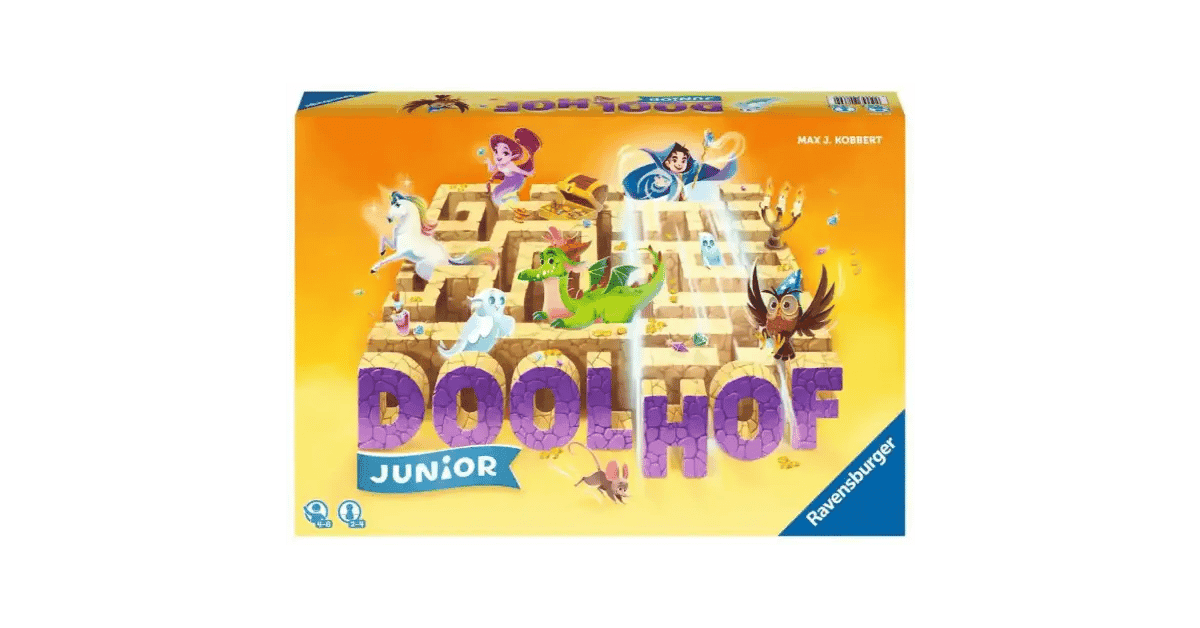
2 to 4 players · ages 4+ · 15 minutes · children's game
A maze that changes every turn, with twelve secrets hidden inside. A four-year-old does not need any more explanation than that.
Set up in one minute
- Place the corridor cards on the empty spaces of the board, in random order. One card is left over: that is the sliding card.
- Shuffle the twelve round secrets and stack them next to the board, picture side down.
- Everyone chooses a figure and puts it on the corner space of the same colour.
- Turn over the top secret. That is the picture everyone is now looking for at the same time.
How to play a turn
In short: slide the loose corridor card into the board at a yellow arrow. Then walk your figure as far as the corridors are open. If you land on the picture of the face-up secret, it is yours.
Sliding always comes before walking, even if you could already reach the picture without sliding.
- Take the sliding card and push it into the board at a yellow arrow. On the opposite side, a card comes out of the board: that is the sliding card for the next player.
- One spot is off limits: the side where the card just came out. You may not push it back in there, because that would immediately undo the previous player's move.
- Was there a figure on the card that slid out? Put it on the card you just pushed in. That can be your own figure too, and it does not count as walking.
- Now walk your figure. You can go as far as you like, as long as the corridors are open, and you may also stay put. You cannot go through walls. Several figures on one space is fine.
- Are you standing on the space with the picture of the face-up secret? Take the secret and put it in front of you. Turn over the next secret.
- Did not make it? Then the next player tries to reach the same secret, with the new sliding card.
When does the game end?
As soon as someone takes the last secret, the game stops immediately. Count the secrets in front of you: whoever has the most wins. The rulebook says nothing about a tie; we share the victory, or play a quick second game with half the secrets.
Frequently asked questions
Can I push the card back in where it just came out?
No. That is the only spot that is off limits, so the move of the player before you stays in place for at least one turn. Any other yellow arrow is fine, including an arrow on the same side of the board.
What happens if my figure is pushed off the board?
Your figure is not out. Whoever is sliding puts it on the card that was just pushed in, so on the other side of the same row or column. That does not count as a move: you simply pop up again on the far side.
Do I have to slide if I can already reach the picture?
Yes. Sliding is compulsory and always comes before walking. In that case, choose a row or column that does not change your own route, or one that gets in someone else's way.
What is the difference from De betoverde doolhof (published in English as Labyrinth)?
The sliding is the same; the difference is in the treasures. In the big game, everyone has their own pile of treasure cards that only they can look at, and the first player to collect them all and get back to their starting space wins. In Doolhof Junior, one secret lies face up and everyone looks for the same picture, on a smaller board with 17 corridor cards instead of 34. Want to practise for the big game? That rule is in the rulebook as a harder variant.
Does it really work with a four-year-old?
Yes, if you build it up slowly. The first time, play with only some of the secrets, half for example, so the game stays short. Hold the board steady while your child pushes the sliding card with both hands. When walking, trace the corridor with a finger; after a few games they will do it themselves.
Tips for experienced players
- Before you slide, first look at where the picture is and which row or column can move that card. Often one slide is enough to open up a corridor.
- Slide a row an opponent is standing in. They move along with it and suddenly end up quite a bit further from the picture.
- Already next to the picture and it is not your turn? Expect someone to shift your row. Keeping two routes open is better than one.
- Playing with a five-year-old? Let them say out loud where the picture is and which arrow they are choosing before they push. That way a child learns to think ahead without you stepping in.
Do you play a house rule that is not listed here, or have you spotted a mistake? Let us know and we will update it.
Game help for tonight
Schuiven: wat mag wel en niet
De schuifregels op één scherm, voor als niemand het boekje kan vinden.
Schuiven: wat mag wel en niet
| Inschuiven bij een willekeurige gele pijl | Ja |
| Terugschuiven aan de kant waar de kaart er net uit kwam | Nee |
| Twee keer achter elkaar dezelfde rij, vanaf de andere kant | Nee, dat is terugschuiven |
| Een rij schuiven waar een andere speler in staat | Ja, die figuur schuift mee |
| Een figuur die eraf schuift op de nieuwe kaart zetten | Ja, verplicht, telt niet als zet |
| Niet schuiven omdat je al bij het plaatje kunt | Nee, schuiven is verplicht |
| Na het schuiven blijven staan in plaats van lopen | Ja |
Email me the game help and the short rules
You also get the weekly letter: one email a week with new rules, a game help and one game that fits what you already own. Unsubscribe any time.
Next game night
What do we play next?
Five questions, thirty seconds, and you have three games that fit whoever is at the table tonight.
To the game finderOok vanaf 5 jaar en ook op zoek naar een schat, nu samen tegen het spel
Didn't grab the game help yet?
Email it to yourself, together with the short rules.