


Vantage review
13 oktober 2026
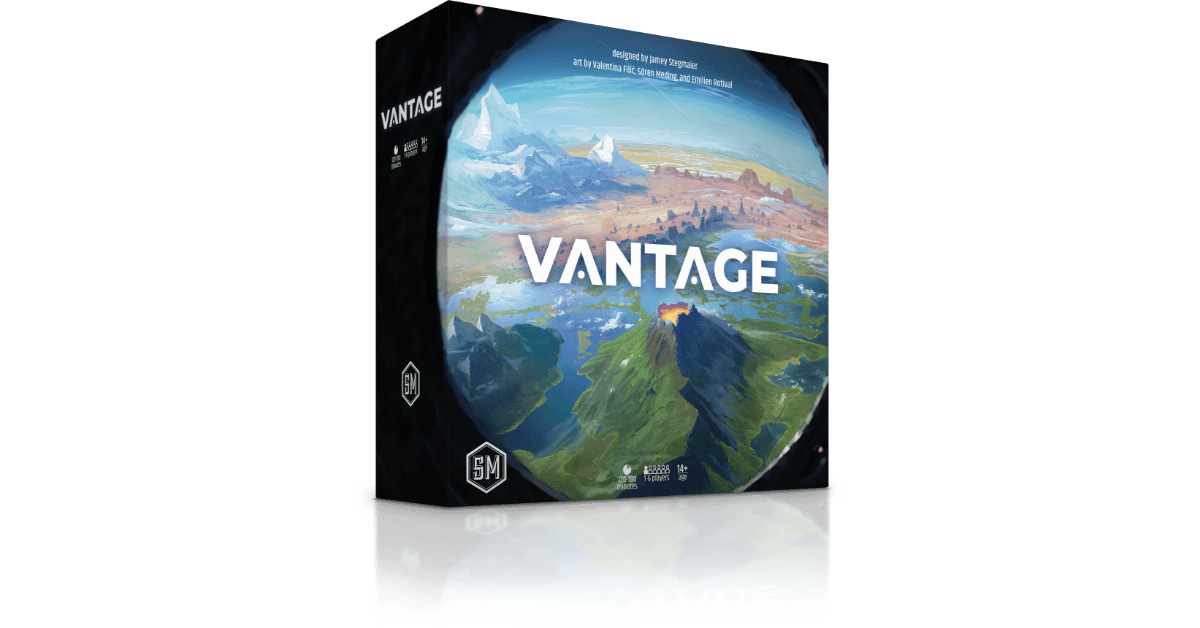
Vantage review
Stonemaier Games | 1 to 6 players | 14+ | 120 to 180 minutes
A horizon is, technically speaking, the furthest point you can see from where you are standing.
It is not a fixed thing. It moves with you, politely withdrawing at exactly the moment you think you are getting closer. Every horizon is someone's somewhere, and beyond every somewhere lies another, entirely different horizon, inhabited by someone else who cannot see yours and is probably not giving you a moment's thought.
That is, more or less, the central mechanic of Vantage.
The premise
You start every game aboard an intergalactic ship heading for an unknown planet. That ship does not land gracefully. You crash. In hindsight, that may well be the most honest way to begin a game of exploration. Not with a triumphant arrival and a firm handshake from the locals, but with a piece of escape pod, a pounding head and a world that has scattered you across several places, far from your companions, and is not yet quite sure what to make of you.
Vantage is a cooperative adventure game for one to six players, designed by Jamey Stegmaier of Stonemaier Games, and it was eight years in the making. It contains almost 800 interconnected location cards, more than 900 additional cards to discover, nine storybooks with around 7,000 action outcomes in total, its own set of dice, coins, tokens, a central board, a Book of Vantages for aerial views, a Book of Secrets with solutions to puzzles, and a sense of scale that is, frankly, mildly embarrassing for the other games on the same shelf.
Just as important is what it is not. It is not a campaign game. You do not carry any progress over between sessions. You only take with you what you have learned about the world, and that turns out to be rather a lot.
The world
The planet has no name. It has forests, deserts, cities, caves, coasts, ruins and underground passages. It has animals of the wild and the loyal kind, thinking beings with opinions about the weather and about your intentions, travelling merchants, glass orbs that may or may not be connected to a website, structures you can build and curses you can pick up, elementals, flora with peculiar properties, and at least one thing the rulebook refuses to name because you are supposed to discover it yourself.
That reticence is not coyness. It is the core philosophy of the game. The rulebook very deliberately does not describe what you will find in the box. The glossary is tucked away in a separate document, the Book of Secrets, and you are firmly advised not to read it beforehand. You get to know the planet by being there. The designer's stated aim was to reward curiosity and observation, not preparation.
The artwork by Valentina Filić, Sören Meding and Emilien Rotival shows each of your almost 800 locations from a first-person perspective. You see what your character sees. The view through a mountain pass is different from the view from the bottom of a cave. In that sense, the planet is not just a setting but also a statement: exploring requires genuine ignorance of what is coming, and the image in front of you is not the decoration of the game, but the game itself.
How it plays
Each player has a character, one of six possible starting characters, each with their own asymmetric abilities, and looks at their own location card, which the others may not see, because you have landed on different parts of the planet. The cooperative structure lies in communication: you can tell your companions what you see, ask for resources and work together towards shared goals, but you cannot just lean across the table to peek at their card. When playing remotely, the game explicitly recommends communicating by audio only. That, the designer notes, is more thematic.
On your turn you choose one action from three types. Location actions come from the six options on your current card, move, look, engage, help, take or overpower, and each refers to a specific passage in a storybook for the outcome. Card actions use the items, animals, skills and other discoveries you have built up in your personal grid. Depart actions move you in a compass direction to an adjacent location.
The crucial and unusual thing about all these actions is that you commit to them before you know the cost or the outcome. You decide to study something before you know how long it will take or what you will find. That is not random cruelty on the designer's part. It is, once again, the philosophy turned into mechanics: exploring means pressing on without certainty. You cannot see the cost first and then decide to do something easy after all. You have chosen. Now you find out what that means.
The price is paid in challenge dice. You roll a number of black dice equal to the remaining cost after skill tokens have reduced it. Each face of such a die shows a penalty, lost time, lower morale or damage to health, and your task is to absorb those results by placing dice in slots on your cards. A loyal animal might accept a movement die, for example. A skill card might absorb a morale result. Whatever you cannot place becomes a real penalty and comes straight off your tracks. You start every game with ten points on each track: time, morale and health. The first time one of those three reaches zero, you are not immediately out of the game. The game is generous enough to give you a warning first.
The card grid
Each player builds a personal grid of cards around their character. That grid can hold up to eight surrounding cards, items, animals, skills, vehicles, structures and other discoveries, and every card in it does at least two things. It offers slots for challenge dice that let you absorb penalties. It also has boost powers, which can be activated at any moment and on any turn by spending the boost tokens collected on that card. Boost is the game's soft currency, representing accumulated knowledge and familiarity with the resources you carry.
That grid changes over the course of a session. You tame wild animals into loyal ones. You improve your character. You craft items, build structures, acquire spells, learn to swim. The game contains a bewildering amount of discoverable content: thinking beings you can build relationships with, curses that complicate your options, puzzles left behind by unknown parties, runes, orbs, and now and then a duel fought out through a separate card mini-game called Skirm. And the game very deliberately chooses not to tell you most of it in advance.
Winning, losing, and the question of what success really is
At the start of every game, the players share a mission, drawn from the available supply. Completing that mission is one form of victory. On top of that, each player also has a personal destiny, a longer-term goal which, if achieved together with the mission, results in what the game calls an epic victory. You may also, as the rulebook remarks in a somewhat philosophical mood, define success by everything you pursue and achieve.
That is a rather unusual remark for a rulebook. Most rulebooks are not the least bit interested in your personal relationship with success. They have victory conditions and loss conditions and a track that has to move forward and a boss that has to be defeated. Vantage certainly has ways to lose, time, morale or health reaching zero for good, but it wears its definitions of victory remarkably lightly. Depending on how you approach games, that feels either liberating or slightly disorienting.
Three difficulty levels and six variable starting characters, combined with random mission selection, random crash locations and the sheer amount of as yet undiscovered content, mean that the same world gives essentially different experiences from session to session. This, the designer notes, is a complete game. There will be no expansions. According to him, the planet already contains enough content for three complete worlds.
The assessment
Vantage takes two to three hours and asks for patience with a rulebook of average density, a set-up time that is unusually and pleasantly short at around two minutes, and a willingness to be surprised rather than wanting to be prepared. The start of a session can feel slightly disorienting. You are in one place, your companions are somewhere completely different, the world is bigger than you can hold in your head, and the dice occasionally show an interest in your morale that you would rather not be confronted with.
What you get in return is hard to sum up without using the words open world, and a decade of video game marketing has worn those words rather thin. Suffice it to say that the game honestly earns the description. The planet is a thing that really exists, in the sense that the northern path from location 272 actually leads somewhere specific, and that place in turn has its own six actions, one of which leads somewhere else again. The coherence is real, not merely suggested.
The game also plays solo with full support, and scales from one to six players without the cooperative experience falling apart at either end. At higher player counts, some early critics noted that the waiting time per player can add up. That seems a fair observation. The game is designed to reward patience over haste, and that is simply not to everyone's taste.
Our verdict
There is a horizon on an unknown planet in Vantage. You cannot see it, because you are looking at a first-person card of the place where you crashed. Your companions cannot see yours either. The planet does not offer to explain itself. The dice may already have dented your morale before you have reached the interesting part.
And yet. Somewhere out there, beyond location 202, through a cave system and across a body of water you first need to have learned to swim in, lies something nobody at this table has found yet. The game does not tell you that. It simply gives you locations, numbered in ascending order on both sides of double-sided cards, and refuses to apologise for the fact that there are almost eight hundred of them.
It took eight years to make this. On reflection, that sounds just right.
For fans of: Breath of the Wild, The 7th Continent, Sleeping Gods, Earthborne Rangers. Essential for anyone who has ever wanted to experience genuine open-world exploration at the table, without an app, without a campaign, and without being told in advance what the world actually contains.