


Unstoppable review
13 oktober 2026
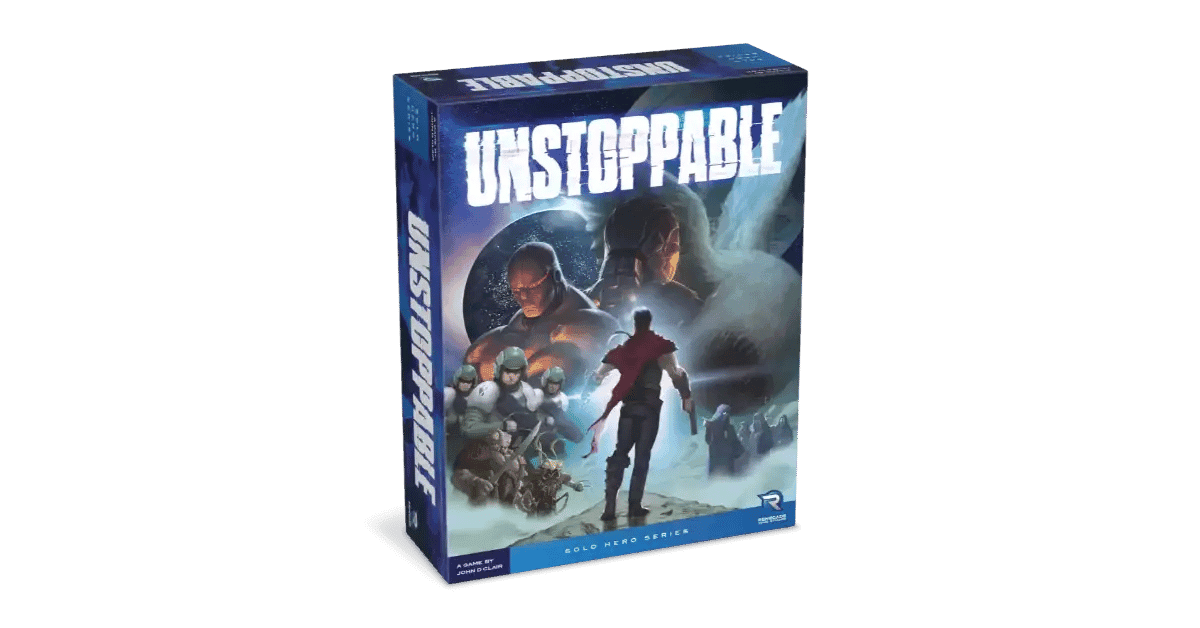
Unstoppable review
Renegade Game Studios | 1 to 2 players | 14+ | 45 to 75 minutes
Spare a moment's thought for the card sleeve.
It is a small thing. A transparent plastic cover, the kind you come across by the million at game fairs, meant to protect bits of cardboard from greasy fingers and the accumulated residue of a hobby in which snacks are remarkably seldom far away. Nobody has ever written a poem about a card sleeve. No philosopher has ever pondered its deeper meaning. It dangles at the very bottom of the hierarchy of interesting objects.
And yet. In Unstoppable, the card sleeve is more or less the whole point.
That is either a masterstroke or a practical joke taken remarkably far, and after a few hours of play we lean strongly towards the former, although the dividing line, in board games as in life, is thinner than anyone could reasonably wish.
The world
The game takes place across three worlds. Ceres II is a city planet where, as the rulebook diplomatically puts it, every alley offers a quick and quiet death. Virenos is a lush forest where the local wildlife has strong opinions about sharing meals. Mithras is a wasteland of discarded scrap that somehow is also full of treasure, which says a lot about the economic systems apparently at work here. A threat of world-ending proportions, one of the three bosses, hangs over all of these places, and you, someone touched by fate and wielding growing power, have to do something about it.
Sensibly, the game does not linger too long on this background. It points to a science fantasy universe populated by Viren activists, Junker mechanics, Silver agents and Council diplomats, four factions whose political grievances occasionally surface in the flavour text on the cards, and then steps aside in good time so that you can simply play. Banana Chan, who was responsible for the narrative and the world, has clearly built something bigger than could ever have fitted neatly into a rulebook, and it is precisely that restraint that gives you the pleasant feeling that this world carries on beyond the edge of the table.
The sleeve mechanism
And this is the thing that makes Unstoppable unusual.
Before your first game, you put every card in a sleeve. That is not just for protection. Each sleeve holds two cards, a core card on one side and a threat on the other. As the game goes on and you defeat enemies, you draft new cards from a shared supply, slide them into sleeves together with threats from the danger deck, and so build a personal deck of double-sided objects. Every card you own is both a resource and a problem: on one side a useful ally or tactic, on the other a monster that will strike back if you let it pile up on your battlefield for too long.
You can also add upgrades, a third layer that slides into the middle of the sleeve and changes both sides. After such an upgrade, a card that heals you can also become a tougher opponent when it eventually turns against you.
The result is a game in which deck-building and threat management are essentially the same action, and in which every new acquisition carries weight. You do not just buy cards to shuffle into your deck. You choose which threat you are willing to live with in exchange for a powerful new tool. If you think about it calmly for a moment, that is a remarkably accurate simulation of how decisions work in general.
How it plays
Each turn follows five phases, with the pleasing efficiency of a well-oiled machine that, unfortunately, is also trying to kill you.
You start by gaining three action points and refreshing your allies, permanent cards with repeatable effects, unlike tactics, which are one-offs. Next you draft a new card: draw three from a core deck of the right level, keep one, pair it in a sleeve with the top threat of the danger pile, and add it to your hand without looking at the threat side. In effect, you are buying a pig in a poke. Then you spend your action points on playing cards and spending credits on upgrades from a shared market, and you defeat the active threats on your battlefield to draw them back as new core cards. Then the threats strike. Then comes the clean-up phase: danger advances, threats are replenished, and if your deck has run out, you go up a level.
Levelling up is the heartbeat of the game. When your deck runs out and the conditions are met, your level markers move up. That permanently changes which level of core cards you draft from, while your played cards are temporarily discarded and your discard pile is shuffled into a new deck. The enemy of levelling up is the danger track, which advances relentlessly and, when it reaches the end, means your time is up, no matter how much health you have left. The tension between “defeat threats quickly to level up efficiently” and “do not take too much damage while you are at it” is where the game really comes alive.
There are three bosses. The Harbinger poisons your deck with Order cards that deal damage when you draw them and cannot be removed, so you have to defeat him before the infection gets out of hand. The Triumvirate has to be hit with specific types of damage and slips cards into your discard pile as you level up. Duomo’s Menace demands almost surgical attention to active threats and forces interesting choices about how you spread your damage. Each of them has its own danger track, with spaces that trigger different effects at different difficulty levels, Normal, Hard and Expert, so the same boss feels noticeably different on a second attempt.
The faction system
Cards belong to one of four factions: Council, Junker, Silver and Viren. Each faction has its own keyword mechanic. Conspire triggers if you have another card of the same faction in your hand. Focus grows with the number of cards of the same faction in play. Unite scales with how many different factions you have collected. Bargain gets cheaper for every card of the same faction you are holding.
Those keywords reward you, subtly but constantly, for thinking about what you draft. A deck that chases one faction for Focus bonuses plays very differently from a deck that deliberately spreads out to build up Unite effects. There is no wrong answer, but some answers suit the boss you are facing at that moment better than others, and that is exactly the kind of strategic texture that makes repeat games worthwhile rather than merely familiar.
Two players
The two-player mode is cooperative, with each player controlling their own character and a boss whose health and required damage are doubled. Players may attack threats on each other's battlefields, which creates a pleasing structure of mutual help: you can damage your partner's threat so that they then get the card, or clear a Taunt threat together before it locks down both play areas. The Threat Phase remains individual, though. You are only hit by your own battlefield. As a result, the game does not turn into one big shared organism, and each character deck keeps its own identity.
The verdict
Unstoppable asks you to read a rulebook carefully, slide a heap of cards into sleeves before your first session, and then keep several interlocking systems in your head at once. This is not a game you hand to someone who has never played a card game and expect them to be cheerfully joining in within minutes. The learning curve is real, and it starts before the box is even fully open.
What you get in return is a deck-builder with a genuine mechanical identity. The double-sided sleeve system is not a gimmick. It is structural, and it changes the way you think about every decision. Buying a powerful card also means choosing your next threat. Levelling up resets your hand, but also lets you permanently remove one card if you wish, a precise form of deck surgery available once per cycle. Defeating threats is the only way to draw cards, which means aggression is not an optional choice of style. It is the engine.
The game plays in forty-five to seventy-five minutes, which proves accurate for experienced players and, for beginners, a touch more optimistic than is probably healthy, as is often the case with playing times printed on boxes.
Our final verdict
In its own way, there is a tortoise and an eagle in Unstoppable. The eagle is the boss: inevitable, circling, armed with a danger track that advances whether you are ready or not. The tortoise is your deck, slow to get going, staying close to the ground with its starting cards, waiting for the moment when the combined weight of upgraded allies and carefully chosen upgrades turns it into something that, against all reasonable expectations, can fly.
The game is for one or two players, takes less than an hour once you know it, and has enough variety in bosses and enough interplay between factions to stay interesting over many sessions. It is, in the best sense of the word, a system, one in which the parts know what they are there for and behave accordingly.
That the whole thing ultimately fits in a sleeve feels, on reflection, entirely fitting.
For fans of: Slay the Spire, the video game it openly nods to, Mystic Vale and Shards of Infinity. Best suited to players who feel at home with deck-builders of medium complexity and who enjoy being surprised by genuine mechanical ingenuity.