


Unmatched: Bruce Lee vs. Muhammad Ali review
13 oktober 2026
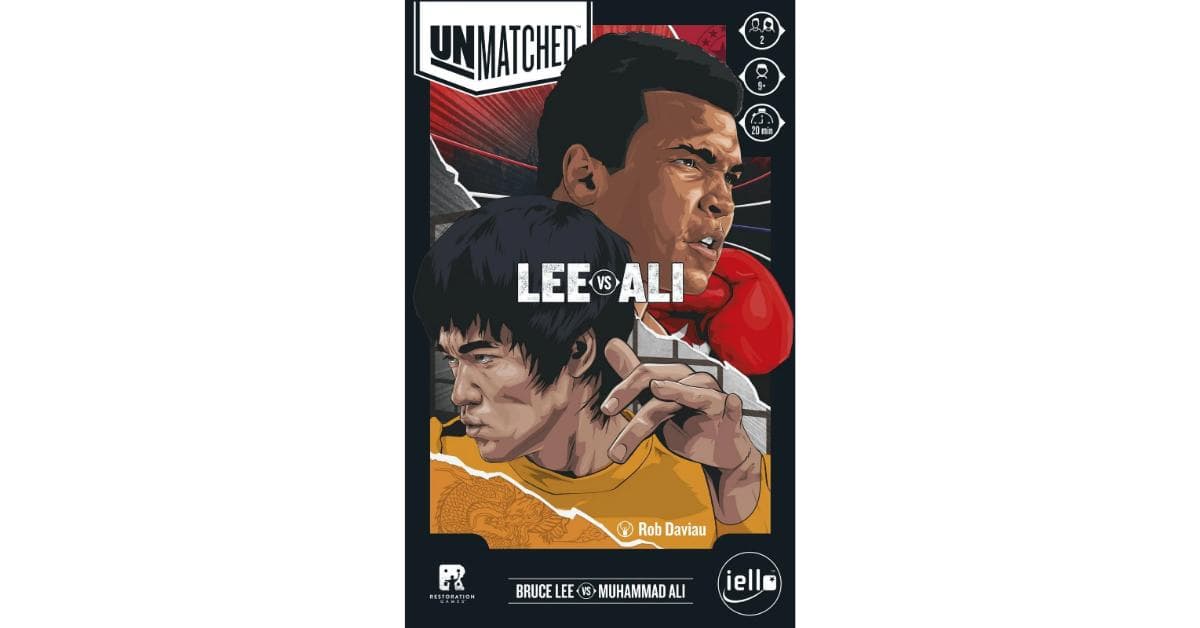
Unmatched Bruce Lee vs Muhammad Ali review
Restoration Games | 2 players | 9+ | 20 minutes
This fight never took place.
That is, depending on your point of view, either one of the great missed opportunities in sporting history or one of its great blessings. Bruce Lee was a martial artist of almost supernatural ability, a film star, a philosopher of combat, and a man who, by every credible account, could move at a speed that made witnesses doubt what they had just seen. Muhammad Ali was the greatest heavyweight boxer who ever lived, a man who turned a sport of raw power into something that began to resemble poetry, who was fast enough to make grown men look slow, and who introduced himself to the world with a line about his own speed that has lost none of its force in half a century. The question of what would have happened if the two had ever met in a theoretically neutral arena has kept a certain kind of late-night debate alive ever since, and it has never been answered, because the laws of physics only move through time in one direction.
Unmatched: Bruce Lee vs Muhammad Ali is Restoration Games' answer to a question physics refused to settle. It is not a simulation. It is a twenty-minute, card-driven skirmish game in an abstract arena, and it is good to see it that way too. But it is also, in the very specific way good games manage very specific things, a serious attempt to make you feel what it would have been like to be in that room.
What Unmatched is
For anyone who does not know the system yet: Unmatched is a highly asymmetric miniatures combat game, designed by Noah Cohen, Rob Daviau and Justin D. Jacobson and published by Restoration Games. As is customary for this studio, it was “restored” from the now out-of-print Star Wars: Epic Duels, which itself never quite found its audience, and rebuilt into something that has since grown into one of the most extensive and consistently well-regarded two-player combat systems in the hobby. The playable characters include King Arthur, Medusa, Bigfoot, Sinbad, Sherlock Holmes, Dracula, Jekyll and Hyde, Robin Hood, Buffy the Vampire Slayer, Black Panther, Sun Wukong, Achilles and many more. Each of them fights differently, because each of them has a different deck.
The battlefield is a board divided into colour-coded zones, with round spaces connected by lines to show adjacency. Melee fighters may only attack adjacent spaces; ranged fighters may attack anyone in the same zone. On your turn you take two actions from the available options: manoeuvre (draw a card and then optionally move your fighters according to their movement value), play a scheme, or attack. You may take the same action twice, or two different ones in any order.
Combat is simultaneous and diceless. The attacker plays a card face down; the defender may play a defence card face down. Both are then revealed at the same time, effects are resolved in order, and damage is calculated as attack value minus defence value. The defender “wins” if they take no damage. As soon as your hero's health reaches zero, the game ends. You lose.
What makes the system sing is that every deck contains exactly thirty cards, and every card is designed for precisely the character it represents. The deck is not just a collection of numbers; it is a character portrait in mechanical form.
Bruce Lee
Bruce Lee's deck is built around Jeet Kune Do (the martial art he developed himself), which he called “the way of the intercepting fist”, a philosophy that valued directness, adaptability and stripping away all wasted movement. In game terms, this shows up as a recurring engine of techniques that can be reused.
Certain cards in Lee's deck are marked as Jeet Kune Do techniques, and effects on other cards let him return specific techniques from his discard pile to his hand. A technique used in one fight can come back later in another. The deck rewards thinking ahead: understanding which techniques you want to use in which order, when to hold on to a specific card so it can be retrieved later, and how to make sure the right tools are available at the moment you need them. This is not a deck that punishes aggression, but it does punish careless aggression. Lee's play style is, mechanically and thematically, the expression of an idea: economy of movement, intelligence applied to power.
He has no sidekick. Bruce Lee fights alone. That is both the most fitting thematic choice the designers could have made and a mechanical fact that shapes the whole game. There is nothing to sacrifice, nothing to manoeuvre as a distraction, no extra health to soak up blows. Everything depends on the miniature on its transparent stand, which has him hovering above the board mid-kick, like someone who has decided gravity is no more than a suggestion.
Muhammad Ali
Ali's deck is built around one of the most famous lines in sporting history: float like a butterfly, sting like a bee. Here that is not a decorative reference; it is the mechanical backbone of the game.
Ali starts every fight with a stance token on its butterfly side. In butterfly stance, he may attack from up to two spaces away, an unusually long reach for a hero without a sidekick. This is meant to express the range and speed of his footwork, his ability to control distance and create angles that other boxers simply did not have. If he attacks and wins that fight, the token flips to its bee side, and his attacks gain +2 power. Sting like a bee.
In this way, the design elegantly captures the rhythm that defined Ali's prime: the movement and jabbing that set up the combinations, and then the moment the combination landed and everything suddenly sped up. The butterfly sets up the bee. The footwork makes the power possible.
The tension in Ali's game is that this stance mechanism depends on winning attacks. In butterfly stance he is mobile and dangerous at range, but not yet at full punching power. When those attacks are blocked, the switch does not come, and he keeps circling, looking for an opening, while his deck slowly thins and the situation grows more urgent. But when those attacks do land, the switch is immediate and unmistakable. What was tactical positioning suddenly becomes the deciding factor.
The double-sided board
The set includes a double-sided board with two arenas. Both follow the standard Unmatched format of colour-coded zones and adjacent spaces, but their layouts create noticeably different tactical environments. One arena rewards direct confrontation and makes evasion difficult: the zones are closer together, the chances to create distance are limited, and Ali's butterfly reach counts for less when Lee can close in quickly. The other opens up the space, rewards mobility and makes Ali's extended reach more valuable, at the expense of Lee's ability to force positioning through a quick approach.
That is no side issue. The choice of battlefield is a strategic decision in itself, and experienced players of the Unmatched system will understand that board asymmetry is just as much part of your character choice as the deck itself.
The mix-and-match ecosystem
Every Unmatched set is compatible with all previous sets. Bruce Lee versus Muhammad Ali is the official match-up in this box. Bruce Lee versus Dracula is a valid alternative. Muhammad Ali versus Sherlock Holmes works too. And all those combinations play differently, because all the decks are different and no character was designed specifically to counter another. The balance comes from the system itself, not from fixed match-ups.
This set is also notable because it brings back Bruce Lee's original deck, which appeared as an online exclusive in 2019 and has not been printed since, so new players could only get hold of it at second-hand prices that neatly reflected how high demand was. Pairing that deck with a brand-new character, in a box depicting one of the best-known hypothetical fights in sporting history, is either a commercial insight of obvious cleverness or a genuine service to fans who had been waiting for this for years. Probably both. After all, the two are not mutually exclusive.
The verdict
A twenty-minute game is a different kind of proposition from most of what sits on the shelves of a board game shop. It does not try to offer the long, drawn-out strategic depth of a game lasting an hour (or more). It does not ask for the steady build-up of resources or the careful assembly of an engine. What it offers is intense and compressed, and in those twenty minutes it calls for a very specific kind of thinking: reading hands, judging position, dealing with uncertainty in simultaneous card reveals, and keeping a long-term awareness of what is left in a thirty-card deck as it slowly thins out.
The simultaneous reveal is the mechanism that produces the most genuine tension. Both players know their own card. Neither knows the other's. The attacker who has played a strong card faces the question of whether the defender also has a fitting answer (and is willing to use it now). The defender who has nothing useful must decide whether to simply take the damage or sacrifice a card to limit it anyway. These are not complicated decisions; they are immediate decisions that feel important in the moment, and designing that is harder than it sounds.
Ali's reliance on winning attacks in butterfly stance is the one mechanical point that reviewers have sometimes called frustrating. If those early attacks are defended, the switch to bee stance is delayed, and the rhythm that defines his character stalls. It is good to know that in advance, and wiser still to plan for it. In practice it feels less like a flaw and more like a challenge: the challenge of carrying out Ali's game plan under pressure from a Lee player who understands exactly how small the window is in which he has to strike.
Our final verdict
Nobody will ever know what would have happened. The fight that never took place remains, in the very specific way of historical contradictions, both possible and impossible. A vacuum in which the imagination is free to work precisely because evidence cannot. Two of the fastest, most technically refined fighters of the twentieth century, one who developed his own art and the other who was told he was not fast enough and then proved the opposite, together in one room with something to settle.
What would have happened if Bruce Lee and Muhammad Ali had ever fought each other?
Unmatched: Bruce Lee vs Muhammad Ali does not answer that question. It does something more interesting: it turns the question into a game, gives both men mechanisms that feel like their reputations, and lets the outcome depend on twenty minutes of hand management and positional chess on a small board that, with its colour zones and adjacency lines, is the simplest possible depiction of the space between these two legends.
A guaranteed knockout in twenty minutes. The best reason to go a few rounds with someone who loves you.
For fans of: Unmatched, of course – all sets are compatible with each other – Odin's Ravens, NMBR 9, and any game in which asymmetry and twenty minutes together produce decisions that feel bigger than the playing time would suggest. Essential for fans of either legend, and at the same time an excellent entry point into the Unmatched system for anyone who is still new to it.