


The Castles of Burgundy review
13 oktober 2026
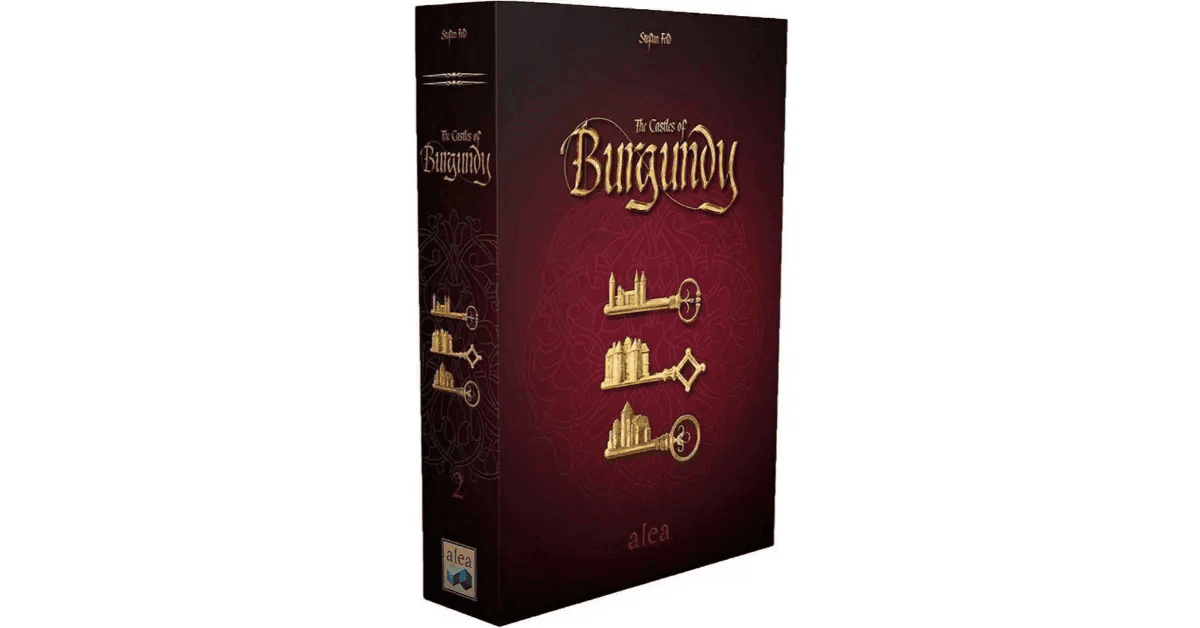
The Castles of Burgundy review
Awaken Realms / Alea | 1 – 4 players | 12+ | 70 – 120 minutes
The Castles of Burgundy: the most important game you can never describe with any enthusiasm at a party.
There is a certain kind of board game that resists recommendation. Not because it is bad, but because it is good in ways that sound terrible the moment you say them out loud. “You roll two dice and place hexagonal tiles on a personal estate board to score victory points through several overlapping mechanisms.” You can watch the light go out of someone’s eyes in real time.
And yet The Castles of Burgundy has sat in BoardGameGeek’s all-time top twenty for fourteen years, a quiet survivor alongside games with better art, bigger boxes and marketing budgets that could have funded a small medieval duchy.
Something is going on here. The question is what.
The premise
You are an aristocrat in medieval Burgundy. You are building an estate. You have dice. That is about all the theme you get, and I want to be honest about it so we can stop pretending and talk about what the game really is: one of the most elegantly constructed optimisation puzzles ever committed to cardboard.
Stefan Feld (a German secondary school head teacher who designs games the way a watchmaker builds movements, with a precision that makes you suspect he dreams in interlocking gears) made this in 2011. He has said that he designs the mechanisms first and only applies a theme afterwards, which in the case of Burgundy means the medieval decoration arrived after the hexagonal tile-laying system was already singing in four-part harmony. The castles are not the point. Burgundy is not the point. The point is the dice.
How it plays
Every turn you roll two dice. Each die gives you one action: take a tile from a numbered depot on the central board, place a tile from your storage on a matching numbered hex on your personal estate, sell goods, or take worker tokens. Workers let you adjust a die result by one in either direction, including, and this is crucial, wrapping a one round to a six. That last one is the kind of rule that separates newcomers from veterans as cleanly as a castle wall separates the lord from the mud.
Five phases. Five rounds per phase. Twenty-five rounds in total. The numbered depots are refilled with new tiles every phase, and finishing a region early scores more than finishing it late, which creates a quiet, constant pressure that hums beneath every decision like an idling engine.
The tiles themselves are where the depth hides. Six types, each with its own function: castles give free actions, ships improve your turn order and collect goods, mines generate silver income, animals score for herd size in connected pastures, buildings offer unique ongoing powers, and knowledge tiles, twenty-six of them, each one unique, do such a wide range of things that during your first game you pick them up one by one, squint, consult the rulebook and put them back with the expression of someone who has just been handed a menu in a language they studied for two terms at school and have since completely forgotten.
What it does (very) well
The dice. The dice are the whole trick, and the trick is brilliant.
In most games, dice decide whether you succeed or fail. In Burgundy, dice decide which options you have. You are always doing something useful. The question is whether the useful thing is also the necessary thing. This distinction sounds academic until you are sitting there with a five and a two, staring at the three-hex region you desperately need to complete before the phase ends, counting your workers, realising you have exactly enough to bridge the gap, and feeling the particular satisfaction of a plan coming together despite the universe’s sincere efforts to thwart you.
Feld uses randomness not as a punishment but as a frame, and that makes all the difference. Every turn the dice narrow the decision space just enough to prevent the analysis paralysis that would otherwise swallow a game with this many options, while leaving enough room for genuine tactical adjustment. It is a magic trick performed so smoothly that you forget someone is holding the cards.
The personal estate boards deserve praise too. Each player builds on their own board in parallel, which means you never have to wait for someone to move off the space you need.* You race for tiles in the central market and for the phase-completion bonuses, but the building itself is yours alone: a private cathedral of efficiency whose full shape only you can see.
The replayability is, frankly, ridiculous. Multiple board layouts, random tile distribution, twenty-six knowledge tiles of which only some appear each time, variable bonus points. People report fifty games without feeling the design running dry. This is a game built to last, and last it has.
What it does less well
The original 2011 edition looked like a tax form designed by someone who had once heard a description of medieval France but had never seen a picture of it.** The hexes were functional. The colours could be told apart. The art was present in the same way wallpaper is present: technically covering the wall, saying nothing. For years, the biggest barrier between this game and the audience it deserved was simply that it looked as though it would rather you did not play it.
The 2023 Special Edition from Awaken Realms largely fixed this by wrapping the same mechanical brilliance in art that finally looks as if it belongs on a table rather than in an accountant’s archive. But the original’s reputation lingers stubbornly.
The first game is also genuinely hard. Not because the rules are complex, because the core of each turn is elegant, but because the knowledge tiles need constant checking, the layers of scoring demand attention and the whole thing feels denser than it really is. It is the game that seems harder than it is, which is exactly the opposite of what you want when you are trying to persuade someone to sit down for ninety minutes with coloured hexagons.
And then there is the point salad question. Everything scores. Ships score. Animals score. Buildings score. Mines score. Leftover goods score. Leftover silver scores. Leftover workers score. Final scores cluster in a range where the winning margins can feel uncomfortably narrow, and some players walk away from a narrow defeat wondering whether any single decision actually mattered, or whether the points simply piled up like sediment until someone happened to have slightly more. This is not exactly a flaw; it is a consequence of the design philosophy. But it is the reason some people drop out of an otherwise impeccable game.
Who is it for?
If you love optimisation puzzles, the pleasure of getting maximum output from a limited system, you will find one of the finest examples ever designed here. With two players it hits the sweet spot: tight, brisk, done in under an hour once you know the tiles. Looking for the game that takes you from entry-level euros to the middle ground where the hobby really gets interesting? This is the bridge.
If you need games that make you feel something beyond the satisfaction of efficient resource conversion, Burgundy may leave you cold. It does not try to tell a story. It does not try to create drama. It offers you twenty-five rounds of increasingly finely tuned decisions and trusts that the pleasure of making them well is enough.
For most people, it is.
Our verdict
The Castles of Burgundy is a game designed by a man who understands that the deepest satisfaction in board games is not winning, but the feeling of having played well, of taking what the dice gave you and making something better of it than chance alone could account for. It has outlasted flashier games, prettier games, games with miniatures the size of small dogs. It will almost certainly outlast whatever is currently number one on BoardGameGeek. It is not exciting to describe. It is not beautiful to look at, or at least it was not until someone finally gave it the wardrobe it deserved. But in the way that matters most, it is very nearly perfect.
The quiet masterpiece that outlived everything that shouted louder.
* Which, depending on your point of view, is either the game’s great mercy or its great limitation.
** Shut Up & Sit Down memorably likened it to the offspring of a maths syllabus and hotel room art, which is both devastating and fair.