


Sleeping Gods review
13 oktober 2026
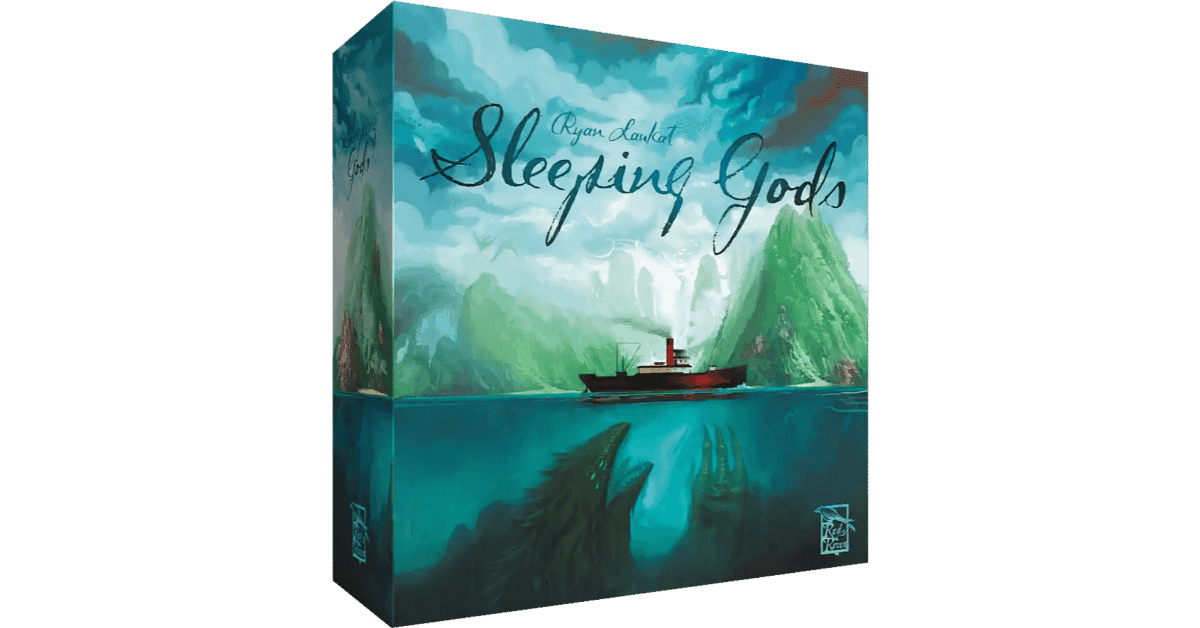
Sleeping Gods review
Red Raven Games | 1 to 4 players | 13+ | campaign of 10 to 20 hours
Think back for a moment to the school atlas of your childhood.
It is a book of maps. Maps have one particularly useful property: they tell you where you are in relation to everything around you, and that turns out to be exactly the kind of information that suddenly becomes extraordinarily important the moment you no longer have it. Historically, sailors have therefore placed a great deal of trust in maps. A sailor without a map is not, technically speaking, lost. He merely possesses an unexpectedly large amount of freedom and a rapidly dwindling supply of optimism.
Captain Sofi Odessa has a map. In Sleeping Gods the map is the game and the game is the map, and both turn out to be considerably bigger than they first appear.
The premise
It is 1929. The steamship Manticore, on its way to New York, is swept by an enormous storm into a sea that appears on no map at all. The stars are wrong. The coast is not a coast that ought to exist. And an old woman on the beach seems, for reasons that remain unclear for now, to have been expecting you.
The world you have ended up in is called the Wandering Sea. The gods of this world have fallen into a deep sleep. In their absence, the world has become unpredictable, in the way worlds tend to when nobody is minding the rules any more. The totems of these sleeping gods have been scattered across islands, archipelagos, coastlines and hidden depths of a place that, as far as anyone can tell, exists entirely on its own terms. Find the totems. Wake the gods. Hope they are in a good mood. Sail home.
That, roughly speaking, is the goal. What this summary fails to mention is that you will spend somewhere between ten and twenty hours chasing it, and that the chasing ultimately turns out to be considerably more interesting than the arriving.
The world and its atlas
Sleeping Gods is an atlas game. The atlas, twenty-six interconnected pages of illustrated maps, is the physical world. When your ship reaches the edge of a page, you turn to the number shown and sail on. The maps join up. The world carries on. If you are determined enough, you can sail all the way round it.
The illustrations are by Ryan Laukat, who also designed the game and co-wrote it with Malorie Laukat and Brenna Asplund. Laukat's style is instantly recognisable: rich in colour, slightly melancholy, full of faces that look as though they are thinking about something they would rather not tell you just yet. Every island has character. Every stretch of sea suggests its own weather. The world looks as though it was drawn first and the game was then carefully built around it, which may well be exactly what happened.
The storybook, a separate volume of almost novel-like length, contains the outcomes of every exploration. When your ship docks at a location circled in red and you decide to explore it, you look up the matching number, read it aloud and discover what that place has in store. It might be a choice. It might be a fight. It might be a stranger with a request, a ruin with a secret, or a merchant with unreasonably strong opinions on the current price of grain. Many of these encounters give you quest cards, which trail behind you like loose threads for the rest of your journey. Some will eventually come together in a conclusion. Others are left dangling. The world does not wait until you are ready.
What the storybook does with admirable dedication is remember. If you have already burnt a bridge, the storybook tells you that the bridge is gone. If you have already saved the child, the game knows that too. And if in a previous game you sided with the wrong party in a conflict, and you are now replaying the campaign in full knowledge of what that choice cost you, the storybook cannot get you out of it either. You made that decision, and it stands.
The turn and its structure
Each player turn consists of three steps, carried out with exactly the kind of clear structure that makes a complicated game navigable once you know it.
First comes a ship action. The Manticore has five rooms: Bridge, Galley, Deck, Quarters and Sick Bay. Each room offers different combinations of skill cards, command tokens and recovery. You must move your action pawn to a different room from the one it is in now, which creates a subtle but constant tension between what you need this turn and what you needed last turn. The ship itself can take damage in combat or from events, and a fully damaged room cannot be used again until it has been repaired. The ship is not just transport. It is a resource, a responsibility and, now and then, simply a problem.
Then comes an event. You draw and read an event card. Events come in three intensities: mild, dangerous and deadly, and the make-up of the deck gradually shifts towards the more dangerous end of the spectrum. An event might give you a choice, set you a challenge, grant you resources, or simply show that the Wandering Sea has not forgotten you are there.
After that you get two actions. You can move the ship to a new region of the atlas, explore a location in your current region, visit a market to buy equipment, rest in a port to heal and spend experience, or skip an action entirely to gain a command token. You may choose the same action twice. The game will not stop you from spending a whole turn stocking up on grain and having the carpenter's knee looked at, although it might well have an opinion about your priorities.
The crew and how to manage it
Eight crew members are divided among the players, each with their own skills, health values and weapons. Everyone also shares Captain Sofi Odessa, who may be used by whoever holds the captain token at that moment. Each crew card shows five skills: Craft, Cunning, Savvy, Perception and Strength, plus a built-in weapon. Give them ability cards to expand what they can do. Keep a close eye on their health and fatigue, because a crew member with two fatigue tokens can no longer take part in challenges, and a crew member on zero health is a problem for everyone.
Command tokens, blue wooden hexagons gathered through ship actions and spent during the turn, are the soft connective tissue of the whole system. You use them to equip cards, activate crew abilities, trigger the effects of adventure cards and, in combat, to cross the line between one player's turn and another's. The command system stops the game from falling apart into four separate solo experiences. It creates small moments of involvement in what other players are doing, because spending a command token in someone else's fight genuinely costs you something.
Combat without dice
Sleeping Gods uses a diceless combat system that truly deserves the attention it gets. When your crew fights, you draw from the fate deck, a small shuffled deck of numbered cards, instead of rolling dice. This produces results between one and five, with accuracy bonuses from weapons adjusting the result against the enemy's defence value. You hit, or you miss. If you hit, you deal damage. If the enemy survives your attack, it strikes back.
The difference from dice is not just aesthetic. The fate deck runs out and refreshes in a way dice never do, which means a long run of bad results carries the implicit promise that better ones are on their way, and a long run of good results works as a quiet warning. You also draw fate first and only then apply modifiers, which means the decision to spend a resource to improve a result is made in full knowledge of what that result already was. That is a small mercy dice have never offered.
Enemy cards are laid out in a row, each with health segments that are covered as damage is dealt. Some enemies attack at the end of every round, whether or not they were targeted. Others have abilities that trigger at certain health thresholds. Some have the keyword flying, which gives a penalty to accuracy for non-ranged weapons, and some are simply much tougher than your current crew can comfortably handle, which is information you sometimes only discover after the fight has already begun.
Campaign, saving and the long game
A full campaign of Sleeping Gods takes ten to twenty hours, spread over several sessions. The save system consists of a journey log, a sheet on which you note the ship's position, current health and resources, active quests and the cards you hold. The included campaign box keeps everything specific to a session saved halfway through neatly in one place. Setting up again when you want to continue takes perhaps ten minutes, which for a game of this size can fairly be called a small miracle of organisational thoughtfulness.
Players can join or drop out between sessions. The division of characters simply adjusts. The world does not demand constant attendance, and for a cooperative campaign game that can stretch over weeks, that is a quiet but essential plus. The game has a normal and a brutal difficulty level. On normal, a defeat, whether it comes from crew health or ship damage, leads to a setback and a move to the nearest port, not to a campaign that collapses for good. Brutal mode removes that forgiveness completely, presumably intended for people who feel the Wandering Sea has not yet been unkind enough to them.
Alongside the main goal of finding totems, the game contains hundreds of quests, each with several outcomes. The quest you did not finish lingers somewhere in the deck of loose threads. The totem you decided not to make a detour for three sessions ago may still be within reach, or it may not. The world holds more content than a single campaign will ever bring to the surface, which means a second playthrough, enriched by everything you missed the first time, feels meaningfully different from the first.
An expansion, Tides of Ruin, adds a second atlas, a second storybook, new enemies, new adventure cards and even more content to stretch the world further. A standalone successor, Distant Skies, uses the same engine in a new setting.
The verdict
Sleeping Gods is not a light game. The rulebook is substantial, and although the included quick-start scenario does an excellent job of introducing the mechanics through the story, it is genuinely advisable to read the full rules before the first session. There is terminology to learn, and that terminology matters because it links specific game situations to specific rules. Players who arrive expecting a breezy story game and instead find a system of interlocking resource management, crew health, ship condition, command economy and quest threads may need a session to find their feet.
What they find after that is a game that puts its mechanisms to work in service of its world rather than against it. The five-room structure of the ship actions is not there to add extra complexity. It is there because the Manticore is a ship with rooms, and those rooms need maintenance and attention. The fate deck is not there to be different from dice. It is there because chance with a memory is more interesting than chance without one. The quest threads are not there to overwhelm you. They are there because the Wandering Sea is full of things that were already under way before you arrived and that carry on whether you pay attention to them or not.
The game needs a considerable amount of table space. Use a big table.
Our final verdict
There is an old woman on the beach who was expecting Captain Odessa and her crew. She does not explain how she knew. The Wandering Sea is full of things that prefer not to explain themselves. The gods are sleeping. The totems are scattered. The atlas has twenty-six pages and the storybook contains considerably more passages than any single campaign will ever visit.
Sleeping Gods is a game about existing in a world that is bigger than your ability to take it all in within the time you have, and that is, if you think about it for a moment, a fairly accurate description of most journeys that are truly worth making. The mechanics carry the story. The story justifies the mechanics. The atlas joins up at every edge.
Try sailing east. See what is there.
For fans of: Tainted Grail, Earthborne Rangers, The 7th Continent, Near and Far. Essential for anyone who wants a cooperative campaign that feels truly oceanic in scale, a game that rewards patience, lateral thinking and the willingness to follow a quest into waters you have not yet charted.