


Slay the Spire: The Board Game review
13 oktober 2026
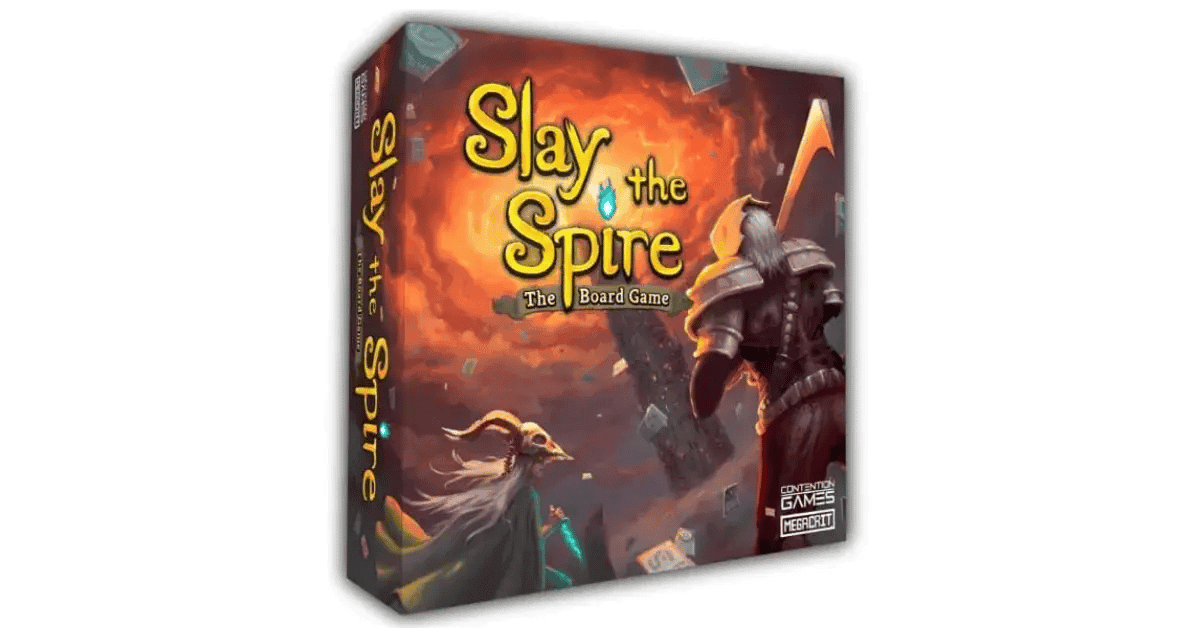
Slay the Spire: The Board Game review
Contention Games | 1 to 4 players | 12+ | 60 to 150 minutes per Act
In Slay the Spire, death is not a setback. It is the curriculum.
You die. You lose everything: the carefully built deck, the relics you gathered over two Acts, the synergies that were finally starting to come together into something that looked suspiciously like beauty. All gone. You start again at the bottom of Act 1 with the same ten starting cards you always had, facing the same first corridor full of enemies, carrying nothing but the knowledge of what went wrong. Come to think of it, that is a remarkably efficient model of education. The Spire is not interested in your progress. It wants to know whether you have learnt anything.
The board game version of that philosophy comes from Contention Games, designed by Gary Dworetsky together with Anthony Giovannetti and Casey Yano, the creators of the original video game. It raised almost four million dollars on Kickstarter, which suggests that a good number of people who had already spent a lot of time following the Spire's curriculum were willing to pay to do it all again in a form that requires a table and other people.
That instinct turns out, in the end, to be entirely justified.
The source material
Slay the Spire is a roguelike deck-building video game released by MegaCrit in 2019, and it has since grown into one of the most influential pieces of game design of the past decade. The premise is simple in form and almost endless in practice: follow a branching path up a tower full of procedurally generated rooms, fight monsters, collect cards, claim relics, spend gold in shops, and slowly forge a deck that turns those original ten cards into something capable of defeating whatever waits at the top. When you die, everything resets. The lessons remain. The cards do not.
What made the video game so special was not any single mechanic but the layered interplay between them: the way a relic from Act 1 could turn a seemingly weak card into the engine of an entire strategy, the way a well-timed card removal cleared dead weight from your deck and suddenly brought its purpose into focus, the way the branching map kept asking you to make small choices whose consequences only became clear a few rooms later. The game earned its reputation. So the board game had a lot to live up to.
The set-up
Each player chooses one of four characters, each with their own starting deck and a pool of more than eighty unique cards to draw on during a run. The Ironclad relies on strength and on self-harm as a resource, spending his own health in ways that make onlookers slightly nervous. The Silent piles up poison and huge hands of cards, building status effects that quietly accumulate until enemies simply vanish. The Defect manages a collection of Orbs, constructs of elemental energy that circle around him and fire automatically, passive participants in a meticulously orchestrated economy. The Watcher switches between stances, gliding between Calm and Wrath, and unleashes enormous bursts of power at the cost of considerable vulnerability.
These are the original four characters from the video game, faithfully translated. Each has its own feel and its own learning curve. Experienced players will have opinions about who they want to play. New players will probably start with the Ironclad, because the Ironclad comes closest to what people roughly expect a fantasy warrior to do.
The board itself represents the route through the Spire: a branching map of room tiles, partly fixed and mostly laid out at random during set-up by shuffling light and dark tiles that show what kind of encounter to expect. Light tiles offer rest sites and shops. Dark tiles bring monsters and elite fights. The board does not tell you which specific monsters you will meet, only whether a room is likely to be helpful or dangerous, which is roughly as much information as anyone has ever had about what lies around the corner.
A run
A run through the Spire unfolds room by room, encounter by encounter. Combat is the beating heart of the game. Enemies openly reveal their intentions: each enemy card shows what it will do next turn, whether that is an attack with an exact number, a status effect, building block or working up to something worse, and all of that information is right there on the table. The challenge is not that you do not know what is coming. The challenge is that you need a hand that can offer a sensible reply.
Each turn, players draw five cards and have three energy to spend. Most cards cost one energy, the stronger ones two or three, and every now and then there is one of those blessed cards that costs nothing at all. You play what you can afford, in whatever order seems sensible, trying to deal damage, build block to absorb incoming blows and apply exactly the status effects your deck is built around. Then the enemies attack. Then you draw five cards again.
The board game's cooperative layer adds something the video game never had: the chance to help each other. Players can attack enemies that are threatening a struggling teammate. New card effects grant block and healing that can cross the table. Because the players choose the turn order themselves, the group decides who acts when, so that block is in place before damage arrives, or a poisoned enemy dies before the player with the lowest health has to take another hit. Two or three players at the table produce a very particular kind of conversation, tactical, slightly hurried and occasionally contradictory, that the solo mode cannot offer and that ordinary cooperative games rarely manage with this much precision.
Between fights, the map offers choices. Rest sites let you heal or upgrade a card. You upgrade a card by flipping it round in its sleeve so the improved version on the other side shows, an elegant physical translation of a digital system. Shops let you spend the coins you earned in combat on new cards, potions for immediate use, or relics that change the rules of the game for the rest of the run. You can also remove cards there, for a fee, and just as in the video game, that often turns out to be the most valuable purchase on the shelf.
Relics
Relics deserve a paragraph of their own, because relics are where Slay the Spire lives.
Each relic is a permanent passive effect that applies from the moment you get it until the moment you die. Some are simple: one extra energy per turn, a little healing at the start of each fight. Others bend the rules in ways that seem slightly absurd at first and, on closer inspection, turn out to be the whole point of the run. A relic that makes the first card you play each turn cost nothing is interesting enough on its own, and becomes transformative once you have built a deck around playing as many cards as possible in a single turn. A relic that deals bonus damage every time you draw a card seems fairly harmless until you find a card that lets you draw three cards, each of which summons two more, and suddenly the numbers on the enemy's health bar drop faster than could ever have been politely intended.
The board game contains seventy-eight relics. They will not all appear in a single run. That is the engine of its replay value: the exact combination of cards, relics and map layout that a run produces is extremely unlikely ever to appear in quite the same way again, and the question of whether this particular combination is better off turning left or right on the map, towards the elite fight and the better rewards, or towards the shop and the chance to cut the dead weight from your deck, shifts with everything already on the table.
The Ascension system
For players who survive the Spire and would like to do so even more impressively, there is the Ascension system, taken straight from the video game. Each Ascension level adds another handicap: more enemy health, less healing at rest sites, extra hazards, enemies that hit harder. Ascension 13 is the ceiling, and it is not a welcoming place. Dedicated players unlock specific Ascension cards that are only available at higher levels, building a ladder of mastery that reaches far beyond the point where a beginner should be anywhere near such things.
The verdict
Slay the Spire: The Board Game can rightly claim to be the most faithful video game adaptation ever to appear in physical form, which is a very particular kind of achievement, because a faithful adaptation and a good board game are by no means always the same thing. The maths of the original has been scaled back (the video game easily runs into the hundreds, while the board game sensibly stays in smaller numbers), the cooperative mechanics have genuinely been designed rather than hastily bolted on, and the physical solutions to the original's design problems, the double-sided sleeves for upgrades, the branching tile map for procedural variety, the colour-coded rarity system, are consistently elegant.
What the game does not do is hide the complexity that the video game handled for you automatically. Status effects have to be tracked. Orb slots need attention. The interaction between a relic you found two rooms ago and a card you have just drawn is not always immediately obvious and will often call for a discussion around the table. First games take a long time. The rulebook is clear enough, but there is a lot of card text across the four characters, and new players will spend their first Act reading more than playing.
What it does do, once you have mastered it, is capture exactly the feeling that makes the video game so irresistible: the slowly growing conviction, somewhere in the middle of Act 2, that this particular combination of cards and relics is finally, very tentatively, starting to work, followed by that very particular kind of grief in Act 3, when it turns out that it worked until it no longer did, and that the lessons have already been neatly filed away for the next attempt.
With two or three players, this is the best cooperative deck-builder you can get right now. Solo, it is an extremely precise physical translation of something that is also available digitally for a fraction of the price, and that comparison has to be made honestly. The group that will get the most out of this game is the one that already loves the video game and wants to share that experience. The game was made for them, and it shows.
Our final verdict
The Spire does not care about you. It does not reward loyalty, does not punish haste on principle and certainly offers no advice. It simply stands there, generating its encounters, handing out its relics and waiting to see whether the deck you have built is good enough for the floor you happen to be on.
Usually it is not, the first few times. Eventually it is. Eventually you start to understand which rooms to seek out and which to avoid, which card removals are worth the gold and which were mostly vanity, when a deck is lean enough to trust and when it is still carrying too many passengers. That understanding cannot simply be handed over or explained. It has to be scraped together card by card from the rubble of earlier attempts.
That Slay the Spire: The Board Game manages to evoke exactly the same feeling, at a table, with other people, with cardboard and plastic: that is the achievement. And it is not a small one.
For fans of: the video game, of course, but also Aeon’s End, Dominion and any cooperative game that rewards the very particular pleasure of a perfectly timed synergy landing at exactly the right moment. Note: for solo players on a tight budget, the digital version remains the more accessible way in.