


Battle of Hoth review
13 oktober 2026
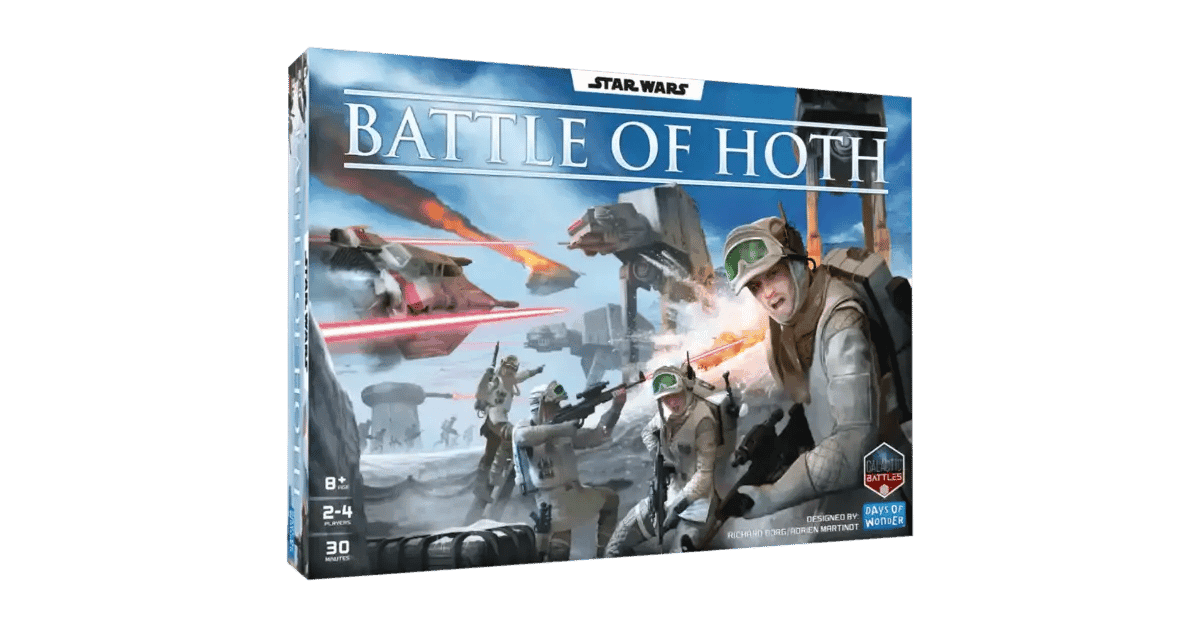
STAR WARS: Battle of Hoth review
Days of Wonder | 2 to 4 players | 8+ | 30 minutes
There is a particular kind of memory that belongs to seven-year-olds who watch a film they are really just a little too young for, in a room that is just a little too dark, at an hour that is just a little too late in the evening. The kind of memory that does not so much fade as calcify, becoming permanent and load-bearing, a fixed part of the architecture of who you are. One of this game's co-designers, Adrien Martinot, has been remarkably open about this. He saw The Empire Strikes Back when he was seven, and by his own account the Battle of Hoth made a lasting impression. He has apparently spent the decades since working towards this moment.
The result is a miniatures battle game, built on Richard Borg's venerable Commands & Colors system, dressed in a Star Wars outfit that has been put on with visible enthusiasm, and it delivers exactly what the seven-year-old in most people would want: snowspeeders, AT-ATs, an ice planet, and the very specific pleasure of watching giant walking tanks cross a hexagonal battlefield towards a Rebel base that is probably not going to hold.
The setting
The Battle of Hoth, for anyone whose cultural memory skipped a chapter, is the opening sequence of The Empire Strikes Back from 1980. The Galactic Empire has found the hidden Rebel base on the frozen planet Hoth. It has sent AT-ATs, short for All Terrain Armored Transports, which essentially amount to four-legged metal fortresses the size of small buildings, to destroy that base. The Rebels, who own nothing that could even remotely sensibly be set against them, have sent snowspeeders into the air and placed their troops in trenches, hoping to buy enough time to evacuate Echo Base before everything goes very thoroughly wrong.
History, or rather cinema, tells us that this is exactly what happens. The question the game asks is: what if you had been in charge?
What is in the box
The box contains seventy-four miniatures: three AT-ATs, nine snowspeeders, thirty-two snowtroopers, twenty-four Echo Base troopers, four Imperial probe droids and two pieces of Rebel artillery. They come in two colours, dark grey for the Empire and light grey for the Rebels, and are detailed enough to satisfy without demanding the devoted attention of an afternoon's painting. The game is emphatically family-friendly, and the components reflect that. Everything is sturdy, clear and designed to be on the table and in play within minutes.
There is also a double-sided board, a scenario book with fourteen battles of increasing complexity, four campaign booklets, fifty command cards neatly divided between the two factions, ten additional support cards, six attack dice, and nineteen double-sided terrain tiles representing the various features of Hoth's surface: ridges, rocks, seracs, trenches, crevasses and the structural objectives of the shield generators.
How it plays
At the heart of Battle of Hoth is Borg's Commands & Colors system, which has already been applied successfully to Napoleonic battles, Roman warfare, the ancient world, medieval combat and now, with suitable adjustments, the ice planet Hoth. Its construction is clear, and years of use and refinement have pared it down to a lovely simplicity. Each player has a hand of command cards. On your turn you play one, activate the units the card allows, move them, attack with them and draw a replacement card. The first player to collect the required number of victory medals, usually four or five, earned by eliminating enemy units or capturing objectives, wins.
The hand of command cards is the central tension of the game. Section cards activate units on the left flank, in the centre or on the right flank of the hexagonal battlefield, in the numbers shown on the card. If the card says you may order three units in the centre and you have no units there, those orders simply vanish into the void. Tactic cards offer more flexible options: special moves, extra attacks, specific powers that belong to the Star Wars setting. You play what you have. And you make it work.
That produces a pleasant fog-of-war feeling without any actual fog anywhere. Both sides see everything. The uncertainty is not on the board but in the hand. Your opponent knows where your snowspeeders are, but not whether you also have the card to activate them, or whether you have been sitting on a tactic card for three turns, waiting for exactly this position.
The units and their rules
Each unit type has its own movement and attack profile, and the differences feel fitting rather than arbitrary.
AT-ATs move exactly one hex per turn and cannot end up on ridges. They ignore all retreats, because a twenty-metre-tall walking battle station simply does not retreat from a Rebel trooper's blaster fire, whatever the dice may think about it, and they benefit from no terrain protection at all, because nothing on Hoth was ever designed to give them cover. Nor are they destroyed simply by reaching a standard damage threshold, but through a confirmation roll: every hit result must be rolled again, and only an explosion symbol on that second roll destroys them. That is elegant. It means AT-ATs really do feel like AT-ATs: slow, unstoppable, formidable, and yet occasionally, improbably enough, brought down by a well-timed cable around their legs.
Snowspeeders move up to three hexes and can cross crevasses, which ground units cannot. They attack at range and are only hit by vehicle symbols or explosions, which makes infantry only moderately effective against them. Echo Base troopers and snowtroopers behave like standard infantry units: move one hex and attack, or move two hexes without attacking. Rebel artillery cannot move at all, but is immune to retreats and has a frightening number of attack dice, provided it has a clear line of sight and is not immediately overrun.
Imperial probe droids and Rebel artillery are special units: eliminating them earns no victory medals, a detail that punishes players who pour too many resources into targets that do not move the score forward.
Special troops and leaders
Besides the standard units, scenarios can assign special unit badges that modify certain groups. Elite snowspeeder squadrons start with four miniatures instead of three. Assault infantry can break through after a successful close combat. E-Web heavy blasters may reroll attack dice as long as they do not move. Scout units on ridges give allies an extra attack die against enemies in their line of sight. Elite infantry can move two hexes and still attack, getting round the usual trade-off.
Leader cards, Darth Vader, General Veers and Admiral Piett for the Empire, Leia Organa, Luke Skywalker and Han Solo for the Rebels, are an optional addition and each add three tactic cards to a player's command deck. They are strictly supplementary and do not have to be used in every scenario, but they bring a layer of thematic flavour that is hard to resist. Having Luke Skywalker on the battlefield leads to different outcomes than having Leia, which in turn has different consequences than Han Solo, who one suspects is mainly taking part because the odds against him were sufficiently entertaining.
The scenarios and campaigns
The scenario book contains fourteen battles, starting with a simple skirmish around a probe droid and building up to snowspeeder counter-attacks, assaults on shield generators, missions to secure data and evacuation operations with wounded officers who literally have to be carried off the battlefield. Several scenarios feature sudden death conditions: the Empire wins immediately if both shield generators are destroyed; the Rebels win immediately if an officer reaches the evacuation space. These are not gimmicks. They create games that can tip abruptly on a single dice roll, in a way that feels entirely in keeping with both the setting and the underlying tension of the system.
The four campaign booklets bring a longer storyline across consecutive scenarios. Victories and defeats have consequences for later battles, for example in the form of adjusted starting hands or different set-ups. The campaigns give players who have played through the individual scenarios a clear reason to come back, and offer the feeling of an ongoing conflict rather than a series of separate skirmishes.
Team play
A team variant supports three or four players, with the command deck split between two players per side and the turn order alternating within each team. Command cards may not be shared with each other. Each player draws and plays from their own part of the deck. Players may, however, discuss their strategy openly, which according to the rules must be done out loud so that the other team can listen in. That detail is somewhat ruthless and entirely right. It produces exactly the kind of discussion, blame and second-guessing that joint military planning has historically been known for.
The verdict
Battle of Hoth is not a deep game. With thirty minutes per scenario and a recommended age of eight, it does not try to be. The Commands & Colors system was always designed to be quick to learn, quick to play and quietly difficult to master. The simplicity of the structure hides real tactical depth in hand management, positioning and the ability to read the board two turns ahead while your opponent cannot yet see what you are planning.
What this version adds is a licence that earns its place. The asymmetry between the factions is not merely cosmetic: the Empire and the Rebels play differently because their on-screen counterparts did too, and the game captures that through unit rules that are mechanics and characterisation at the same time. An AT-AT that ignores retreats and needs a confirmation roll to be destroyed does the work of a game rule and of science fiction storytelling at once.
The miniatures are excellent for a game in this price range and age group. The campaign mode noticeably extends its lifespan. The scenarios build up at a pace that stays accessible to new players without becoming dull for anyone who has played a Commands & Colors game before. Set-up takes about five minutes, thanks to the clearly illustrated maps in the scenario book.
Our final verdict
There is a small, dark room, and a child watching a battle they cannot take their eyes off. Steel walkers in the snow. Snowspeeders with tow cables. A base that has to hold out long enough for the ships to get away.
Battle of Hoth does not ask you to have ever been that child. It is generous enough to work without nostalgia too. The Commands & Colors system is solid enough to stand on its own feet, the asymmetry is well thought out enough to reward experience, and the thirty-minute playing time is honest enough to actually be true.
But if you did sit in that room? Then the AT-ATs on this table will be exactly the right size.
For fans of: Memoir ’44, BattleLore, Command & Colors: Ancients, or for anyone who spent part of their childhood on an ice planet they did not choose.