


Root: A Game of Woodland Might & Right review
13 oktober 2026
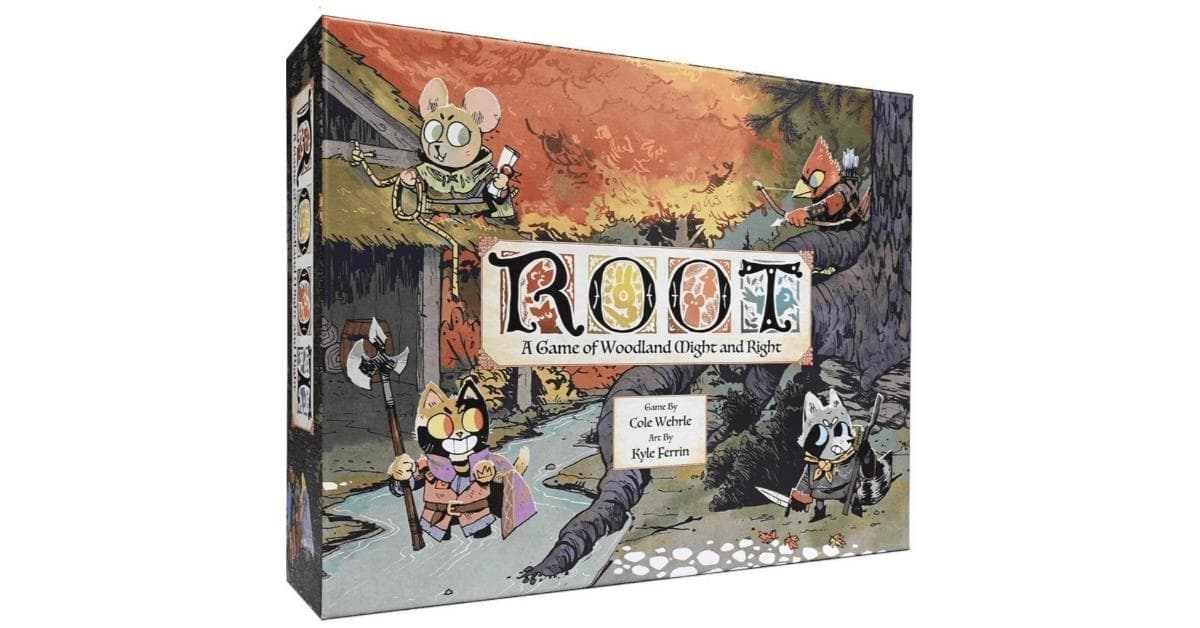
Root: A Game of Woodland Might & Right review
Leder Games | 2 to 4 players | 10+ | 60 – 90 minutes
There is a forest. In this forest live cats, birds, mice, foxes and a suspicious-looking raccoon with a sword. They are at war. Not a polite, chess-like war of manoeuvres and counter-moves, but the ugly kind, the kind where supply lines matter more than heroism, where a popular uprising can undo months of carefully built empire, and where the raccoon has nicked your crossbow while you were busy arguing with the birds.
Root asks you to accept two things. First, that woodland creatures make excellent stand-ins for the messy reality of colonial occupation, rebellion and political decay. Second, that you and your friends are each playing a fundamentally different game at the same table, with different rules, different goals, and the occasional exchange of glances across a clearing full of smouldering cat workshops while someone mutters: “I did not know the birds could do that.”
They can. Absolutely. Right up until they cannot, and then everything comes crashing down spectacularly. That is more or less the point.
How it really works
Cole Wehrle, who designed Root while doing a PhD on British imperialism (which, in hindsight, explains a lot), built the game around four factions so different that they might as well have come out of separate boxes.
The Marquise de Cat occupies almost the entire board from turn one. She builds sawmills that produce wood, which she uses to put up more buildings. An industrial engine, and like all industrial engines it runs beautifully until someone sets fire to one of the factories. The Eyrie Dynasties are fallen bird aristocrats who reclaim their territory through an ever-growing Decree: a programmed series of mandatory actions that makes them frighteningly efficient, right up to the moment it makes them frighteningly incompetent. The Woodland Alliance starts with nothing. No warriors, no buildings, just righteous anger and a stack of sympathy tokens that work as both propaganda and tripwire. And the Vagabond roams the map alone, completing quests, rummaging through ruins and befriending everyone until the exact moment friendship stops paying off.
Every turn has three phases. You play cards, move pieces, fight. Battles use two dice; the attacker takes the higher, the defender the lower, which keeps combat quick and slightly cruel.¹ The first player to 30 points wins. Or you throw the points race overboard, play a Dominance Card and try to hold territory instead, which is the board game equivalent of flipping the table, only within the rules.
The factions affect each other constantly, parasitically, beautifully. The Alliance taxes movement through sympathetic clearings. The Vagabond trades items for goodwill. The Cats are stretched too thin trying to hold on to everything. The Birds crash, burn and rise again. Every decision ripples outwards. You cannot play Root in isolation. The game simply will not let you.
¹ There is a special kind of despair, reserved for the moment you roll a zero as the attacker against a single defending mouse. The mouse knows. You can see it in those tiny, ink-drawn eyes.
What it does well
Root's asymmetry is real. Not the cosmetic kind where each faction gets a slightly different bonus; this is structural, architectural, load-bearing asymmetry. The Cats play a logistics game. The Birds play a programming puzzle. The Alliance plays an insurgency simulator. The Vagabond plays an RPG. They share a board, a deck of cards and a combat system. That is where the similarity ends.
Which means Root creates stories. Not scripted narratives, but the spontaneous kind, the kind that starts with “remember when the otters sold mercenaries to both sides and then declared war on everyone?” Kyle Ferrin's gorgeous, hand-drawn illustrations sell the trick completely. His creatures are charming enough for a nursery wall and fierce enough to make you believe they really would go to war over a clearing full of mushrooms. The art did not win a Golden Geek for nothing.
The game also does something quietly brilliant with the balance of power. The Marquise looks dominant at the start; she occupies the whole map. Experienced players know she is actually vulnerable, stretched too thin, dependent on a supply chain, one well-timed uprising away from disaster. The Alliance looks weak. Experienced players know it is a ticking time bomb. Root rewards reading the table, negotiation and a willingness to point at the leader and ask: “Are we all just going to let this happen?” The answer, historically, is yes. Until it is too late. Then panic. Then blame. Then someone suggests another game and everyone immediately says yes, which is the highest compliment a board game can receive.
What we liked less
Teaching Root is an ordeal. There is no kind way to put this. Four factions means four sets of rules, four player boards full of iconography, four completely separate strategic frameworks. The rulebook recommends a “learning game”, and it is not being modest about it. Your first game will be messy, lopsided and roughly twice as long as the box suggests. Someone will accidentally let the birds score fifteen points unopposed, because they did not understand how the Decree worked. That someone might be you.
The Vagabond remains a talking point, even after years of discussion in the community. He often plays around the other factions, takes less part in the fight over territory and can sometimes win while everyone else feels they were the ones actually playing the real game. With two players, the base game does not always work that well. Leder Games later improved this with expansions, bots and the Hirelings mechanism, but that did take several years and several boxes.
Root also asks for multiple sessions. Not in the way a good puzzle invites you back, but in the way a language demands immersion before you become fluent. Your fifth game of Root is a categorically different experience from your first, and the game only really shows its hand around game three or four. That is a big ask, especially if your group switches games regularly.
Who is it for?
Root wants a regular group. Four players, ideally, who commit to learning together over several sessions and develop the table instincts that stop one faction from running away with it unchecked. It rewards players who get as much enjoyment from reading their opponents and the state of the board as from reading their cards. If your favourite gaming moments revolve around negotiation, betrayal or the slowly dawning realisation that you have been outplayed by someone who looked like they were losing: Root has been waiting for you.
If you like your strategy games symmetrical, if you hate explanation-heavy first sessions, or if your game nights are tied to a strict ninety minutes, then this is not your forest. Root is not going to apologise for that. It has a war to fight.
Solo players and couples can lean on the Clockwork Expansions, which provide capable automated opponents, although the experience is a narrower path than the sprawling chaos of a full table. The digital version from Dire Wolf is excellent for learning; its tutorials do in forty minutes what the rulebook does in an evening.
Our final verdict
Root is a game about power: who has it, who wants it, and who is quietly hoarding sympathy tokens while the powerful are not paying attention. It is a war game that looks like a picture book and plays like a political thriller. The learning curve is steep and honest; it does not pretend to be simpler than it is, and that in itself is a form of respect.
Wehrle designed it from the conviction that games should be engaging rather than merely fun, and Root is engaging in the way a good argument is engaging: you come out of it seeing the other side a little more clearly, even if you lost without a chance and the raccoon stole your last hammer.
Never has starting a civil war been so much fun.