


Spirit Island review
13 oktober 2026
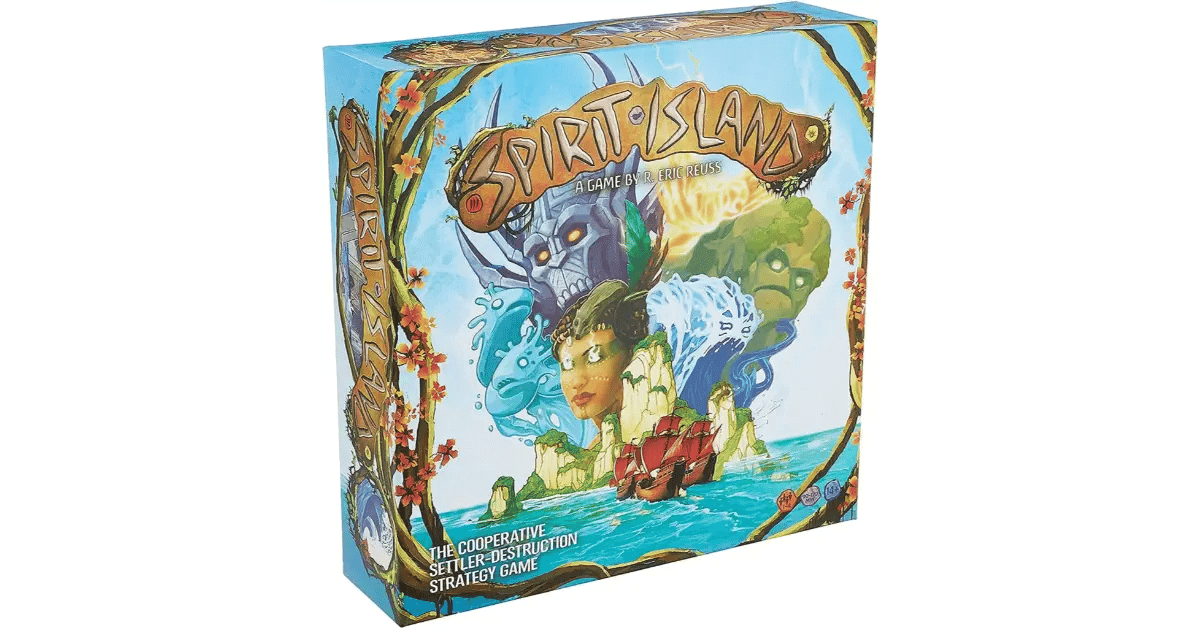
Spirit Island review
Greater Than Games | 1 to 4 players | 13+ | 90 to 120 minutes
Most games about colonisation put you on the ships.
You arrive on the coast with your settlers and your ambitions, you clear land and build villages, you push further inland and deal with whatever you find there. The native population is at best an obstacle, at worst a resource. The land is a canvas. Progress is the goal. Such games are not rare. They make up a sizeable genre, and most of them are perfectly enjoyable in that very specific way in which it is enjoyable to slide wooden tokens across a map in pursuit of efficiency, without anyone at the table having to think very carefully about what those tokens actually represent.
Spirit Island, designed by R. Eric Reuss and published by Greater Than Games, is a game that noticed that tradition and decided to take the opposite side.
You are not on the ships.
You are the island.
The premise
Somewhere in the world, in an alternate history in which the age of exploration followed its historical course but this particular island remained inhabited by ancient elemental spirits, settlers have arrived. They are called the Invaders. They are represented by white plastic pieces, a deliberate design choice, the rulebook notes, to emphasise that light colours do not always mean the good guys. They arrive as Explorers, small and individually fairly harmless. They build Towns. Towns become Cities. Wherever they go, they bring Blight with them, the creeping degradation of land that has been cleared, cultivated, built on and stripped bare, and where Blight piles up, the island grows weaker and the spirits grow ever more desperate.
You play those spirits. Each player controls one, and each spirit is different in ways that matter deeply.
The spirits
The base game contains eight spirits. Simply listing them is not enough. They need to be described.
Vital Strength of the Earth is old and slow and unyielding. It spreads its presence steadily, defends the land with enormous strength and becomes almost impervious to damage in the late game. It is a spirit that demands patience and repays patience tenfold.
Lightning’s Swift Strike is the opposite: fast, aggressive, able to generate a lot of energy in a short time, and able to strike before the invaders get the chance to act. It punishes concentrated enemy presence and rewards decisive action.
River Surges in Sunlight commands water and the Dahan, the island's native human inhabitants, who fight back against the invaders and whom this spirit directs with particular skill. It is a mid-range spirit, not as slow as Earth and not as immediate as Lightning, excellent at preventing blight and at moving people to where they can make the most difference.
Shadows Flicker Like Flame is a spirit of stealth and terror, at work in places where the Invaders cannot quite predict what is happening, stirring up fear rather than dealing direct damage, operating through the minds of mortals rather than against their bodies.
Bringer of Dreams and Nightmares can never cause direct damage. Everything it does is psychological. Even the pillar of flame it might summon is an illusion, meant to provoke terror rather than wreak destruction. It is one of the most interesting spirits in the box to play, and one of the hardest, because removing Invaders here has to happen through the fear system rather than through direct attacks, and that calls for a fundamentally different relationship with the game's time pressure.
Thunderspeaker moves among the Dahan like a general, commanding them and travelling with them, converting Invaders to the native way of life through a power called Call of the Dahan Way, and sending explorers fleeing in panic with Delusions of Danger.
This is where the game's ambition is most clearly visible: the mechanics are the theme. Every card does what its name says, in ways that extend the metaphor rather than merely decorating it. When you play Thunderspeaker, you do not fight the Invaders with war. You work through the people who were already there. When you play Bringer of Dreams and Nightmares, you win through terror and psychological disruption. When you play Vital Strength of the Earth, you are the geology itself, which was there long before the ships arrived and intends to still be there long afterwards.
How a turn works
Each round runs in two broad phases. In the Spirit Phase, every player simultaneously chooses which power cards to play, pays their energy costs, and then decides, crucially, whether each power is used in the Fast Power Phase, before the Invaders act, or in the Slow Power Phase, after they have acted. That choice is the central tension of the game at turn-by-turn level. A fast power used to destroy invaders before they ravage a land prevents the blight that would otherwise be added. A slow power with the same damage value, used after they have rampaged, cannot remove the blight from the land, cannot bring back the Dahan who died in the attack, and cannot undo what has already happened. Timing matters in Spirit Island at the granular level of the turn, not just at the macro level of the whole game.
The Invader Phase follows a three-step sequence that rotates through the Invader deck. Invaders Ravage in lands matching the current Ravage card, dealing damage to the land and the Dahan, adding blight wherever two or more damage is dealt, and letting that blight cascade into adjacent lands if there is already blight there, which can set off domino effects of island-wide devastation. They Build in lands matching the Build card, with Explorers becoming Towns and Towns becoming Cities. They Explore lands matching the newly revealed Explore card, sowing the threat for the next round. The Invader deck is set up so that, by looking at the board, you always know which lands will be ravaged this turn and where new exploration will take place. The semi-predictable nature of the invasion is what makes planning possible, and planning is above all what Spirit Island asks of you.
At the end of the Invader Phase, the fear built up by destroying Towns and Cities and by certain spirit powers is compared with the Fear Pool. When enough fear has been generated, a Fear Card is triggered and the Terror Level rises. That is the game's escalating victory condition. At Terror Level 1 you must remove every Invader from the island to win. At Terror Level 2 only buildings still count: destroy all Towns and Cities. At Terror Level 3 only Cities are still relevant. If you generate enough fear to push the Terror Level past 3, you win immediately, regardless of what is still on the board. The invaders have then simply become frightened enough to leave.
The Dahan
The Dahan deserve a section of their own, because they are one of the most distinctive parts of the game.
The island already had people when the ships arrived. The Dahan are those people, represented by wooden pieces on the board, and they are neither passive bystanders nor tools of the player. They exist independently, fight back against Invaders when attacked in the Ravage phase, each Dahan dealing two damage and taking two damage, and can be moved, helped, directed and protected by various spirit powers. Some spirits build their entire strategy around the Dahan. Other spirits barely interact with them directly. All spirits have to take them into account, because Dahan who die in Invader attacks are both a moral and a strategic loss, and because some victory conditions explicitly require the Dahan to survive.
This is not a game that treats indigenous people as background colour. They are central to the island's survival and to how the spirits function, with their own agency and their own ability to harm the Invaders. When the invaders are frightened enough, the resistance of the Dahan itself adds to the terror. Perhaps the game's most elegant move is that it makes the island's native inhabitants the spirits' most powerful allies without reducing them to the spirits' servants.
The adversaries and scenarios
Spirit Island would be an excellent game if it only offered the base experience with eight spirits and a standard Invader deck. It would then also be a game that experienced players would exhaust relatively quickly.
The game does not count on that. Adversaries are named historical colonial powers, the Kingdom of Brandenburg-Prussia, the Kingdom of England, the Kingdom of Sweden, each with several difficulty levels and each with changes to the way the Invaders work that call for fundamentally different responses. Brandenburg-Prussia restructures the Build phase. England demands more stamina against blight. Sweden gives the Dahan a different role and makes the Invaders' tools more destructive. Playing against Sweden after learning the introductory rules is the experience of discovering that the game you thought you knew turned out to have extra dimensions.
Scenarios add further modifiers. In one, you have to protect the island's inner highlands at all costs. In another, an aggressive Dahan uprising breaks out. These are not just difficulty dials. They change what the game is actually about in a particular session.
The four expansions, Branch & Claw, Jagged Earth, Feather and Flame and Nature Incarnate, each add spirits, adversaries, scenarios and new mechanics, and together grow into a game ecosystem of extraordinary depth. Jagged Earth alone adds ten new spirits. The buying guide on the official wiki exists because the question of what best to buy is genuinely complicated, and the answer depends on how many players you play with, which spirits already feel familiar, and how much complexity you are willing to absorb.
The verdict
Spirit Island is a heavy game. The rulebook is extensive. New players are advised to play their first session with a simplified set-up, using the Power Progression Card that guides them through a predetermined sequence of power gains instead of confronting them straight away with the full Minor and Major power decks. Even with that simplification, the first game takes longer than the box suggests, and players will spend time looking up card interactions and consulting the section on game concepts. That is not meant to put you off. It is honest context for what this game is, namely the most mechanically refined cooperative game of the past decade.
What it offers in return is a cooperative experience that almost completely defeats the quarterbacking problem. Each spirit has its own cards, its own unique powers, its own presence tracks, its own energy economy. No single player can fully keep track of all of this at once. The coordination required is real: agreeing which lands need defending this turn, which spirits can deal with which threats, where the Dahan need to be moved before the Ravage phase tears through. That conversation is not background noise. It is the game.
Solo play is exceptionally strong. The scaling is linear and precise, and the experience of managing two spirits on your own is demanding in exactly the way that makes success feel earned.
A note for our readers: although Greater Than Games, the publisher, suspended its operations in April 2025 following changes to American import tariffs, the game itself remains available through shops and distributors, and future production has continued through other arrangements. The decade of expansions and the depth of the community, the wiki with 3,321 pages, the active forums, the digital version on PC and mobile, mean that Spirit Island is not going anywhere for now.
Our final verdict
The ships arrive. The Explorers build villages. The villages become cities. The land starts to darken with blight, and somewhere in the middle of the island a spirit older than the settlers' civilisation awakens, reaches into the minds of the invaders, and makes them afraid of what they came to do.
Spirit Island is the cooperative board game that turned the colonial metaphor upside down and made that reversal structural rather than cosmetic. It is built into the mechanics, the card names, the relationships between spirits and Dahan, and into the simple fact that winning through terror is possible because a land that fights back is a terrifying idea. At the same time it is an extraordinarily well-designed game of interlocking systems that rewards hundreds of hours of play and still manages to present new configurations.
The island will fight back.
The only question is whether it fights back well enough.
For fans of: Pandemic Legacy, Arkham Horror, Aeon’s End, and for anyone looking for a cooperative game that takes the full intellectual potential of the genre seriously, applies it to a premise with real moral weight, and delivers an experience that does not wear thin with repetition.