


Nocturne review
13 oktober 2026
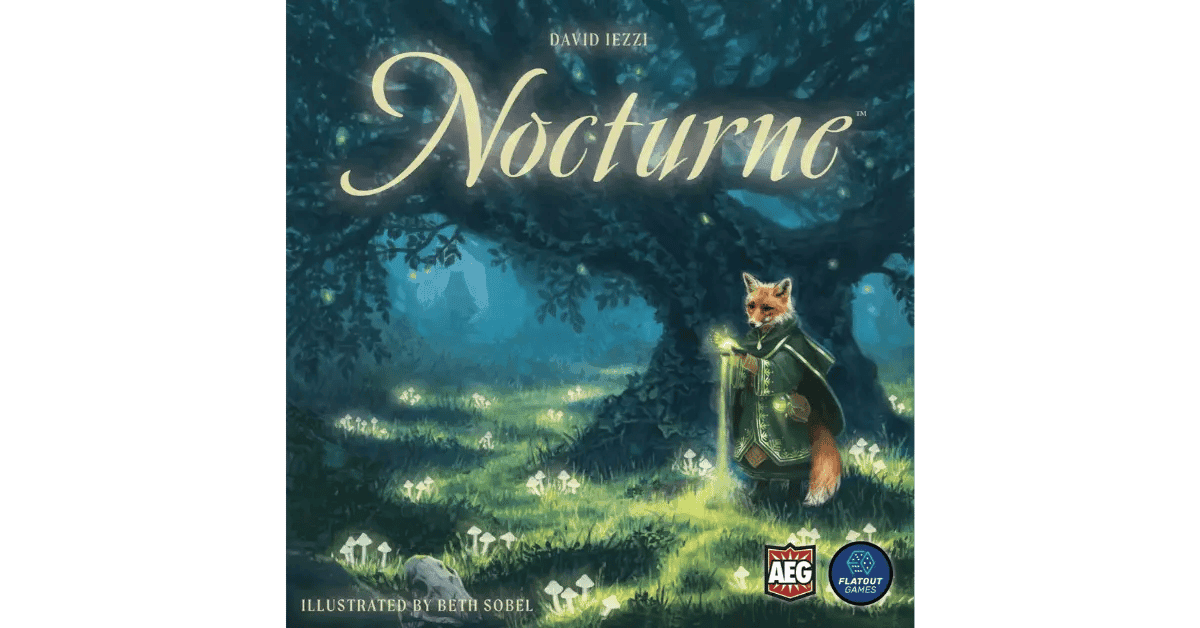
Nocturne review
Alderac Entertainment Group / Flatout Games | 1 to 4 players | 10+ | 45 to 75 minutes
Bidding games are built on a simple and ancient cruelty: what you spend to win, you cannot spend again. The token that secures the prize is the token that leaves your hand. So victory is not just a matter of wanting something badly enough. It is a matter of wanting the right thing at the right moment, holding back when you need to hold back, and spending when waiting would end up costing you more than losing. That is, in essence, the whole discipline of economics, squeezed into a handful of numbered tokens and let loose on a moonlit forest full of fox mystics.
Nocturne, designed by David Iezzi and the Flatout Games CoLab, is a spatial bidding and set-collection game for one to four players, illustrated by Beth Sobel in watercolours of exactly the luminous kind that makes you feel the forest is real and you are the one who looks slightly translucent. It is lighter than it first appears, and more interesting than its playing time would suggest it has room for.
The setting
You are a fox mystic. The rulebook simply says so, and it apparently requires no further justification. The forest is enchanted. The night has two phases, Twilight and Moonlight, and in both you compete with rival fox mystics for a collection of magical items: firebird feathers, animal skulls, glowing mushrooms, mysterious eggs, rare herbs, ancient runestones, mirror stones and cursed treasure chests. These items score points in different ways, depending on how many you collect and in which combinations. There are also potions to brew, goals to achieve and a Forest Sprite Board with a not entirely fathomable character that you somehow have to learn to work with.
Beneath that playful surface lies a rather tightly wound machine of competing priorities. It just wears its moonlit fox aesthetic with so much conviction that you do not immediately hear the gears clicking.
The spell system
This is the mechanism at the centre of the game, which is at once the bidding system, the spatial puzzle and the logistical problem.
Each player has a set of numbered spell tokens, from one to seven, plus a Star token that beats everything. On your turn in a spell phase, you place a Spell token on any item tile in the grid that is orthogonally adjacent to the highest token already played. Your token has to be higher than the current highest token. Once all the other players have passed, the player with the highest token takes the tile their winning token sits on, flips that token over to mark the now empty space, and starts the next phase, with the restriction that their opening spell in that new phase must be placed next to the tile they have just won.
That restriction forms the spatial dimension of the game, and it is more interesting than it sounds. In a four-player game the forest is a grid of twenty-five tiles, and the position of the flipped, used tokens gradually changes which adjacent spaces are still available. A player who wins a tile in a corner can sometimes place their next starting token so that no adjacent tile borders anything usable any more. The rulebook calls this Corner Casting. The result is that the next tile is won uncontested. It is a powerful, somewhat ruthless move, and entirely in keeping with the behaviour one can apparently expect from competing fox mystics.
Losing a bidding war is not simply a loss, either. Players who did not win may choose to send one of their used tokens to the Forest Sprite Board instead of taking it back, slotting it onto that board in a fixed order. At the end of each round the Forest Sprite Board pays out: players with tokens on the board each claim one item tile from the board's own supply, in order of their position. So the board is at once a second market, a consolation mechanism and a strategic resource. Sending a high-value token to the board protects your position. Sending a low-value one is a gamble that the board will stay manageable. Deciding which used tokens to take back and which to commit is one of the game's quieter pleasures.
In the switch from Twilight to Moonlight, all the unused tokens from the Twilight round are exchanged for Shadow spell tokens, wild tokens that may be played in the Moonlight round but have no identity and so can no longer be traced back to a player for goal scoring. The exchange also thins things out straight away: for every Shadow token you receive, you must permanently discard your lowest spell token. As a result, the Moonlight round is played with a slightly leaner, more concentrated hand. That is well thought out. Players who hoarded tokens in Twilight enter Moonlight with extra flexibility but a slightly smaller range, while players who spent aggressively come in leaner and possibly more focused.
The items and how they score
Eight kinds of item tile fill the grid, and each one scores according to its own logic. That is a big part of what gives the collecting side of the game its texture.
Skulls simply have their individual point value printed on the tile. That is straightforward addition. Firebird feathers score on a rising scale that speeds up as it goes. A small collection earns modest points, a complete set of seven earns considerably more, and if you somehow manage to collect more than seven, you simply start a second set and score both. Mushrooms come in two kinds that interact in an unusually spiteful way: Tripti Fungilus tiles score individually but punish matching pairs, while Duode Dax tiles are worth nothing on their own and pay out generously as a pair. Collecting one of each without really understanding how this works is just about the quickest route to a deeply unsatisfying score.
Herbs score on their individual value, with a bonus when you collect three, four or five different kinds, and they include a wild herb that may count as another kind. Mysterious Eggs score by ranking: whoever has the most scores four points per egg, the second player three, and so on. That creates a competitive dynamic in which a single egg at the right moment can shift the rankings and upset everyone's calculations at once. Cursed Treasure Chests cost you one point and give you a blind draw of three face-down tiles, of which you keep one. That is how the game makes chaos feel like a reward.
Ancient Runestones let you draw three Potion cards and keep one, which you add to your secret hand of recipes. Mirror Stone tiles, which are only assigned at the end of the game, copy one other tile you own for scoring purposes. Handy, but only if you worked out in time what will later prove worth copying.
Potions and goals
Each player starts with a secret Starting Potion card showing a recipe of item symbols. Ancient Runestones can add extra potions to that private hand. At the end of the game you score for how many of your recipes you have completed with the symbols spread across your collected tiles. Enchanted tiles carry two symbols and so count towards two different recipes at once, which makes them disproportionately valuable for anyone serious about brewing. The character card itself also contributes one symbol towards completing a potion, which means your identity as a fox mystic at least has a concrete point value.
Three Twilight goals are revealed at the start of the game. These are goals such as being the first to win a tile with a specific spell number, forming an area of control of three connected spaces with used tokens, or pulling off Corner Casting. They are worth three points each and usually available to only one player, namely the first to meet the condition. Three Moonlight goals are revealed at the start of the second round and can be achieved by every player, with the score depending on how far you complete them rather than on who got there first. Both sets bring forward planning into what could otherwise have been a purely reactive game.
The advanced character and the kind of fox it makes you
In the standard set-up, character cards are decorative. In the advanced set-up, each player's card has a unique one-time ability on the back. Redd might tinker with the Forest Sprite Board. Sage handles spell adjacency differently. Abigail and Flint have their own quirks. Using such an ability costs nothing, but not using it earns you two points at the end of the game. That creates a pressure that makes the ability both more and less tempting than it would otherwise have been, exactly the kind of small, elegant doubt that shows a game has been thought through rather well.
Family mode, solo mode and the achievement system
A Family mode removes the Forest Sprite Board, the Shadow spell tokens and the goal cards entirely, stripping the game back to its core of bidding and set collection, which makes it more accessible for younger or less experienced players. Scoring for Mysterious Eggs is simplified to a flat scale instead of a competitive ranking, removing precisely the one element most likely to cause friction among people who did not sit down to a game about fox mystics to experience ranked economic warfare.
The Solo mode pits you against an AI opponent driven by a deck of Solo Opponent Cards. These cards determine how aggressively the opponent bids, in which direction it casts spells and whether it assigns tokens to the Forest Sprite Board. It is a properly designed solo mode, not a hastily added afterthought, with three different behaviour profiles and enough variety in the deck to stop it feeling as if everything has already been scripted.
Twenty scenario challenges, from Easy to Hard, each with a specific character, a particular combination of goals and a minimum score to reach, give structured progression to players who like having something to work towards over several games. Twenty-five standard achievements and five rule variants stretch the game further for anyone who is susceptible to that sort of thing.
Our final verdict
Nocturne occupies a very specific and eminently defensible place in the gaming landscape: it is heavier than it looks from across the table and lighter than it feels while you are learning it. The order of spells clicks into place fairly quickly. The scoring system, with eight item types that each work in their own way, takes a full game to really sink in, and players who have not read the rulebook carefully may suddenly find themselves halfway through the Moonlight round with a tableau full of single Duode Dax mushrooms, sincerely wondering where exactly it all went wrong.
What the game offers, once understood, is genuine positional tension in every bidding phase. The adjacency rule means the tiles you can contest are not random. They are shaped by where the game has already been. The Forest Sprite Board adds a second layer of resource management that rewards players who lose with a degree of dignity. The potions and goals give direction to what could otherwise have been purely reactive opportunism. And Beth Sobel's art, which depicts every ingredient of the moonlit forest with a specificity suggesting she has personally made the acquaintance of several enchanted mushrooms, gives the whole thing a coherence of atmosphere that lighter games by no means always allow themselves.
In the end, the game is about the tension between two things pulling in opposite directions: the specific item you need for your potions and goals, and the item the bidding system is offering you at that moment. Sometimes they are the same. Sometimes they are not, and then you have to decide whether to overpay for necessity or underpay for opportunity.
That, in all kinds of guises, is how most decisions work.
The fox mystics just have better hats.
For fans of: Sagrada, Azul, Wingspan (in terms of the drafting instinct, not the birds), and anyone looking for a bidding game that earns its depth without needing a whole evening to learn.