


Lost Ruins of Arnak review
13 oktober 2026
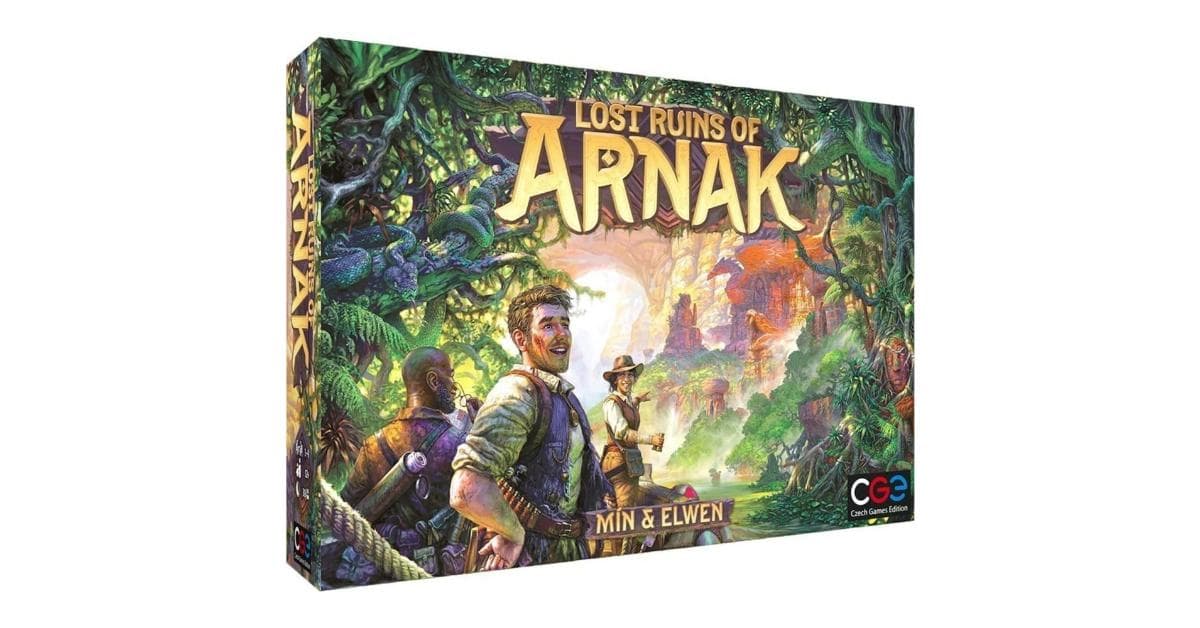
Lost Ruins of Arnak
Czech Games Edition | 1 to 4 players | 12+ | 30 – 120 minutes
Somewhere in the mists of an undiscovered island, ancient ruins lie waiting for exactly the kind of people who would be better off leaving ancient ruins alone. You are one of those people. You have a notebook, a magnifying glass and the unshakeable conviction that whatever is lurking in that temple, it will all be fine once you have studied it and labelled it.
Lost Ruins of Arnak, designed by the Czech husband-and-wife team Michaela and Michal Štach, asks you to explore a mysterious island, defeat guardians, collect artefacts and push your research forward, all within five tightly wound rounds. On paper it is a worker placement game crossed with a deck-builder. In practice it is the board game equivalent of a buffet where everything looks delicious and you have a tragically small plate.
How it really works
Each round you start with a hand of cards and two archaeologists. On your turn you do one thing. One. You can place a worker on a location to grab resources. You can play a card for its effect. You can buy a new card for your deck. You can push your magnifying glass one agonising step further along the research track. Or you explore a new location, which costs compasses and reveals a guardian who, if you ignore it, stuffs a fear card into your deck like a passive-aggressive note from the universe.
Then it is the next player's turn. They take the location you needed.
The deck-building stays remarkably lean. You start with six cards and may end the game with a dozen or so. No sprawling engine here, no forty-card monstrosity that takes three minutes to shuffle. Every card you acquire has to earn its place, because your deck cycles quickly and dead weight is fatal. Fear cards, earned from undefeated guardians, are the game's silent punishment. They do nothing. They score minus one point. They sit in your hand and stare at you.
The research track is where the real points live. Two tokens (magnifying glass and notebook) climb a path that costs ever more expensive resources. The notebook cannot overtake the magnifying glass, which creates a satisfying ratchet effect. There is a lovely metaphor in there about theory never being allowed to outrun the evidence, but the designers are Czech LARPers, not epistemologists. This may be accidental genius.
Reach the top first and you claim the best temple spot, worth serious points. Arrive late and you get what is left. Those are still points, but the kind of points that feel like a consolation prize. Five rounds. That is all. The first feels open. The second feels busy. By the third you are doing calculations that would make an actuary nervous. The fourth is desperation. The fifth is triage.
What it does well
The hybrid. Everyone said combining worker placement with deck-building was tricky without one mechanism swallowing the other. Mín and Elwen (as the designers are known, names they picked up during their Live Action Role Playing years) solved this by making cards do double duty. A card can be played for the effect printed on it, or spent as transport to send a worker to a distant location. As a result, your hand is never just fuel for one system. Every card offers a choice, and the choices interlock instead of competing.
The exploration system deserves separate praise. New locations do not simply appear; you pay to discover them, and they bite back. That guardian staring at your archaeologist is not going to attack. Not really. It is going to wait. And at the end of the round, if you have not dealt with it, you receive a fear card that says less about the guardian's menace than about your poor time management. The game turns “I will do that later” into an actual mechanical cost. More honest than most games dare to be.
In terms of production, it is gorgeous. Ondřej Hrdina's illustrations give the island real atmosphere; less “theme-park adventure” and more “place you would actually want to explore, despite the snakes.” The player boards, the sturdy resource tokens, the card art that makes every artefact feel like something a museum would fight over. Czech Games Edition clearly knew they had something worth dressing up beautifully.
And the pacing. Five rounds should not work this well. Most games of this weight need seven or eight rounds to breathe. Arnak makes five feel like exactly enough, by front-loading choices and gradually narrowing the action spaces. You never quite have enough time to do everything, which means the things you do manage to do matter enormously.
What we liked less
There is a ceiling, and you will hit it. Somewhere around your twelfth game, the paths become familiar. Not predictable, exactly; the card market and guardians provide variety. But the strategic outlines start to repeat. Rush research. Balance exploration and research. Explore widely and buy powerful artefacts. After a while you have walked all three paths and the jungle stops surprising you.
The point-salad scoring also dilutes the tension in a way the rest of the game does not deserve. You score points for research, for guardians, for idols, for cards, and lose a point per fear card. Everything counts and nothing dominates. This is democratically fair and dramatically flat. The game gives you a dozen small satisfactions where one big triumph might have been more memorable.
Player interaction also stays on the thin side. You can take a location someone else wanted, or buy a card they had their eye on, but that feels much more like traffic congestion than confrontation. With two players the island is roomy enough that collisions are rare. With four it gets tighter, but never to the point of real conflict. If you need games with a knife hidden somewhere, this one keeps all its cutlery neatly in the drawer.
The solo mode exists and works fine, with an automated rival that advances with card-driven efficiency. Technically competent and utterly soulless, like a self-checkout. It works. You just do not tell anyone about it.
Who is this for?
If your group has played gateway games and someone at the table is ready for something with a bit more weight (the type of person who starts reading the back of the Wingspan box) send them here. Arnak is generous to new players. The iconography is clear, the turns are simple (one action, sit back), and the theme offers enough narrative scaffolding that decisions feel like story rather than maths.
Experienced players will find a well-oiled mechanism that respects their time. Ninety minutes, a tight arc, no downtime spiral with three players. It will not replace their favourite heavy euro, but it earns a permanent spot as the game they suggest when the group includes someone who has never met a resource conversion chain.
For those who partly collect games for how they look on the shelf: this one earns its place. The solo mode works with mechanical precision and zero personality, like a metronome that keeps score. Couples should know that with two players the island becomes quiet enough to feel genuinely exploratory, and that turns out to be exactly when the theme works best. But anyone who wants to see blood at the gaming table should look elsewhere.
Our verdict
Lost Ruins of Arnak is a game that knows exactly what it wants to be and carries out that vision with the confidence of a designer who has clearly played a thousand games and made a note of which bits people actually enjoy. It files the rough edges of worker placement and deck-building down until what remains is smooth, fast and deeply satisfying; at least until you have mapped the whole island yourself.
The expansions help. Expedition Leaders adds asymmetry that really should have been there from the start. The Missing Expedition pushes the system further than seemed possible. But the base game, on its own, is a remarkable debut from two LARPers who apparently decided that if you are going to design one game, you might as well make it one of the best hybrids in the hobby.
The temple awaits. The guardians are patient. Your notebook is empty and your magnifying glass sits at the bottom of a very long track.
The best kind of trap: one you walk into willingly, enjoying every second you fail to escape.