


Forestry review
13 oktober 2026

Forestry review
Pink Troubadour | 1 – 4 players | ages 13+ | 70 – 120 minutes
In Forestry, everything revolves around trees and timber. You step into the shoes of a forest manager. You will be fulfilling contracts, but how do you keep the forest's ecosystem in balance while you do?
As a forest manager, you divide your actions between two workers: the Harvester and the Manager. They are really a felling-and-sawing duo, with the Harvester doing more of the felling in the forest and the Manager more of the sawing in the sawmill. You badly need the pair of them to deliver the finished products: from wooden tableware to a proper builder's hut. There is work to be done!
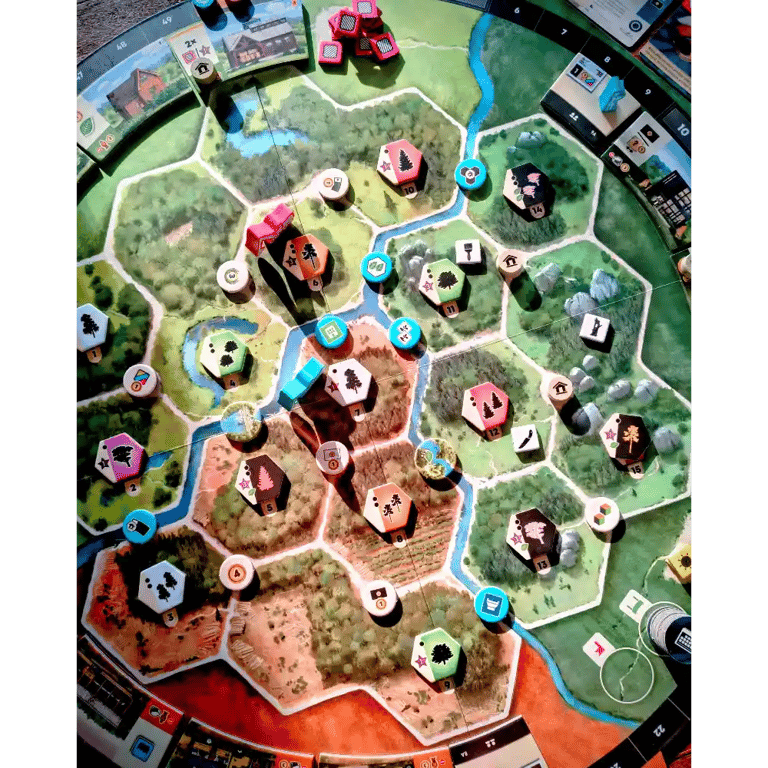
The theme is clearly present in Forestry and comes back everywhere in the game. You are constantly trying to optimise your actions and divide them as well as possible between your two workers. It always feels as though you are one action short. The same goes for the number of rounds in the game, by the way: you always want to play just one more.
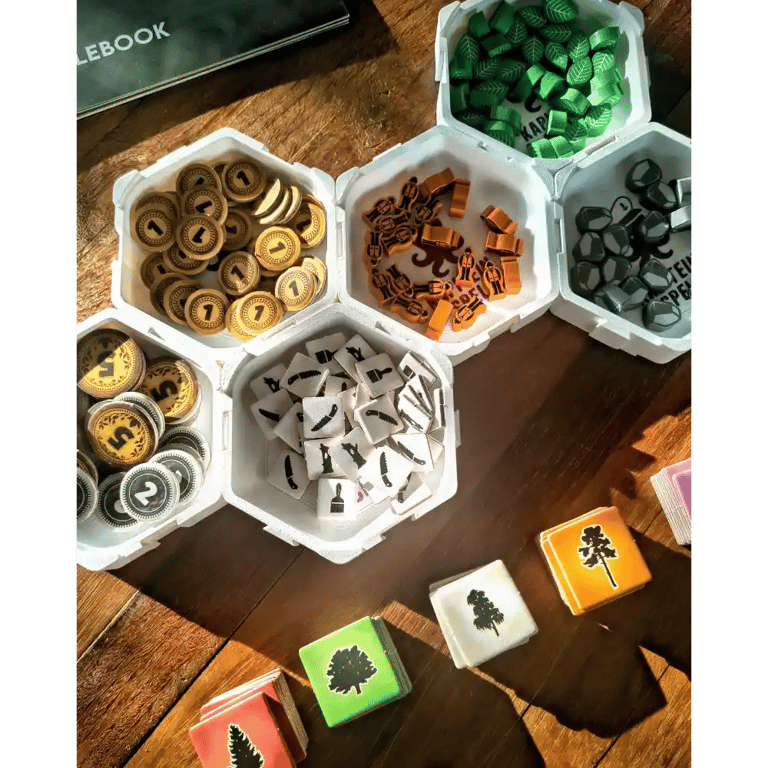
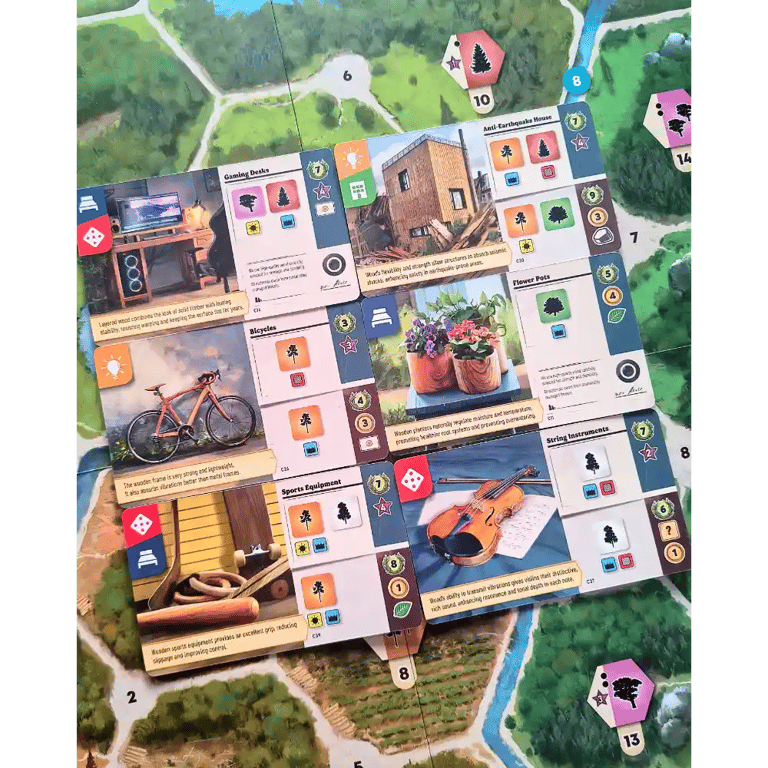
The number of components on the table can seem rather overwhelming, but despite the sheer amount of wood (ha!), the game plays surprisingly smoothly. In your first game you are still working out everything you want to do and can do, but by the end of the game you are already thinking about what you could do better next time. Fulfilling contracts (those are the finished products we mentioned) is one of the most important ways to score points. However, it is not the only way, and other parts of the game should not be underestimated either. Dividing your action points between your dynamic duo, the Harvester and the Manager, therefore needs to be done with the utmost care. And that is how Forestry creates different strategic routes.
The interaction in the game depends heavily on the number of players. With two players you can leave each other in peace fairly well, but with three or four it really is first come, first… felled. Or sawn. The type of interaction depends on where you are on the board: in the forest you mainly occupy spaces, while at the buildings you block bonus actions. Do you really get in each other's way? Meh, not really. You can always take some action, even if it is perhaps a little less ideal than you hoped. We find the ideal player count to be two or three. A fourth player means you have to wait just a little too long between turns, which feels like putting down roots…
Forestry is a beautiful game that plays very smoothly. From start to finish, you are drawn into the world of timber and woodworking. The rulebook contains fun, informative passages, and every contract card includes a short text about the product you are making. That makes the game educational as well.
The game
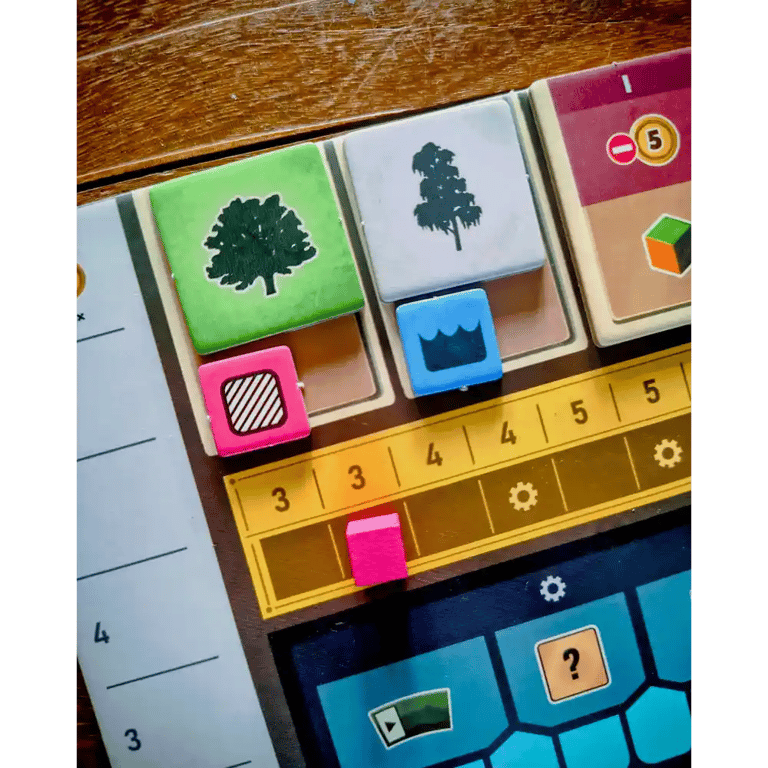
The game is played over ten rounds. Each round starts by flipping the round token, which in most cases gives every player something, such as money or resources. Some tokens cause trees to be felled, and that might just be the very tree you need to fulfil your contract. Then it is the players' turn, and you take turns carrying out all your actions. The number of actions is determined by your development track. The development track is an important part of the game, because it lets you gain more actions per turn as the game goes on.
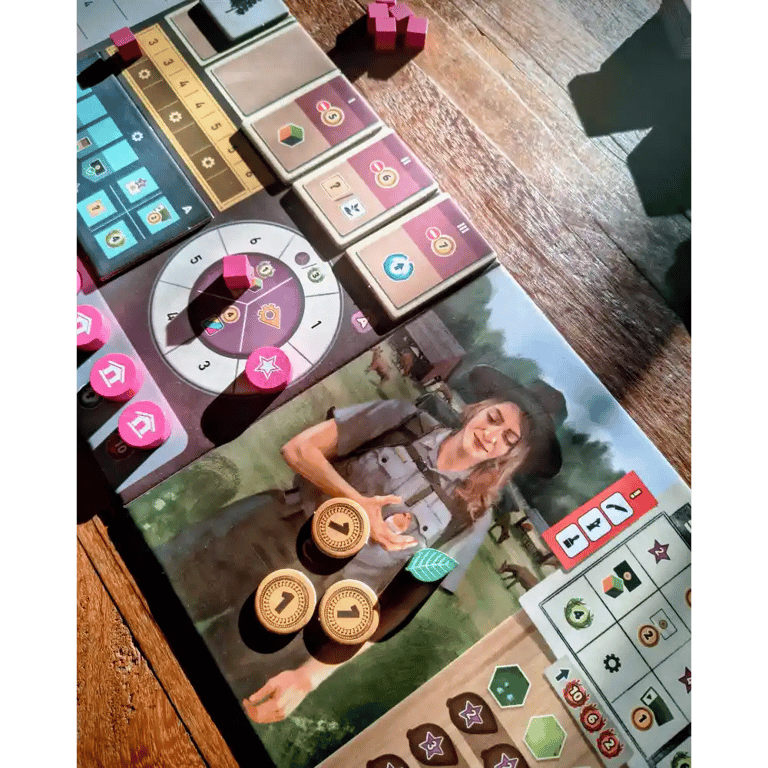
Fulfilling contracts is the main and easiest way to rake in points: you get them straight away and they come with nice bonuses too, but a good ecosystem is something you build for the long term. A good water network matters for protecting your forest from outside threats, and doing research in the forest is very important for knowing what is going on. Both the water network and research contribute to your end-game goals.
Depending on where you build your water network, you decide for yourself which end goal (or perhaps several) you want to go for. For example, the symbols on your contract cards, building lookout towers in the forest or planting new trees. If you manage to upgrade your water network, the points come flooding in.
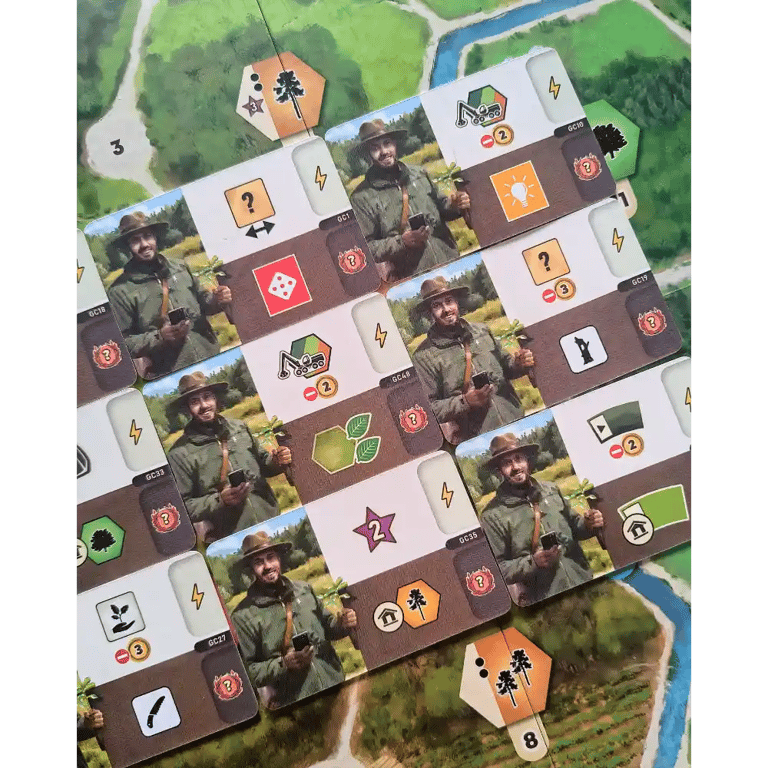
Then there are the Task Cards, where you have to choose whether to use them during the game or go for points at the end of the game. You can use Task Cards to take just that one action you are short of, or to get ready for your next turn. If your turns are running like well-oiled machines and you do not need all those extras, you can use them to score points at the end of the game. The more Task Cards you complete, the more points they earn.
As soon as the last round is over, it is time to count the points. If you have scored the most points, you are the best forest manager!
Let’s go solo!
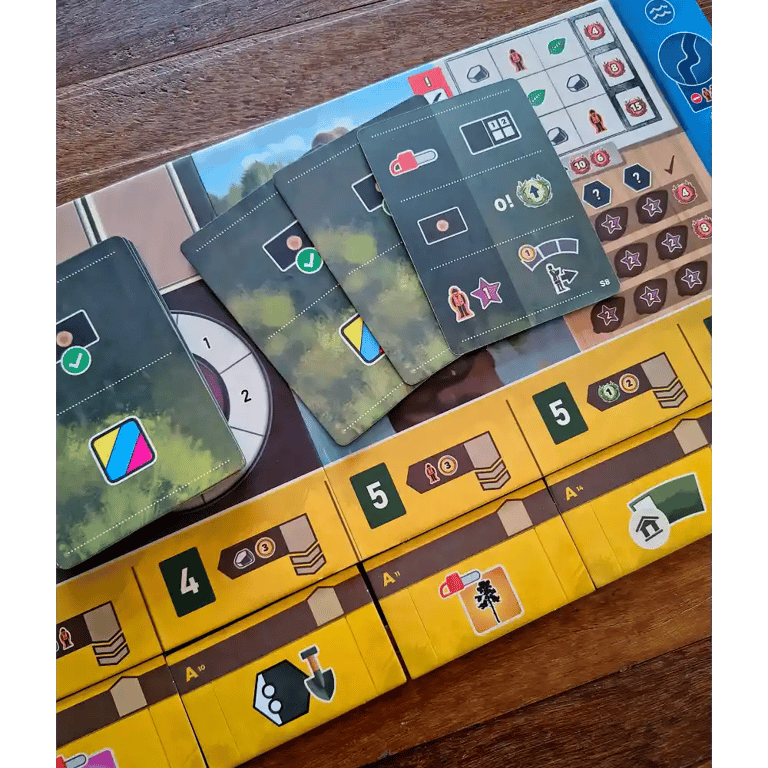
Forestry also thinks of solo gamers, with a really fun and enjoyable solo mode, at least if you like the feeling of playing against a second player. On your own, you take on the forester, who simulates a second player. The nice thing is that as a player you do exactly the same as in a multiplayer game, so there are no extra rules to learn. Happily, you can still see the wood for the trees!
The forester takes actions based on forester cards. The actions resemble those of a real player, but have been simplified a little. Otherwise, the game runs the same as a multiplayer game. Only for you as a solo player has an extra challenge been added, but more on that in a moment. You play ten rounds and win by scoring more points than the forester at the end.
You are the starting player, so your turn works exactly the same as in a multiplayer game. Then it is the forester's turn. The forester's development track shows how many actions, in other words how many forester cards, are played. These cards consist of six possible actions the forester can take, such as fulfilling contracts and moving the manager. Once all the cards have been played, a new round begins.
Now for that extra challenge we mentioned. As well as the number of actions, the development track shows which extra resources the forester receives that round, and of course you would rather that did not happen. Fortunately, you can put a stop to it! You do that by completing the goals shown, for example felling a green tree or constructing a building. If you achieve the goal before the forester's next turn, you deny it the resources shown. And so the turns alternate, and after ten rounds the game ends and you see who has scored the most points.
Nice extras
Have you played the game a few times and want a bit more Forestry? Then you can play the advanced mode. In this mode, characters have their own role and play style. This creates whole new tactical choices to make. Thought ten rounds was not much? In advanced mode you only get nine! That means you have to optimise your actions even better to get everything done.