


Everdell Duo review
13 oktober 2026
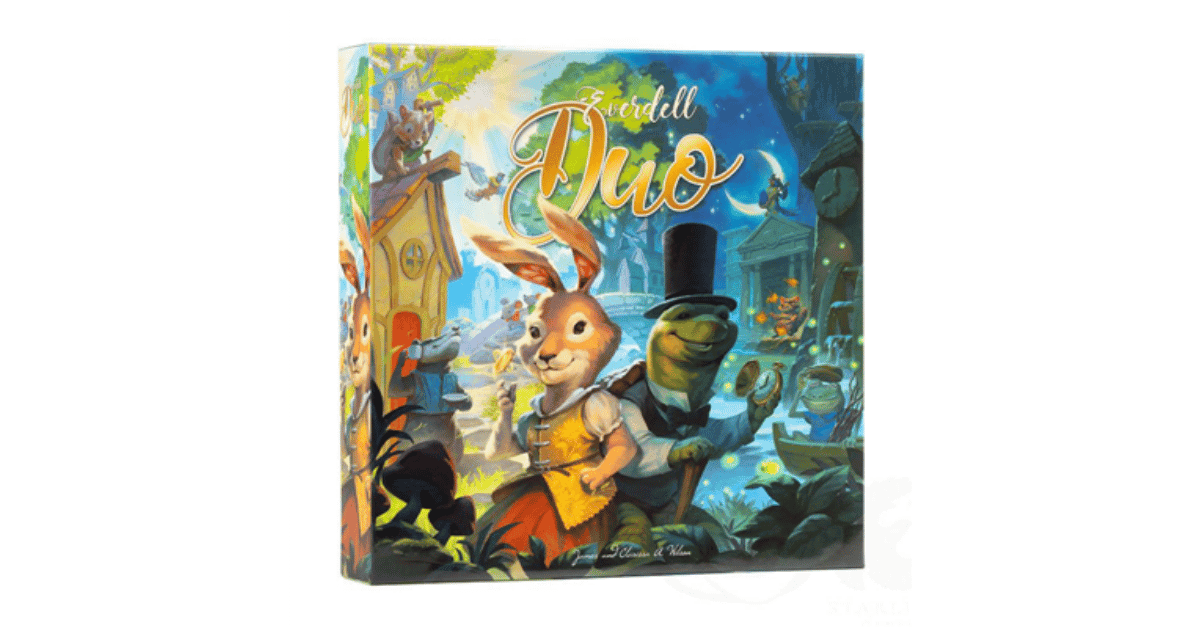
Everdell Duo review
The tortoise and the hare are at it again.
This time they are not racing through the forest, but running one. Mayor Honey Sundew, the hare, and Mayor Oliver Topshell, the tortoise, are the joint leaders of a new forest city in the Emerald Valley, and they have, roughly speaking, four seasons to make something of it before Miss Lily Thorn of the newspaper The Root decides whether their term of office was worth a mention. Miss Thorn has opinions. She also has skunk workers, and that is worse.
Everdell Duo, designed by James and Clarissa Wilson and published by Tabletop Tycoon under the Starling Games label, is a standalone two-player version of the much-loved Everdell, a worker placement and engine-building card game that has collected expansions at the rate Rotterdam collects suburbs. You do not need the original. Nor is it a simplified version of the original. It is something more interesting than either, namely a game designed from the ground up for two players, which borrows the world, the artwork and the card ecosystem of its predecessor while rethinking the mechanisms that make a small player count sing.
The world
Everdell is set in the Emerald Valley, inhabited by woodland creatures of the industrious and architecturally ambitious kind. Squirrels run inns. Otters operate ferries. Monks ponder over resources. Moles in the mine activate production cards from their hand, and that is exactly the kind of specialisation that only makes sense once you have spent long enough with the game to understand why it matters. The artwork by Andrew Bosley and Enggar Adirasa gives the whole thing a quality of gentle melancholy, the kind of art that suggests the world it shows is very old, completely at ease with itself, and only mildly surprised that you are taking an interest in it.
The cards are beautiful. That is said here without reservation and should not be underestimated, because they really are the game, and in Everdell Duo you will be looking at them for the whole session.
The Sun and Moon system
This is where you find the mechanism that does the most work, and that sets Duo apart most sharply from the base game.
The board has a central track of seven spaces, on which two tokens are tracked: a Sun and a Moon. Every time you take an action, one of these tokens moves one space to the right. Place a worker, move the Sun. Play a card from your hand or from the Meadow, move the Moon. Take a card, move either one of your choice. As soon as a token reaches the end of the track, no more actions may be taken that would move that token any further, not by you and not by your opponent, until the next season resets both tokens to the start.
The Meadow, meanwhile, is a row of twelve cards laid out around the token track, and a card is only accessible when a token is next to its position. You may play freely from your hand, but cards from the Meadow require the right token to be nearby.
What this produces is a timer that is also an interaction system. The Sun and Moon tokens do not just count turns; they restrict access, apply pressure and add a spatial layer to what would otherwise be a fairly open game of hand management. The moment you decide to play a card instead of placing a worker is not just a question of efficiency. It is also a decision about which token moves, how far access to specific Meadow cards reaches, and whether your opponent gets shut out of their last worker placement before the season ends. A player who drives their Sun to the end of the track in early summer while they still have three unplaced workers has made a decision the board will not let them take back.
This, once it sinks in, is the central pleasure of the game: the intersection of what you want to do and when the sun or moon actually allows you to do it. It takes a session to internalise and rewards experience to a remarkable degree.
Building the city
Each player builds their own city, an open tableau of Construction and Critter cards, spread over four seasons. There are five card colours, and each colour activates in a different way. Green production cards work when you play them and again at the start of spring and autumn. Blue governance cards give discounts and conditional rewards. Tan travellers activate once, immediately. Red destination cards activate when a worker is placed on them, including by your opponent, who gives you a point token for the privilege of the visit. Purple prosperity cards wait until the end of the game and then work out bonus points based on what else you have built.
Critters may be played with berries from your supply, or for free if you have an Occupied token of the right colour. You earn Occupied tokens through specific actions rather than starting with them, which makes early access to them a meaningful priority rather than a given. Constructions cost twigs, resin and pebbles in various combinations.
The interactions between cards are numerous, more than seventy-five unique effects in a deck of eighty cards, and they form the depth of the game. A Chip Sweep activates another green production card when it is played. A Dungeon lets you sacrifice a Critter to make a future card cheaper. An Inn gives a discount on Critters, after which an Innkeeper can sacrifice itself for an even bigger discount. These effects do not combine by breaking rules. They combine through timing, hand management and awareness of what is lying in the Meadow, waiting to be activated by the right set-up.
Resource management is tight but readable. Twigs come from Farm locations, where a maximum of four workers may be placed over the course of the game. River locations, two per season, shuffled and refreshed, offer variable and often better deals: activate two green production cards, draw a card and reduce its cost, or make a flexible exchange of resources. The River tiles are the game's shifting variable, the element most likely to tip a strategy over in the middle of a season, and replacing them at the start of spring and autumn adds a small moment of reorientation that stops the game settling too comfortably into its own pattern.
Events
Six Event tiles lie at the top of the board, drawn from a random supply during set-up. To claim an Event, you have to place a worker on it while meeting the conditions shown, for example owning one card of each colour, having more Critters plus berries than your opponent above a minimum threshold, or having built up specific card combinations. Every Event gives you a resource immediately and is worth the printed points at the end of the game. Each Event may only be claimed by one player. The Journey tile, a seventh bonus, does not require a worker placement and goes to whoever ends the game with the most cards in city and hand combined, provided that player is genuinely in the lead on their own. In a tie, nobody gets it, exactly the kind of outcome both players try to avoid all game without ever being able to give it their full attention.
Events are the high point of the game's scoring. They are worth more than most cards, call for strategic thinking about the make-up of your city rather than simply piling things up, and create direct competitive pressure in a game that otherwise runs largely in parallel. The tension they add is well judged: enough to matter, but not so much that the game would become all about denying your opponent rather than building your own city.
Four modes, one box
Everdell Duo does not come with one way to play and a note saying that should be enough. The four modes really are different from each other.
The competitive mode is the head-to-head duel described above, with separate cities, competing Events and the Journey bonus as the deciding extra at the end of autumn.
The cooperative mode has both players build one shared city together, dividing card draws and production activations between them however they like. Workers from both supplies are placed on the same spots. Resources stay personal and may not be paid from your partner's supply, although a Sharing tile allows cooperation under conditions: fully open in some chapters, limited to specific board positions in others, and completely forbidden in others still.
The Campaign consists of fifteen chapters, each introducing a new arrangement of skunk workers, Miss Lily Thorn's stand-ins, who occupy locations and Events and so shrink the space available for actions. On top of that come specific goals, changing partial rules, Pocket Watch tokens that let you turn the Sun or Moon back one space, and Good News cards that are drawn at the start of each chapter and offer one-off optional advantages. The campaign has a score sheet, a city name, a medal threshold and difficulty settings that adjust retries, Pocket Watch rewards and keeping Good News cards. A solo player controls both mayors at once and keeps the two hands of cards visibly separate above their reference cards.
The challenge mode pits both players against Miss Thorn as an AI opponent. Each season she builds up her own pile of cards from the Meadow, scores them at the end and claims Events that neither player managed to achieve. Ten challenge conditions, such as Hard Working (no Constructions), Balanced (three of each card colour) or Excited (five Events achieved), give you focused goals across several games.
The big question: is it any good?
The competitive mode is the game at its sharpest. The Sun and Moon dynamic creates real interactive pressure without direct conflict, the Events form a shared focal point for competition, and the asymmetric seasonal bonuses for Hare and Tortoise add subtle texture at the start of every round. The playing time of thirty minutes is honest: an experienced pair can play through to autumn without any trouble and still have time afterwards to argue about the result.
The cooperative and campaign variants are more uneven in how well they succeed. Miss Lily Thorn's skunks, which roll to new positions every season, can occasionally produce set-ups that feel more randomly restrictive than challenging. And a cooperative campaign built around numerical score targets is a different, cooler experience from a campaign that leans on specific narrative choices. The story of the campaign, two mayors dealing with a skunk journalist with strong views, is charming but thin, and delivers mostly atmosphere rather than consequences. Players who want a cooperative campaign to really feel like a story may find this less satisfying than the competitive mode.
The cardboard Sun and Moon tokens are, as several reviewers have pointed out, a small disappointment in a box otherwise full of carefully chosen components. They are moved often and are also the part most easily forgotten on any given turn. That is a mechanical criticism rather than an aesthetic one, but for a system this central it is worth mentioning.
Our verdict
The Emerald Valley has seen quite a few mayors. Most of them had ideas. Fewer of them had plans. And fewer still had plans that held up when the River tiles changed in spring, the skunk turned up at exactly the Event they needed, or the Meadow produced a Wanderer nobody could use for the third time in a row.
Everdell Duo is not simply Everdell with fewer players. It is a thoughtful rethink of what that game wants to be on a scale of two, with a token system that genuinely changes how turns feel and an Event structure that focuses the competition without replacing it with direct conflict. The campaign and cooperative modes add considerably to the value of the box. The world is still as charming as it was, the cards are still as beautiful, and the woodland creatures are still just as good at activating each other in chains that their individual descriptions did not immediately suggest.
Miss Lily Thorn is taking notes. Whether she finds anything in them worth publishing depends to no small degree on how efficiently you placed your workers.
For fans of: Everdell, obviously, Wingspan, Cascadia, and anyone who wanted a worker placement game that fits into half an hour without feeling as if something had been cut out to make that possible.