


Arkham Horror: The Card Game Core Set, Chapter Two review
13 oktober 2026
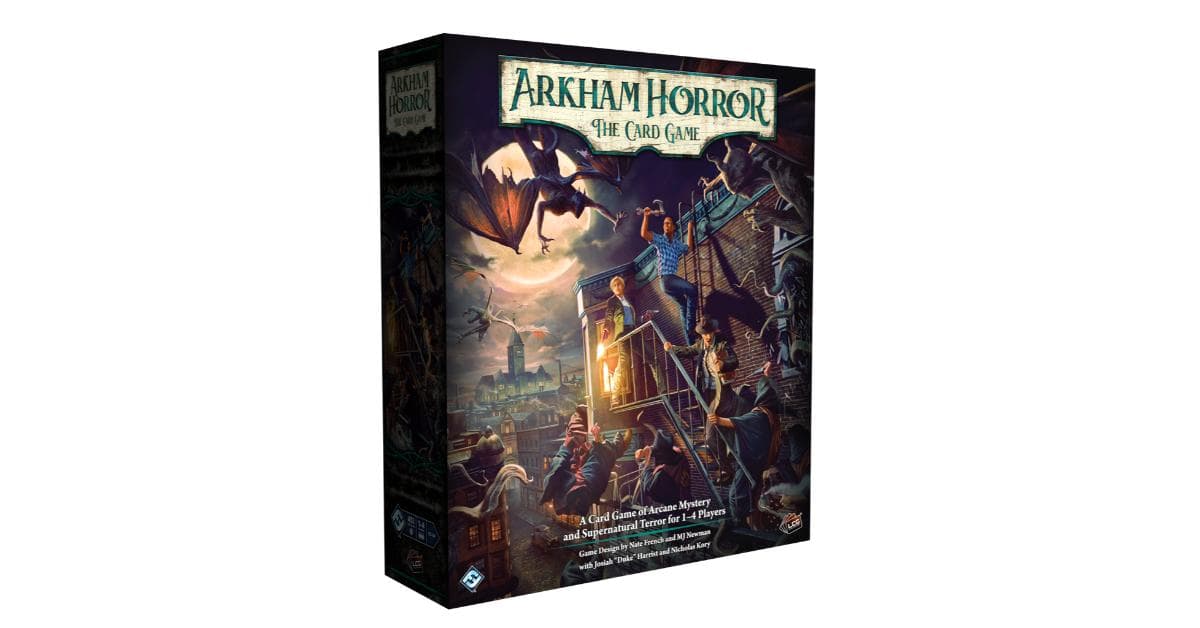
Arkham Horror: The Card Game Core Set – Chapter Two review
Fantasy Flight Games | 1 to 4 players | 14+ | 60 to 120 minutes
It takes a certain kind of nerve to relaunch a game that already has ten campaigns, thousands of cards and a community that knows the timing chart by heart the way monks know their scriptures. It is the nerve of someone who walks into a room full of experts and says: “Right. We are starting over. A bit. Not entirely. But also, yes.” The 2026 Chapter Two Core Set is Fantasy Flight’s attempt to open that door to newcomers while reassuring veterans that their binders are still relevant. It largely succeeds, in the way a tightrope walker largely succeeds: you admire the craftsmanship while being acutely aware of the drop below.
The premise
Arkham, Massachusetts, has had a tough decade. In the fiction, a few months have passed since R’lyeh rose in The Drowned City. In reality, it is ten years since Nate French and MJ Newman first had players draw a token from a bag and confronted them with the idea that the universe does not care about them. The Chapter Two Core Set picks up the thread with five new investigators, a new three-scenario campaign called “Brethren of Ash”, and a redesigned box that finally includes a cloth chaos bag. An addition so long overdue that the community had already solved the problem with Crown Royal bags and quiet annoyance.
You investigate murders. You investigate disappearances. You investigate, as always, Arkham itself, a town that treats cosmic horror the way London treats rain: as a permanent condition you simply learn to dress for.
How it really works
The basics are unchanged. Three actions per turn. Move, investigate, fight, play cards or gather resources. The Agenda deck ticks towards disaster, the Act deck edges towards resolution, and in between the chaos bag reminds you that probability is more of a suggestion than a promise. If you have ever played a version of Arkham Horror: The Card Game, you will feel at home within five minutes. If you have not, the pre-built decks and a noticeably improved rulebook will get you there in one session.
What is new is subtler. The classes have been given sharper profiles. Lead designer Duke Harrist and co-designer Nicholas Kory tackled the five investigator classes with an editorial eye rather than purely mechanical innovation. Guardians protect. Seekers seek. Mystics do what Mystics do, namely communicate with forces beyond human understanding and still hover around three resources. Connector tokens make multiplayer clearer. Modular encounter sets let you tune the difficulty in ways that go beyond just adjusting the chaos bag.
And there is now the Arkham Grimoire. A complete rules summary that answers questions the community has been debating since 2016. It is the kind of document you did not know you needed until you have it, after which you cannot imagine how anyone ever played without it.
What it does well
The production quality is the best the game has ever had. Card dividers, a solid insert, that cloth bag. They are small things that add up to something bigger: the feeling that someone has thought about what it is like to open the box, not just about what happens once you start playing.
The five new investigators are strongly designed and, more importantly, fully compatible with everything that came before. You can take them into any Chapter One campaign, which means this Core Set is not just a starting point but a key to the entire back catalogue. For a game of this size, that is a remarkably generous gesture.
The completeness of a single box counts too. The original 2016 core set was known for needing two copies to build competitive decks, a practice that felt like paying twice for a meal and being told the second portion contained the flavour. That is gone. One box, four players, no small print.¹
And the campaign’s second scenario, with its Codex-driven identification of investigators, is genuinely inventive. One of those moments when you understand again why this game has been at the top of the cooperative card game rankings for ten years.
What we liked less
The “Brethren of Ash” campaign has a difficulty curve that looks more like a cliff than a slope. Scenario one is very doable. Scenario three contains a final boss that early reviewers were strikingly unanimous in calling practically impossible to beat. For a product explicitly intended as an entry point, that is a curious choice. Like ending a swimming lesson with a chapter on how to survive a whirlpool.
The Seeker class feels unfinished. Six of the fourteen cards are reprints, which makes the very class most associated with investigation come across as a collection of leftovers. Anyone who likes to focus on gathering clues will probably experience a feeling best described as polite disappointment on seeing this card pool.
There is also a contradiction between the rulebook and the campaign guide about the use of tokens. Exactly the kind of mistake the Arkham Grimoire should have prevented, which gives the whole thing an irony the Mythos itself would appreciate.
And the final scenario of the campaign is, difficulty aside, the weakest in terms of story. It ends in a sewer. Sewers can be many things. Damp, atmospheric, essential to urban infrastructure. But not the place where your opening campaign should strike its final chord.
Who is it for?
If you have never played Arkham Horror: The Card Game and the idea of a cooperative, story-driven card game with real consequences appeals to you, this is the best starting point there has ever been. Full stop. The decks work, the rulebook is clear, and everything you need is in the box.
If you are a returning player, the new investigators alone are worth the price, especially if you take them into older campaigns. The reworked player cards show that the design team understands how each class should feel, not just what it should do.
If you dropped out earlier because of the complexity, the timing charts, the deck-building rules, the feeling of drowning in cardboard, some edges have been smoothed here, but not removed. This is still a medium-heavy to heavy cooperative game. The chaos bag still does not care about your plans. The encounter deck still has opinions about your evening. If that sounds exhausting rather than exciting, this is not your door.
And anyone looking at the price tag and wondering what it costs in the long run should know that this is a game you build up bit by bit, experience intensely and never really finish. Whether that feels like an advantage or a warning depends entirely on your relationship with the word commitment.
Our verdict
The Chapter Two Core Set is a paradox executed with visible craftsmanship. It is a fresh start built on ten years of experience, a standalone product that also gives access to an enormous whole, and an entry point whose own campaign may well be the least convincing argument for it. The investigators are strong. The production is better than ever. The campaign is uneven. The promise of what comes next, shorter and tighter campaigns, a more sustainable rhythm, a team that clearly cares about this game, outweighs what is in the box right now.
Duke Harrist has said he wanted it to feel like a celebration of everything fans love about the game. It does. It also feels like an invitation, sincere and warm, with a difficulty that is not quite tuned right, to everyone who does not yet understand what all the fuss is about.
The door you walk through twice. Once as a stranger, once as someone who knows what is in the cellar.
¹ The Crown Royal bag industry has not yet commented.