


Andromeda’s Edge review
13 oktober 2026
Andromeda’s Edge review
Lucky Duck Games | 2 to 4 players | 14+ | 80 to 160 minutes
The galaxy is dangerous, and that is entirely the point.
In most heavy board games there is a moment when the table falls silent. Not the polite silence of people listening, but that very particular silence in which four people realise at the same time that they have made a mistake. In Andromeda’s Edge that moment usually comes when someone launches their last ship into a hex that two other players were already eyeing hungrily, triggers a battle they half thought they would win, rolls a single die, and then watches as a lone enemy transport ship, a transport ship, beats them with a natural six.
The table falls silent.
Then someone laughs. Then everyone. And then the player who lost the battle puts on their best face of galactic defiance and starts plotting revenge, because that is exactly the kind of game Andromeda’s Edge is.
The premise
Luke Laurie, a secondary school science teacher by day and on the side the designer of some of the most pleasingly whirring worker placement engines in the hobby, designed Dwellings of Eldervalein 2020, a sprawling fantasy game that gathered a devoted following and settled firmly into the BGG top 150. Then he and his son Maximus did something sequels rarely manage: they listened to what people actually said about it, fixed what needed fixing, moved the whole project into space, and made it better.
Andromeda’s Edge is set on the edge of the Andromeda galaxy, in a region full of the ruins of a vanished Precursor civilisation, guarded by extragalactic raiders with unclear motives and a decidedly hostile attitude, and colonised by desperate factions fleeing from something called the Lords of Unity. That is exactly the kind of name you give a government when you want the audience to understand immediately that these are the bad guys, without having to explain any further.¹
You are one of those factions. You have a space station, a few ships, and exactly the kind of optimism that only arises when you genuinely have no other options left.
¹ It works. You do not ask questions about the Lords of Unity. You just run.
How it really works
Your turn contains exactly one decision: do you launch a ship, or do you recall your entire fleet?
Launching means placing a spaceship on the modular hex map to gather resources, claim a moon, occupy an action space or pick a fight, roughly in that order of ambition and personal risk. Ships come in different flavours. Some can enter nebulae. Others are better in combat. Others again can carry more cargo. If you land somewhere an enemy already is, a battle breaks out. If there is a raider token on the hex you want, a battle breaks out too, because in this galaxy raiders are the most consistent commentators on how unwise your plans really are.
Recalling your fleet is the moment the game shows its true nature. When you bring all your ships home, each ship lands on a module on your personal player board, your space station. Each module activates as soon as a ship is on it and produces resources, points, progress on one of the game’s five tracks, or special powers. Line up enough modules in a row and pay some energy, and the whole row fires at once. A well-built engine hums. A perfectly built engine hums loudly, impressively, and to the mild, envious irritation of everyone who has to watch it.
That recall cascade, the moment your station comes to life as every ship returns home and clicks into place somewhere, is the beating heart of what makes Laurie’s games feel so satisfying. It is tangible in a way cardboard really should not be able to manage. You sent your ships out into a dangerous universe, they came back with something useful, and the station then turns that into something better. There is a narrative logic to it that makes the mechanics feel inevitable rather than arbitrary.
The five progress tracks, Science, Industry, Commerce, Civilisation and Supremacy, run along one edge of the game and mark how successfully each faction is building rather than just surviving. They score at the end, which means the player who quietly and efficiently pushed ahead on Commerce for three rounds while the others squabbled over a cluster of moons may well have won the game before the final battle has even been fully resolved.
What it does well
First: the dual identity. Andromeda’s Edge is at once a euro engine-builder and an exuberant brawl of the kind that people used to describe with a somewhat irreverent term, and it refuses to choose between the two. The tracks and modules reward patience and planning. The dice battles and asymmetric factions reward nerve and timing. Most games that attempt a hybrid like this still pick a side by around the third round. This game does not, which is either a design triumph or proof that Luke Laurie has been teaching pre-engineering for so long that he builds things that work, whether or not they really ought to.
Second: the asymmetric factions. Every faction plays differently. Not dramatically differently, not in a way that would make you want a separate rulebook, but in a way that makes you look at the same board with a different attitude. One faction wants to be everywhere, another prefers to dig in firmly at a few crucial spots. The differences are tuned so that they add personality without your opponents having to spend their entire turn studying your player board.
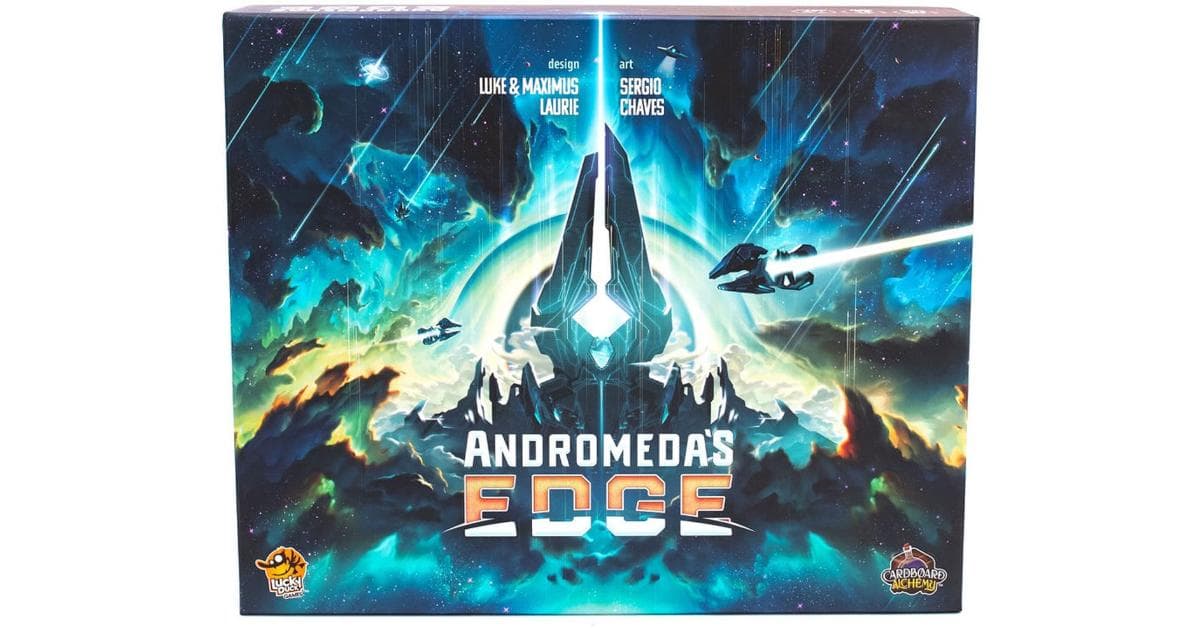
Third: the artwork by Sergio Chaves. The board, the tiles, the faction sheets: everything sits at the intersection of functional graphic design and genuine visual ambition. The raiders look as though someone thought very hard about what a malevolent extragalactic entity ought to look like, and then carried out that idea with complete conviction.
Where it stumbles
On their best day the combat dice are dramatic. On their worst day they are cruel. The rule that a ship may contest a space and still take the action on that hex before the battle is resolved is excellent damage control: you cannot be completely cut off from progress just because an enemy happens to be there. But the outcome in which a single die defeats an entire fleet remains possible, and although that makes for memorable stories, it always does so at someone’s expense. And now and then that someone is you, at exactly the moment it matters most.
The event deck adds variety between rounds, which is exactly its job. It also adds a little administrative weight, one more thing to keep track of, one more card to read, one more token to move, and that chafes just a little alongside everything else the game already asks of you. Not a disaster. More a small pebble in an otherwise rather comfortable shoe.
Setup and teaching really take time. This is not a Tuesday-night game with casual friends. This is a Saturday-afternoon game with people who read rulebooks. The rules are split across two documents, and that really tells you all you need to know about what you are getting into.
Who is it for?
Players who loved Dwellings of Eldervale should really have this at home already.
Players who love games where engines and conflict exist side by side, where you have to build something but also protect it, and now and then take someone else’s apart again, will find one of the stronger examples of the genre currently available here.
Players who want Twilight Imperium , but in under three hours, will find this more manageable than the original, although “under three hours” does call for experienced players and dice in a forgiving mood.
Players who like their strategy completely washed clean of luck would do better to turn their gaze to other hexes. The dice offer no apologies, and neither does the game.
Solo players need the Escalationexpansion. If you want to play this on your own, it is wise to buy both at the same time. Treat it like buying a car: the price is the price, and the extras are in reality not optional.
Our verdict
Andromeda’s Edge is a game built by a designer who understood what people loved about his previous work, what annoyed them and what needed to change, and who then had the rare good sense to change exactly those things and leave everything else alone. The recall engine remains the best reason to play it. The combat remains the most interesting talking point about it. The artwork makes it look like a game that has earned its shelf space before you have even unfolded the rulebook.
The table falls silent. Then someone laughs. Then the revenge begins.
Essential for players who want their engine to have teeth too.